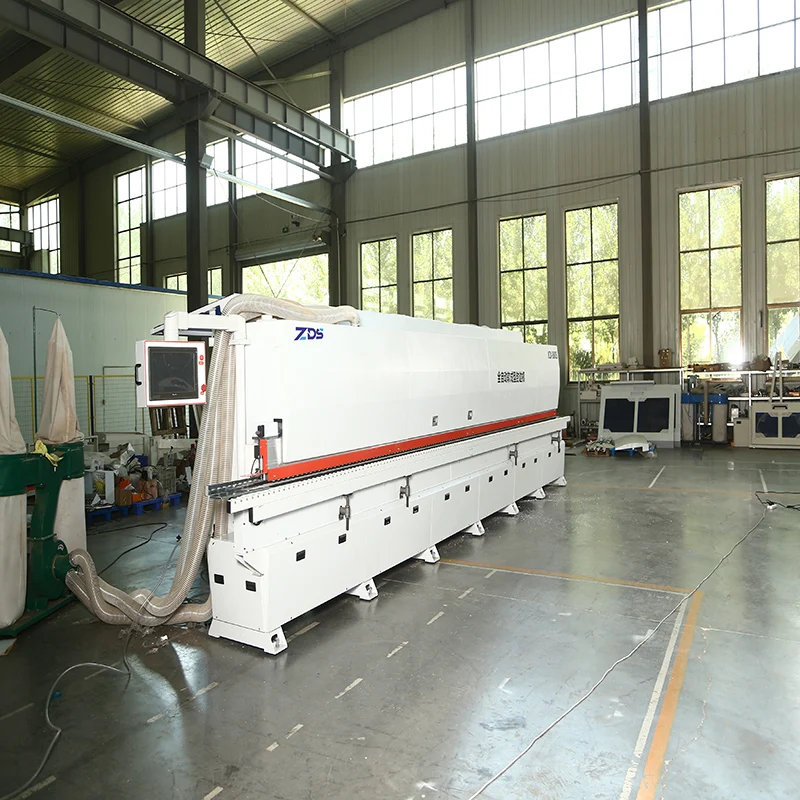
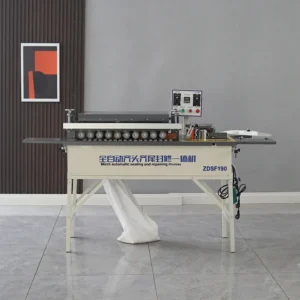
Precision-ground mechanisms — documented ±0.02mm tolerance backed by factory test records rather than brochure claims.
Technical Specifications
| Parameter |
Value |
| Model |
ZDSJCX-880S |
| Product Type |
Contour Edge Banding Machine |
| Overall Dimensions (L×W×H) |
8.82 × 1.07 × 1.85 m |
| Net Weight |
3200 kg |
| Total Power |
47.1 kW |
| Voltage |
380V (frequency to be confirmed for local grid) |
| Panel Thickness Range |
18–22 mm |
| Edge Banding Thickness |
0.5–0.8 mm |
| Edge Banding Width |
58 mm |
| Minimum Sheet Width |
150 mm |
| Minimum Sheet Length |
300 mm |
| Conveying Speed |
6–8 m/min |
| Air Pressure Requirement |
0.6–0.8 MPa |
| Vacuum Opening Size |
Ф100 × 6 |
| Machining Shape Capability |
J type, C type, oblique straight, left/right semi-pass, water drop, rhombus, triangle — 15+ contour profiles |
| Delivery Lead Time |
25–30 days (basis not stated in source) |
| Warranty |
1 year |
Application Suitability
| Application |
Material or Output |
| Curved cabinet door edge banding |
MDF and plywood panels with shaped edges |
| Rounded tabletop contour banding |
Particleboard and MDF with PVC or veneer edge banding |
| Contoured shelving components |
Plywood panels with water drop, rhombus, or triangle profiles |
| Custom furniture shaped panel processing |
Solid wood panels and board materials up to 22 mm thickness |
Why the Voltage Question Must Precede the Contour Edge Bander Purchase
Confirm your local grid frequency and phase before evaluating any contour edge banding machine specifications.
A 380V base specification means nothing if the receiving facility runs on a 440V/60Hz supply. I once spent three weeks coordinating a transformer swap for a curve edge bander that arrived electrically incompatible with the customer's plant — the entire downstream production line schedule slipped, and the customer nearly cancelled a follow-up order for the rest of their equipment. Frequency mismatches can overheat motors and degrade servo performance in ways that only appear after extended operation [NEED_CITE: voltage and frequency standards by export market]. Technical buyers comparing machines should treat electrical confirmation as the first gate, not an afterthought buried in the shipping checklist.

Mapping Profile Range to Your Production Mix
The ZDSJCX-880S supports 15 or more contour profiles including J type, C type, oblique straight, semi-pass, water drop, rhombus, and triangle geometries. For a custom furniture workshop producing shaped tabletops, rounded cabinet fronts, and specialty shelving, this profile library covers the majority of common contour edge banding machine specifications that production planners need to evaluate. Profile changeover time and setup repeatability determine whether a machine can handle short production runs without becoming a bottleneck — a factor that matters more than raw conveying speed when your product mix shifts daily.
Throughput Alignment Across the Production Line
The 6–8 m/min conveying speed sets the tempo for upstream cutting and downstream boring stations. If your panel saw feeds panels faster than the edge bander can process them, work-in-progress accumulates on the floor. If downstream boring machines sit idle waiting for banded panels, you carry unused capacity. Production planners evaluating contour edge banding machine specifications should calculate the cycle time for each station against this feed rate, particularly when processing smaller panels near the 150 mm minimum width where handling time dominates [NEED_CITE: line balancing methodology for panel processing cells]. The 47.1 kW total power draw also informs whether your existing electrical infrastructure can support this machine alongside other equipment on the same bus.
How Substrate Thickness and Air Pressure Define Output Quality
The 18–22 mm panel thickness range with 0.5–0.8 mm edge banding thickness defines the material envelope this machine processes. Thicker panels demand more from the trimming and scraping units, and tolerance drift becomes visible at assembly if the cutting mechanism cannot hold consistent engagement across the full thickness range. The 0.6–0.8 MPa air pressure requirement drives the pneumatic actuators that control profiling wheel engagement and pressure roller force — insufficient supply pressure at the machine inlet leads to inconsistent edge contact and visible glue lines on the finished panel. Six Ф100 vacuum openings handle chip extraction, and undersizing your dust collection system degrades both edge quality and workshop air quality over a full shift.
What Happens When Specifications Are Assumed Rather Than Verified
Tolerance claims on marketing material rarely survive contact with actual production substrates. I have seen contoured panels fail at assembly because the edge banding sat proud by fractions of a millimeter — enough to prevent flush-fitting drawer fronts from closing properly. When electrical parameters go unconfirmed, the machine arrives and the facility cannot energize it, burning weeks from the project timeline. Pneumatic supply that falls below the required 0.6 MPa causes intermittent profile quality that operators cannot diagnose because the fault lives in the compressor room, not on the machine itself [NEED_CITE: pneumatic supply standards for woodworking machinery]. These failures trace back to specification gaps during the selection phase, not to the machine's inherent capability.
Why Technical Buyers Source from This Facility
The patented cutting mechanisms achieve verified tolerance backed by four-stage quality control — incoming material inspection, in-process checks, finished product verification, and pre-shipment testing with recorded results. Every ZDSJCX-880S leaves the facility with a factory test record matching your specified contour profiles, so you see documented output before the crate closes. Voltage and control panel language customization are standard configuration steps rather than special requests, eliminating the electrical incompatibility issues that delay commissioning. The full product family spans entry-level to full-function contour machines, meaning a workshop can scale capacity within one supplier ecosystem without re-qualifying a new vendor. Engineer-led configuration recommendations with formal quotation arrive within 24 hours of a complete inquiry.
Documentation & Verification
- Machine specification sheet with verified tolerances across all 15+ contour profiles
- Electrical schematic confirming voltage and frequency matched to your local supply
- Factory test record on your specified panel thickness and edge banding material before dispatch
- Operation and maintenance manual in your operator's language with illustrated spare parts list
- CE declaration of conformity and ISO 9001 certificate for customs and compliance filing
Installation, Commissioning & Support
- Foundation must support 3200 kg static load across the 8.82 m machine length with level mounting surface
- Dedicated 47.1 kW circuit with confirmed voltage and frequency matching the ordered electrical configuration
- Arrives partially assembled with profiling units pre-aligned — final commissioning includes profile calibration on your substrates
- First-run parameter setup covers conveying speed, air pressure regulation, and vacuum extraction balance across six ports
- Operator training includes profile changeover procedures for all specified contour shapes and edge banding materials
- Spare parts package includes consumable trimming blades and pressure roller elements identified by part number
Preparing Your Specification Inquiry
To receive an accurate configuration proposal, share your typical panel materials and thickness range, the contour profiles required for your current product mix, and your facility voltage with confirmed frequency and phase. If your production line includes upstream cutting and downstream boring stations, include their feed rates so the conveying speed can be evaluated against your cell throughput. Specify the control panel language your operators require and whether you need sample processing on your actual substrates before shipment.
Frequently Asked Questions
Q: How can I verify contour profile accuracy before the machine ships?
A: Request a factory test record showing measured output on your specified panel thickness and contour profiles. The test should include representative shapes from your production mix — water drop, rhombus, or triangle — with documented dimensional results. Sample panels can be shipped for your own assembly verification before the machine leaves the facility.
Q: What electrical confirmation is needed for the 380V configuration?
A: Provide your local supply voltage, frequency in Hz, and phase configuration. The 380V base specification must be validated against your grid — a 60Hz supply requires motor and transformer adjustments compared to 50Hz. An electrical schematic matching your confirmed parameters is issued before production begins.
Q: How does the 6–8 m/min conveying speed align with a complete production line?
A: Compare this feed rate against your panel saw output and downstream boring machine cycle times. For lines processing smaller panels near the 150 mm minimum width, handling and positioning time at each station may reduce effective throughput below the nominal conveying speed. Share your cell layout for a balanced throughput assessment.
Q: What compressor capacity sustains the 0.6–0.8 MPa air requirement?
A: The compressor must deliver stable pressure at the machine inlet, not just at the receiver tank. Pressure drop across piping and filters means the compressor should be rated above the 0.8 MPa upper limit. Undersized supply causes intermittent profiling faults that appear random at the machine.
Q: Can custom contour profiles be added beyond the standard 15+ library?
A: Profile configuration depends on the machining unit setup and available tooling geometry. Share your required profile drawings during the inquiry stage so engineers can confirm whether the existing tooling covers your shapes or whether additional profiling units are needed in the configuration.