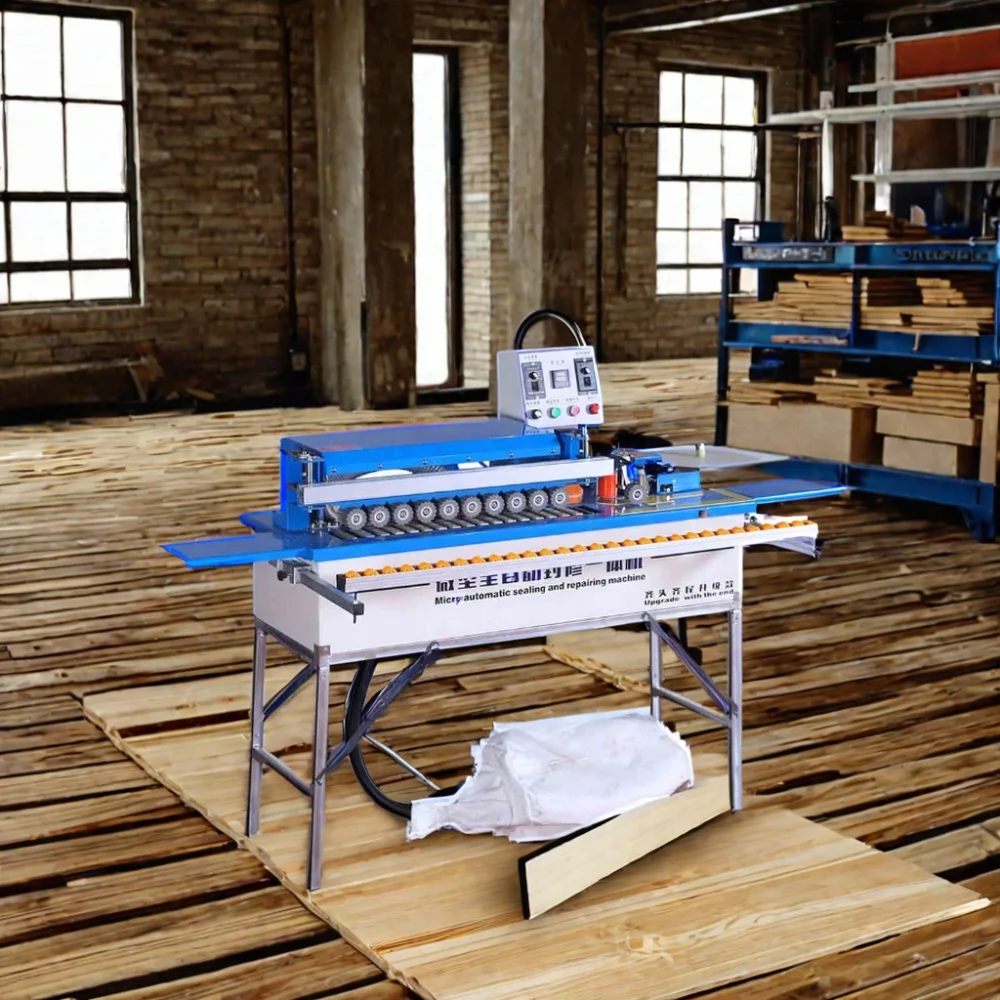
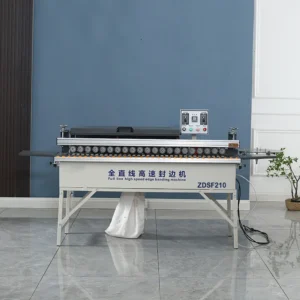
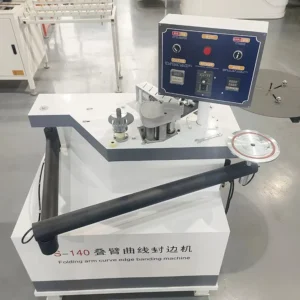
Verified Motor Ratings — every watt and speed figure on this compact automatic edge bander is published here so a technical buyer can map it directly against a workshop's production requirement.
Technical Specifications
| Parameter |
Value |
| Product Type |
Automatic Edge Banding Machine |
| Voltage |
220V (frequency 50/60 Hz to be confirmed per destination) |
| Suction Power |
1200W |
| Belt Power |
25W |
| Transmission Power |
60W |
| Polishing Power |
180W × 2 |
| Trimming Power |
800W × 2 |
| Conveying Speed |
0–15 m/min |
| Edging Speed |
0–6 m/min |
| Edge Height Range |
10–60 mm |
| Edge Thickness Range |
0.3–3 mm |
| Overall Dimensions (L×W×H) |
120 × 54 × 72 cm |
| Gluing Method |
Double-sided adhesive application |
| Trimming Stations |
Up and down trimming with dust suction |
| Polishing Stations |
Cross polishing, up and down (2 × 180W motors) |
| Edge Banding Mode |
Straight and curved (gluing device rotates 180°) |
| Feed Mechanism |
Double-row rubber pressure wheels |
| Assembly State |
Requires on-site assembly |
| Warranty |
1 year |
Application Suitability
| Application |
Material or Output |
| Small cabinet workshop edge finishing |
Melamine-faced particleboard with PVC edge banding 0.4–2 mm |
| Custom joinery prototyping |
Plywood and MDF panels with veneer or ABS banding |
| Low-volume curved panel production |
Shaped cabinet doors and radius shelving in wood-based substrates |
| Startup furniture factory sample runs |
Mixed melamine and PVC banding on boards up to 60 mm thick |
Why the Voltage Question Should Come Before the Quotation on Any Automatic Edge Banding Machine Specifications Sheet
A 220V machine landing in a 60 Hz grid without frequency verification will run hotter, feed slower, and void its warranty before the first week ends.
I once watched a cabinet shop in Shandong receive a compact edge bander rated for 220V / 50 Hz, plug it into a local supply that drifted to 62 Hz on summer peaks, and spend two days chasing uneven glue melt before anyone thought to check the nameplate. The motor windings, the heating element in the glue pot, and the conveyor drive all respond differently to frequency shifts, and none of them announce the problem until a panel comes off the line with a visible glue line or a lifted edge. Asking for an electrical schematic and voltage confirmation document before signing a purchase order takes an hour; discovering a mismatch on the factory floor takes a week [NEED_CITE: voltage and frequency standards by export market].
What Each Power Rating Actually Governs on the Production Floor
The automatic edge banding machine specifications on this unit break power into six independent circuits, and each one controls a distinct stage of the edge finishing process. The twin 800W trimming motors handle the first cut that shears excess banding flush with the panel surface, and their wattage determines how cleanly they slice through 3 mm PVC without chipping the substrate edge. Below that threshold, a trimming motor may stall on dense melamine-faced chipboard and leave a ragged overhang that the polishing station cannot correct. The dual 180W polishing motors then buff the trimmed edge to a uniform finish, and their lower wattage is deliberate — excessive polishing pressure generates friction heat that softens PVC banding and smears adhesive residue back onto the panel face.
Separating Conveying Speed from Edging Speed in Real Operation
Two speed figures appear in the automatic edge banding machine specifications for this model: a conveying speed of 0–15 m/min and an edging speed of 0–6 m/min, and confusing them is a frequent cause of throughput miscalculation. Conveying speed describes how fast the feed mechanism can move a panel through the machine when no cutting or gluing load is applied — useful for repositioning or dry runs. Edging speed is the actual working feed rate under full load with trimming, polishing, and glue application running simultaneously, and it is the number that must match the output rhythm of an upstream panel saw and the cycle time of a downstream boring station. Running the conveyor at 12 m/min while the edging stations are rated for 6 m/min will produce panels with incomplete trimming and uneven glue coverage [NEED_CITE: edge banding feed rate and finish quality correlation].
Reading the Tolerance Window: Edge Height, Thickness, and Substrate Compatibility
The 10–60 mm edge height range and the 0.3–3 mm edge thickness range define which material combinations this machine can process without mechanical adjustment. A 10 mm lower limit means narrow solid wood lipping on thin shelving is within reach, while the 60 mm ceiling accommodates standard cabinet carcass panels and most worktop substrates. The thickness window covers thin melamine foil banding at 0.3 mm up through heavy PVC and ABS profiles at 3 mm, which is where the double-row rubber pressure wheels earn their place — maintaining even feed pressure across that entire range without crushing thin veneers or losing grip on thick rigid profiles. When a buyer's material sits at either extreme of these windows, requesting a sample processing test on the actual substrate is the only way to confirm that the glue temperature, feed pressure, and trimming clearance will produce a clean bond line.

What Happens When Spec Numbers Are Taken at Face Value
A specification sheet that lists 0–6 m/min edging speed without stating the substrate and banding material used during testing leaves the buyer to discover real-world limits alone. I have seen workshops set the feed dial to maximum on melamine board, only to find the glue pot cannot recover temperature fast enough and bond strength drops noticeably on every fifth panel. Trimming motors rated at 800W each handle PVC and ABS cleanly, but when the same machine is fed 3 mm solid wood banding, the cut quality changes and the edge may require a second pass. These are not defects in the machine; they are the gap between a spec tested on one material and a production schedule running a different one. Technical buyers who request a factory test record on their specific panel thickness and edge material close that gap before the machine ships [NEED_CITE: substrate variability in edge banding performance].
Why This Configuration Fits a Specification-Driven Purchase
The machine range within this product family extends from entry-level manual feed units to full-function pre-milling models, so a buyer comparing this compact unit against higher-tier options is comparing within one supplier's catalog rather than across unrelated brands. Voltage customization from 110V to 440V is available as standard, meaning the 220V listed here can be reconfigured before dispatch if the destination grid requires it. A four-stage QC process covering incoming material inspection, in-process checks, finished product verification, and pre-shipment testing ensures the published specifications reflect the actual machine delivered. Control panel language is configurable, so operators reading Spanish, Arabic, Russian, or English will find the interface in their working language at commissioning. An engineer-led configuration recommendation with a formal quotation delivered within one working day means the spec sheet a buyer receives is matched to their stated panel materials and daily volume rather than pulled from a generic template.
Documentation & Verification
- CE declaration of conformity covering this compact automatic edge bander model
- Machine specification sheet with verified motor ratings and speed ranges per unit
- Electrical schematic confirming 220V wiring and frequency compatibility at destination
- Factory test record run on buyer's specified panel thickness and edge banding material
- Operation and maintenance manual in the buyer's chosen control panel language
Installation, Commissioning & Support
- Unit ships requiring on-site assembly; 120 × 54 cm footprint needs a level floor with clearance on all sides for curved-edge operation
- 220V single-phase supply with a dedicated circuit rated above the combined motor and heating load
- Double-sided adhesive gluing system requires initial temperature calibration matched to the buyer's banding material during first commissioning
- Independent function controls allow operators to isolate each station for step-by-step parameter tuning before full-speed production runs
- Dust suction ports on both trimming stations connect to a workshop extraction system rated for fine MDF and PVC particulate
- One-year warranty covers structural and electrical components; spare trimming cutters and polishing pads recommended as day-one stock
Before Requesting a Quotation
To match the right configuration from this product family, share the panel substrates and edge banding materials the machine will process most often, along with typical board thickness and edge height. Confirm the local voltage and frequency at the installation site so the electrical package is built correctly before dispatch. If the workshop runs upstream panel saws or downstream boring machines, note their throughput so the edging speed can be evaluated against the line rhythm rather than in isolation.
Frequently Asked Questions
Q: How do I verify actual edge banding tolerance on my specific panel material before ordering?
A: Request a sample processing test using your own melamine or PVC board stock. The factory runs the machine with your material, documents trimming accuracy, glue line visibility, and bond strength, and ships the test panels with a factory test record. This confirms whether the 0–6 m/min edging speed and 800W trimming motors produce acceptable results on your substrate at the thickness you run most often.
Q: Is the 220V supply compatible with my local frequency, and can it be customized?
A: The standard configuration is 220V, but frequency compatibility depends on the destination grid. Voltage can be reconfigured from 110V to 440V before dispatch, and an electrical schematic with voltage confirmation is included in the shipping documentation. Confirm your local Hz rating during the inquiry stage so the motor windings and heating elements are specified correctly for continuous operation.
Q: What control panel languages are available and when is the language set?
A: The independent function controls support multiple languages, configured before shipment based on the buyer's requirement. Operators can select their preferred language at commissioning without additional programming. Specify the required language during the quotation stage to ensure the interface is ready on arrival, avoiding production delays caused by unreadable control labels.
Q: How does the 0–6 m/min edging speed align with upstream and downstream equipment?
A: The edging speed under full load governs actual throughput, while the 0–15 m/min conveying speed applies only to unloaded feed. Compare the 0–6 m/min working rate against your panel saw output and boring station cycle time to identify bottlenecks. If upstream output exceeds this machine's edging capacity, a higher-tier model in the same product family may be recommended during the configuration review.
Q: What does the one-year warranty cover and which spare parts should I order immediately?
A: The warranty covers structural frame integrity, motor function, and electrical components under normal use. Exclusions typically include consumable cutters and polishing pads. Given the twin 800W trimming stations and dual 180W polishing motors, stocking extra trimming blades, polishing pads, and rubber pressure wheel inserts ensures uninterrupted production during the first months of operation.