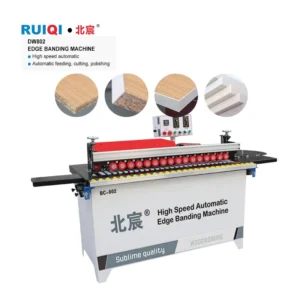
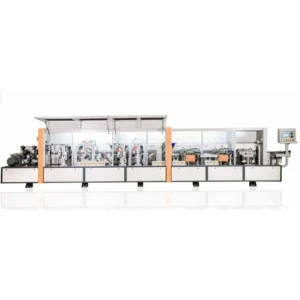
Portable Precision — the ZDSF50+ packs double-sided gluing and pneumatic tape-breaking into a 28 kg footprint so small workshops can run both straight and curved edge banding without committing to a full-size line.
Technical Specifications
| Parameter |
Value |
| Model |
ZDSF50+ Mini Edge Banding Machine |
| Product Type |
Mini Edge Banding Machine |
| Rated Voltage |
220V |
| Rated Power |
1.2 kW |
| Rated Air Pressure |
0.4-0.6 MPa |
| Glue Capacity |
1000 ml |
| Glue Heating Temperature |
150-180°C (medium temperature granular glue) |
| Heating Time |
5-10 min |
| Strip Thickness Range |
0.5-1.5 mm |
| Sheet Thickness Range |
10-60 mm |
| Edge Banding Speed |
0-6 m/min |
| Overall Dimensions (L×W×H) |
54×54×56 cm |
| Machine Weight |
28 kg |
| Key Features |
Straight and curved edge banding, automatic tape breaking, double-sided gluing, pneumatic cutting, foot switch for curves, travel switch for straight lines |
Application Suitability
| Application |
Material or Output |
| Custom cabinet panel edge finishing |
MDF and plywood panels 10-60 mm thick with PVC or veneer strips 0.5-1.5 mm |
| Small-batch furniture production |
Particleboard shelving and carcass panels requiring both straight and curved edge banding |
| On-site carpentry and installation work |
Solid wood panels and board stock processed in workshops with standard 220V single-phase supply |
| Joinery workshop starter configuration |
Limited-volume edge banding before scaling to a full automatic line |
Why Voltage Confirmation Must Happen Before You Compare Mini Edge Banding Machine Specifications
A machine that cannot run on your local grid is a paperweight, regardless of how attractive its spec sheet looks.
I once visited a small cabinet workshop where the owner had imported an edge bander rated for a different frequency than his local supply. The glue pot never reached proper melting temperature, and the operator spent two days adjusting parameters before the bonding held on MDF panels. That machine is still sitting in a corner as a reminder. When you are evaluating a mini edge bander for a compact workshop, the electrical compatibility question needs an answer before anything else [NEED_CITE: voltage and frequency standards by export market]. The ZDSF50+ is rated at 220V, which covers many single-phase markets, but confirming frequency and plug type at the quotation stage prevents costly surprises at commissioning.

Mapping Feed Speed and Glue Capacity to Your Daily Panel Volume
The edge banding speed of 0-6 m/min defines what this machine can realistically handle in a working day. For a joinery shop producing twenty to thirty cabinet carcasses daily, that throughput envelope is sufficient when paired with an operator who manages panel loading and strip alignment. The Mini Edge Banding Machine specifications become meaningful only when matched against your actual batch size — a workshop running hundreds of panels per shift would need a full-size automatic line, not a portable unit.
Double-Sided Gluing and What It Means for Adhesion on Different Substrates
The 1000 ml glue pot operates with medium-temperature granular glue heated between 150°C and 180°C. Double-sided gluing applies adhesive to both the panel edge and the strip backing, which improves bonding on porous substrates like particleboard where single-sided application often leaves dry spots. I have watched operators struggle with veneer strips peeling off MDF because the glue temperature was too low for the material density — confirming the correct temperature window for your specific panel type is part of the selection process [NEED_CITE: substrate adhesion requirements for MDF versus plywood edge banding].
Panel Thickness, Strip Compatibility, and the Assembly Accuracy Connection
The 10-60 mm sheet thickness range and 0.5-1.5 mm strip thickness range define the material envelope. Thicker panels in the 40-60 mm range — such as worktop blanks or stair treads — need consistent feed support so the strip does not drift during application. On thinner stock around 10-18 mm, the pneumatic cutting system must sever the strip cleanly without chipping the panel edge, because any overhang or tear goes straight into the assembly station and shows up as a visible gap in the finished cabinet. The ±tolerance of edge placement directly affects whether dowel joints and hinge bore holes align during downstream assembly.
What Happens When the Machine Class Does Not Match the Workload
Buying a compact edge bander for production volumes it was never designed to handle creates a specific pattern of frustration. The operator pushes feed speed beyond the glue bonding window, adhesion fails intermittently, and the workshop starts blaming the glue brand rather than the throughput mismatch. I have seen this exact scenario with a custom furniture maker who needed to edge-band over a hundred panels per day — by the time they upgraded to an automatic line, they had already lost weeks to rework [NEED_CITE: edge banding failure patterns in high-volume small workshop operations]. The ZDSF50+ serves workshops with modest daily volumes honestly; it is not a bridge to industrial output.
Why Technical Buyers Source This Model Here
In-house manufacturing with verified tolerance on cutting and feed mechanisms means the machine arrives performing to its published specifications rather than relying on third-party assembly quality. Voltage, control panel language, and specification adjustments are handled as standard configuration items, not special requests that delay production. The four-stage quality check — incoming material, in-process, finished product, and pre-shipment verification — catches issues before the crate is sealed. An engineer reviews your panel material and daily volume before recommending this model or redirecting you to a higher-capacity machine in the product family. Factory visits are open for buyers who want to see the assembly floor and run a test on their own material.
Documentation & Verification
- Machine specification sheet confirming 220V rating and 1.2 kW power draw for your electrician
- Electrical schematic with voltage and frequency confirmation matching your local grid standard
- Factory test record on your panel thickness range verifying glue bonding and tape-breaking function
- Operation and maintenance manual written in the agreed language for operator-level readability
- Spare parts list covering glue pot heating tubes, rubber pressing rollers, and pneumatic cutting components
Installation, Commissioning & Support
- Requires a dedicated 220V circuit rated for the 1.2 kW draw plus compressor load on a separate breaker
- Air compressor must deliver 0.4-0.6 MPa consistently to operate the pneumatic tape-breaking reliably
- Compact 54×54×56 cm footprint and 28 kg weight allow benchtop placement without floor anchoring
- Glue pot heating verification at 150-180°C range confirmed during first commissioning run on your material
- Spare glue pot heating tubes and pressing rollers included per the agreed spare parts list at dispatch
Requesting an Accurate Configuration Quotation
To receive a specification-matched proposal, share your primary panel material type (MDF, plywood, particleboard, or solid wood), the thickness range you process most often, and your typical daily panel count. Confirm your local voltage and frequency so the electrical configuration is locked before production. If you work with veneer strips rather than PVC, mention that so the glue temperature parameters can be set accordingly. A sample edge banding run on your own material can be arranged before shipment if you need to verify bonding quality on your specific substrate.
Frequently Asked Questions
Q: How do I check whether the ZDSF50+ feed speed and glue capacity fit my daily output?
A: Calculate your total linear meters of edge per shift and compare against the 0-6 m/min banding speed with realistic loading time between panels. The 1000 ml glue pot handles modest daily volumes but requires refilling if you exceed typical small-workshop panel counts. This machine suits twenty to thirty panels per day comfortably.
Q: Is the 220V rating compatible with my local power grid, and can it be reconfigured?
A: The standard rating covers many single-phase markets, but frequency (50Hz or 60Hz) must be confirmed to ensure the glue pot heater and motor operate correctly. Voltage adjustments within the manufacturer's configurable range are available at the quotation stage so the machine matches your exact supply standard before dispatch.
Q: What compressor specifications are needed for the pneumatic tape-breaking system?
A: The machine requires a consistent air supply between 0.4 and 0.6 MPa to activate the pneumatic cutting reliably. A compressor with adequate flow rate to maintain that pressure through repeated tape-breaking cycles is essential — undersized compressors cause intermittent cutting failures, especially during continuous operation on multiple panels.
Q: How do I choose the right glue temperature for MDF versus particleboard panels?
A: Denser substrates like MDF often need the upper end of the 150-180°C range for proper glue penetration, while lighter particleboard bonds adequately at lower temperatures. Confirming your exact panel material before commissioning ensures the glue pot is set correctly and prevents adhesion failures that show up only after assembly.
Q: Can I request a sample edge banding test on my own panel material before accepting the machine?
A: Yes, a pre-shipment test using your actual panel stock and strip material can be arranged to verify bonding quality, cutting accuracy, and glue temperature settings. The factory test record documents the results, giving you confidence that the configuration works on your specific substrate before the machine leaves the facility.


![` 标签,因为回答本身就是最终内容。 * 使用标准连字符 `-` 代替 en dash `–` 以防编码问题,或者直接使用 `-`。 * `Automatic Wood Panel Edge Banding Machine - Specifications` (57 chars) * 再确认一下结构3: `[应用或物料] [品类词] – [站点修饰词]` * Wood Panel (应用或物料) Edge Banding Machine (品类词) - (分隔) Specifications (站点修饰词) * 完美。](https://ruiqiwoodmachine.com/wp-content/uploads/2026/05/H40e3bbcdfadb464da23e3e88c6ee3d0dB-1-300x300.webp)