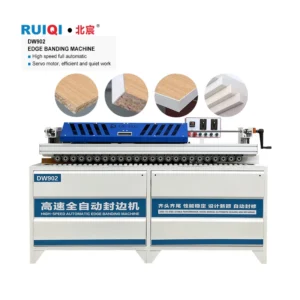
Precision Configuration — the DW902 is delivered with voltage matched to your facility's supply and a control panel in your operator's language, so commissioning begins on day one, not week three.
Technical Specifications
| Parameter |
Value |
| Model |
DW902 |
| Product Type |
Multi-function Edge Banding Machine (Straight and Curved) |
| Total Power |
4000W |
| Voltage Options |
220V / 380V / customizable |
| Trimming Motors |
800W × 2, 24000 r/min |
| Polishing Motors |
380W × 2 |
| Vacuum Power |
550W |
| Edge Banding Thickness Range |
0.3 – 3 mm |
| Edge Banding Height |
5 cm |
| Minimum Sheet Length |
25 cm |
| Minimum Sheet Width |
10 cm |
| Glue Pot Capacity |
4000 ml |
| Air Source Pressure |
0.5 – 0.8 MPa |
| Overall Dimensions (L × W × H) |
175 × 87 × 112 cm |
| Net Weight |
240 kg |
| Control Panel Language |
Chinese / English (customizable to Spanish or other languages) |
| Assembly State |
Fully assembled |
| Key Features |
Oblique and straight dual-purpose, double hot air design, feeding auxiliary slide plate, 4 groups of oblique pressure wheels, double row pressing wheels, chamfering, automatic trimming, scraping |
Application Suitability
| Application |
Material or Output |
| Cabinet door and carcass edge banding |
MDF and particleboard with PVC edge banding |
| Custom furniture curved panel finishing |
Plywood and ecological board with veneer or melamine banding |
| Joinery workshop small-batch production |
Solid wood panels with 0.3–3 mm banding material |
| Home decoration component manufacturing |
Board stock requiring straight and oblique edge profiles |
Why the Voltage Question Should Come Before the DW902 Edge Banding Machine Specifications
A machine wired for the wrong supply sits idle on your loading dock until a transformer arrives.
I once specified a manual edge bander for a European joinery shop without confirming their three-phase configuration. The unit arrived with a 380V motor, and the shop ran on a 220V single-phase feed. Two weeks of downtime followed while sourcing a step-up transformer. Since that project, I begin every equipment review by matching electrical parameters to the facility's existing infrastructure. The DW902 edge banding machine specifications include configurable voltage between 220V and 380V, but that flexibility only matters if you confirm the correct setting before the unit ships. Frequency mismatches — 50 Hz versus 60 Hz — can cause trimming motors to run at incorrect speeds, producing chatter marks on the finished edge [NEED_CITE: voltage and frequency standards by export market]. Requesting the electrical schematic and a signed voltage confirmation document before production closes this gap entirely.

Mapping Power Distribution Across the DW902 Stations
The DW902 allocates its 4000W total power budget across distinct functional stations, and understanding that allocation matters when you evaluate whether the machine can sustain continuous operation on your panel mix. The two trimming motors draw 800W each at 24000 r/min — enough rotational energy to shear PVC and melamine banding cleanly without tearing the substrate surface. Polishing motors at 380W each handle the final surface finish. When you review the DW902 edge banding machine specifications, the dedicated 550W vacuum circuit deserves separate attention: it captures trimming debris at the cutting head before particles can embed in fresh glue joints downstream.
Dual Hot Air and Pressure Wheel Configuration
Consistent edge adhesion depends on glue reaching the correct activation temperature at the exact moment the banding meets the panel edge. The DW902 uses a double hot air system that pre-heats both the panel edge and the banding material simultaneously, reducing cold joints on thicker substrates. Four groups of oblique pressure wheels and a double row pressing wheel configuration maintain uniform contact force across the full 5 cm banding height. This arrangement is particularly relevant when you switch between straight panels and curved components within the same production run. The oblique pressure groups conform to radii that a single straight-wheel setup cannot track, which is why the DW902 edge banding machine specifications list both straight and curved capability as standard rather than optional [NEED_CITE: CE machinery directive requirements for industrial edge banding equipment].
Reading the Numbers That Affect Your Panel Output
The 0.3–3 mm banding thickness range defines which materials you can run without swapping tooling or pressure settings. PVC banding typically falls between 0.4 and 2 mm, while real wood veneer sits at the thinner end of the spectrum around 0.3–0.6 mm; melamine papers occupy the middle. If your production mix includes both thin veneer and thick PVC, the DW902's adjustable feed and pressure system avoids the need for two separate machines. The minimum workpiece dimensions — 25 cm length and 10 cm width — set the lower boundary for viable parts. Small cabinet components like filler strips and plinth blocks often fall near this limit, so verify that your smallest standard part clears these thresholds. Air supply at 0.5–0.8 MPa drives the pneumatic pressure wheels; if your shop compressor cannot maintain 0.5 MPa at the machine inlet under continuous draw, the pressure wheels will pulse, leaving visible wave marks on the finished edge.
The Cost of Skipping Configuration Verification
When a technical buyer selects a machine on throughput claims alone without verifying electrical compatibility, air supply capacity, or control language, the consequences appear after installation rather than before shipment. Operators facing a control panel in an unfamiliar language cannot adjust trimming depth or glue temperature, leading to inconsistent edge quality and material waste. A machine specified for 380V three-phase but installed in a 220V single-phase workshop simply will not start. These failures are not equipment defects — they are configuration oversights that compound into delayed commissioning, frustrated production staff, and rework costs that never appear on the original quotation [NEED_CITE: common causes of edge banding machine commissioning delays].
What Sets This Procurement Path Apart
Every DW902 ships with a factory test record run on the buyer's specified panel thickness and banding material, not a generic demo board. Voltage and frequency are confirmed in writing before production begins, and the control panel language is set to match your operator team. The machine arrives fully assembled — no on-site alignment of the trimming and polishing stations is required. Configuration recommendations come from engineers who review your production volume and panel mix, not from a catalogue picker. A formal quotation with complete DW902 edge banding machine specifications is issued within 24 hours of an inquiry, giving you the data needed to compare models on measurable parameters.
Documentation & Verification
- CE declaration of conformity covering the DW902 edge banding and trimming assembly
- Machine specification sheet listing confirmed voltage, frequency, and control language
- Electrical schematic showing circuit layout for your facility's maintenance team
- Factory test record run on your specified panel material and banding thickness
- Operation and maintenance manual in the agreed operator language
- Spare parts list identifying wear items and reorder intervals
Installation, Commissioning & Support
- The 175 × 87 × 112 cm footprint requires a level floor area with clearance on the feed and discharge sides for panel handling
- A dedicated circuit matching the confirmed voltage — 220V or 380V — with appropriate breaker rating for the 4000W total load
- The DW902 ships fully assembled; positioning and air line connection are the only on-site setup steps
- First-run parameter setting covers glue pot temperature, trimming depth, and pressure wheel force for your panel stock
- Compressed air supply must deliver 0.5–0.8 MPa at the machine inlet to maintain consistent pressure wheel engagement
- Trimming cutter inserts and polishing pads are the primary wear items, listed in the included spare parts schedule
Preparing Your Inquiry
To receive a configuration recommendation and formal quotation for the DW902, share your primary panel material types and thicknesses, the banding materials you run most frequently, and your facility's available voltage and frequency. If your production includes curved components, note the typical radius range so the oblique pressure wheel configuration can be verified against your geometry. Specifying your preferred control panel language at the inquiry stage prevents commissioning delays after delivery.
Frequently Asked Questions
Q: How can I verify the DW902 edge banding quality on my specific panel material before committing to an order?
A: You can request a sample processing test using your own panel stock and preferred banding material. The factory runs the DW902 on your supplied samples and ships the finished pieces along with a test record documenting trimming tolerance and edge adhesion results, so you evaluate output quality before the machine leaves the production floor.
Q: What documentation confirms electrical compatibility of the DW902 before the machine ships?
A: Before dispatch, you receive an electrical schematic showing the confirmed voltage and frequency configuration, a signed voltage confirmation document, and the machine specification sheet reflecting your facility's supply. These documents allow your electrician to verify circuit requirements before the unit arrives on site.
Q: How does the 0.3–3 mm banding thickness range apply to different edge materials?
A: Thin veneer banding around 0.3–0.6 mm requires lower pressure wheel force and careful glue temperature control to prevent bleed-through. PVC banding from 0.4–2 mm is the most common range for cabinet production. The DW902 adjusts pressure and feed parameters across this full spectrum without requiring tooling changes between material switches.
Q: Should I choose a straight-only or dual-purpose straight and curved edge bander for my workshop?
A: If your production includes any curved cabinet doors, radius panels, or shaped furniture components, the dual-purpose DW902 handles both geometries on one machine. Straight-only machines offer higher throughput on linear panels but cannot process curves, forcing you to maintain a separate manual station for shaped parts.
Q: What spare parts are included with the DW902 at delivery?
A: The machine ships with a spare parts list identifying trimming cutter inserts, polishing pads, and pressure wheel components as primary wear items. A starter set of consumables is included to cover initial operation, and the list provides part numbers and recommended reorder quantities for ongoing maintenance planning.