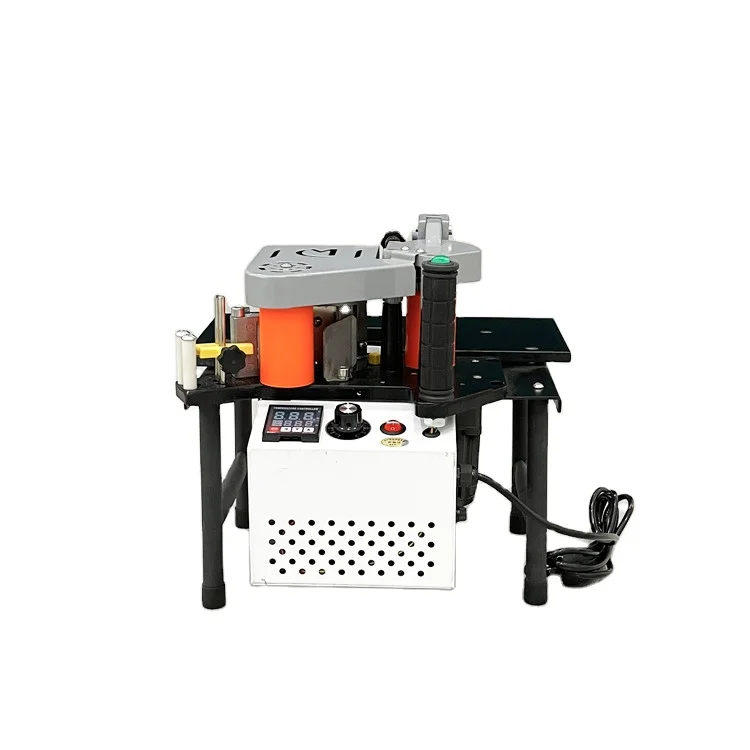
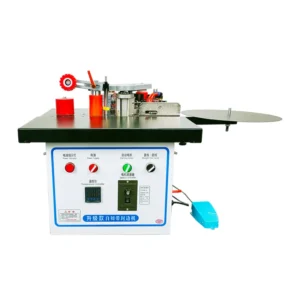
Verified Tolerance Capability — Every portable edge bander leaves our facility with a factory test record documenting actual edge finish quality on your specified panel material and thickness.
Technical Specifications
| Parameter |
Value |
| Product Type |
Portable Edge Banding Machine |
| Voltage |
220V |
| Rated Power |
1000W |
| Plate Shape Compatibility |
Curved & Straight plates |
| Edge Banding Thickness Range |
0.3–3mm |
| Board Thickness Range |
7–60mm |
| Gluing Method |
Double-sided gluing |
| Glue Pot Capacity |
800ml |
| Net Weight |
14kg |
| Assembly State |
Portable / Handheld |
| Customization Options |
Logo customization available; EU/AU/UK/USA/CN plug options |
Application Suitability
| Application |
Material or Output |
| Custom furniture curved-profile edge finishing |
MDF and plywood panels with PVC edge banding |
| Small-workshop straight-edge banding for cabinet components |
Particleboard with 0.4–2mm PVC or melamine strips |
| On-site joinery touch-up and repair work |
Solid wood panels with veneer edge banding up to 3mm |
| Low-volume production runs for bespoke shelving and storage |
Plywood and blockboard with ABS or PVC banding |
Why Voltage Compatibility Must Be Confirmed Before You Order a Portable Edge Banding Machine
A 220V portable edge banding machine plugged into a 110V supply will not reach operating temperature — and the glue line will fail within the first hour of use.
I have seen workshops receive handheld banders that sat unused for weeks because nobody checked the local single-phase supply against the machine rating plate. The heating element in a 1000W glue pot depends on receiving the correct voltage to maintain the thermal stability needed for consistent adhesive flow. When the voltage is wrong, the glue either stays too viscous to bond properly or degrades from overheating, and operators spend days chasing a problem that was entirely preventable at the quotation stage [NEED_CITE: voltage and frequency standards by export market]. Confirming whether your facility runs 50Hz or 60Hz single-phase power is not a detail for the shipping department — it belongs in the very first exchange with the supplier.

Matching the Gluing Method to Your Substrate
Double-sided gluing applies adhesive to both the panel edge and the backing of the edge band simultaneously. For porous substrates like raw particleboard or unsealed MDF, this approach compensates for the material absorbing glue on contact, which single-sided systems struggle to overcome. When working with denser materials such as plywood or pre-laminated board, the second glue layer still contributes to bond strength but becomes less critical. Understanding this distinction helps technical buyers evaluate whether the Portable Edge Banding Machine specifications align with the actual panel stock moving through their workshop.
Curved Profiles and the Limits of Handheld Operation
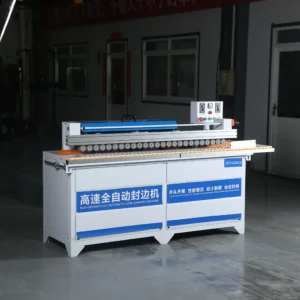
Stationary edge banders handle straight panels with conveyor feed and pressure rollers, but curved components require manual guidance. This unit is rated for both curved and straight plate shapes, meaning operators can transition between radiused cabinet doors and flat shelving without switching equipment. The trade-off is that curved-profile work demands more operator skill to maintain consistent feed speed and pressure. Workshops planning to use this machine primarily for curved sections should budget for additional training time before expecting production-grade edge quality [NEED_CITE: operator training requirements for manual edge banding equipment].
Interpreting the Numbers That Actually Matter
The 7–60mm board thickness range covers the majority of furniture-grade panel stocks, from thin 9mm MDF used in drawer bottoms through to 40mm blockboard for worktops. If your production regularly involves panels below 10mm, verify that the pressure shoe and guide fence can be adjusted without introducing chatter marks on the panel surface. The 0.3–3mm edge banding thickness range accommodates standard 0.4mm PVC through to thicker veneer strips, but the upper limit matters most when working with solid wood lipping on exposed edges. The 800ml glue pot capacity determines how long the machine runs between refills — at continuous use on standard 18mm board, this translates to a meaningful but finite window before the operator must stop and replenish. The 1000W rated power is sufficient for maintaining glue temperature in typical workshop conditions, though facilities in colder climates should allow extended warm-up time before the first panel of the shift.
The Hidden Cost of Specifying the Wrong Edge Thickness Range
Workshops that purchase a portable bander without confirming their edge banding inventory often discover incompatibilities after the machine arrives. A unit rated for 0.3–3mm will not properly feed 4mm solid wood lipping, and forcing thicker material through the guide channel damages both the strip and the feed mechanism. Similarly, running 0.3mm PVC at the lower limit requires precise temperature control because thin material melts and deforms if the glue is even slightly too hot [NEED_CITE: thermal sensitivity of thin PVC edge banding materials]. These mismatches do not show up on a specification sheet comparison — they appear as scrap panels and frustrated operators on the shop floor.
What Sets This Procurement Channel Apart
In-house manufacturing means specification queries are answered by the engineers who assembled the glue pot mechanism, not a sales intermediary guessing at technical details. The four-stage quality control process — incoming material inspection, in-process checks, finished product testing, and pre-shipment verification — applies to every portable unit before it leaves the facility. Voltage and plug configuration are confirmed against your local supply standard before production begins, not assumed from a country code. Factory test records are generated on panel material matching your actual production stock, providing documented evidence of edge finish quality before the machine ships. Engineer-led configuration recommendations ensure the unit is matched to your throughput expectations and panel mix rather than simply sold as a catalog item.
Documentation & Verification
- CE declaration of conformity covering portable handheld woodworking equipment
- Machine specification sheet confirming 220V rating and 1000W power draw
- Electrical schematic with voltage and frequency confirmation for your supply
- Factory test record on your actual panel thickness and edge banding material
- Operation and maintenance manual in your operator's working language
- Spare parts list identifying consumable components with part numbers
Installation, Commissioning & Support
- Single-phase 220V dedicated circuit with appropriate breaker rating for the 1000W load
- Bench-mounted setup requiring stable work surface to support 14kg operating weight
- Glue pot warm-up procedure and temperature calibration before first production panel
- Operator training on feed speed and pressure control for curved versus straight profiles
- Consumable spare parts inventory covering glue pot seals and guide fence wear items
- Routine maintenance schedule for glue pot cleaning and adhesive residue removal
What We Need to Configure Your Portable Edge Bander Correctly
Provide the specific panel materials and thicknesses your workshop processes most frequently, along with the edge banding types and thicknesses currently in your inventory. Confirm your facility's single-phase voltage and frequency so the correct electrical configuration is built into the unit. If your production includes curved-profile components, share the typical radius range and panel dimensions so the application suitability can be verified before the order is finalized.
Frequently Asked Questions
Q: How can I verify the actual edge banding tolerance on curved versus straight profiles?
A: Request a factory test record showing edge finish results on both curved and straight samples cut from your actual panel material. The test should document glue line visibility, edge overhang, and surface quality under magnification. This record is generated before shipment and provides measurable evidence rather than claimed specifications.
Q: Does the 220V rating match single-phase supply at 50Hz or 60Hz, and can it be reconfigured?
A: The standard 220V configuration operates on single-phase supply, but frequency compatibility must be confirmed for your specific market. Reconfiguration for different frequency standards is possible at the manufacturing stage when specified before production. Always provide your local voltage and frequency during the inquiry to ensure correct electrical component selection.
Q: What board materials and edge banding types are confirmed compatible at the stated thickness ranges?
A: The 7–60mm board range and 0.3–3mm edge band range cover MDF, plywood, particleboard, and solid wood panels with PVC, ABS, or veneer strips. Compatibility with specific material combinations is confirmed through sample processing tests using your actual stock, which should be requested before placing the order.
Q: How does the 800ml glue pot capacity translate to continuous run time before refill?
A: Run time depends on panel edge length, gluing method, and adhesive consumption rate per linear meter. Double-sided gluing consumes adhesive faster than single-sided application. Request the manufacturer's consumption data for your typical panel dimensions to calculate expected refill intervals and plan production breaks accordingly.
Q: What plug standard is shipped and is the control interface available in my operator's language?
A: Plug options include EU, AU, UK, USA, and CN standards, specified at order placement. The control interface language is configurable to match your operator's requirements. Both specifications must be confirmed during the quotation stage to avoid commissioning delays caused by unreadable controls or incompatible power connections.