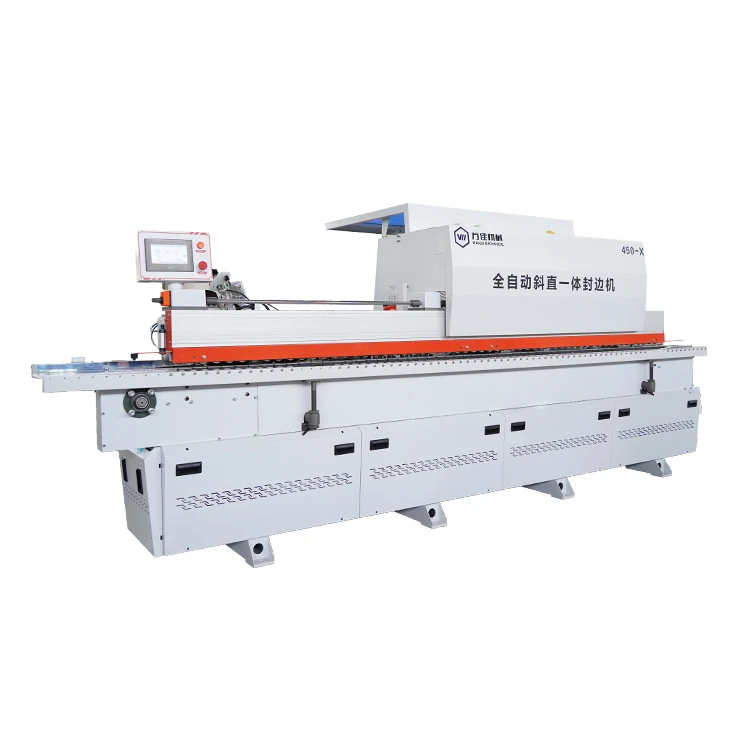
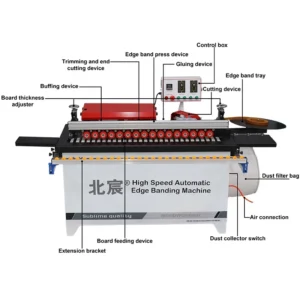
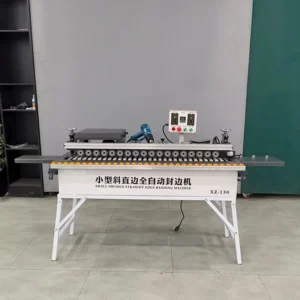
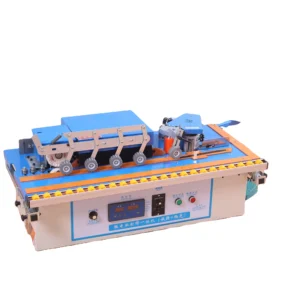
Verified Tolerance Claims — every motor rating and feed speed parameter is listed station by station, so you can match the numbers to your production line before issuing a purchase order.
Technical Specifications
| Parameter |
Value |
| Product Type |
Automatic Edge Banding Machine |
| Overall Dimensions (L×W×H) |
435 × 92 × 165 cm |
| Total Installed Power |
17.5 kW |
| Voltage & Frequency |
380V / three-phase five-wire / 50Hz |
| Conveying Motor |
380V 2.2 kW (with frequency converter) |
| Feed Speed Range |
0–12 m/min (variable, inclined straight edge) |
| Edge Banding Thickness Capacity |
Up to 1.2 mm (material dependent) |
| Edge Strip Width Range |
20–50 mm |
| Panel Width Range |
>100 mm |
| Panel Length Range |
>250 mm |
| Panel Thickness Options |
18 / 22 / 25 mm |
| Compatible Banding Material |
PVC |
| Glue Pot Heating Power |
1.2 kW |
| Glue Pot Operating Temperature |
150–170°C |
| Glue Pot Capacity |
2000 ml |
| Heat Gun Power |
2 kW |
| Trimming Motor |
380V 0.75 kW × 2 |
| End Trimming Motor |
380V 0.37 kW × 2 |
| Milling Motor B |
380V 3.5 kW |
| Selection Motor |
380V 4 kW |
| Polishing Motor |
380V 0.37 kW × 2 |
| Edge Motor |
380V 0.18 kW (with inverter) |
| Slotted Motor |
220V 0.8 kW |
| Lifting Motor |
380V 0.25 kW (with inverter) |
| Air Source Pressure |
0.6–0.8 MPa |
| Air Storage Tank Volume |
5 L |
| External Dust Extraction Port |
100 mm diameter |
| Touch Screen |
Xinjie industrial touch screen |
| Inverter |
Xinjie Industrial Inverter |
| Control System |
PLC / Touch Screen |
Application Suitability
| Application |
Material or Output |
| Custom cabinet door edge finishing |
Melamine-faced MDF and particleboard with PVC banding |
| Wardrobe panel processing |
Plywood panels 18–25 mm thick with 0.4–1.2 mm PVC strips |
| Office furniture component banding |
Particleboard shelving and desk panels with straight edges |
| Kitchen cabinet carcass production |
Moisture-resistant MDF with PVC edge protection |
Why Voltage Must Be Confirmed Before the Automatic Edge Banding Machine Specifications Are Finalized
A machine wired for 380V/50Hz that arrives in a 440V/60Hz market is dead weight on the factory floor until a costly rewiring is completed.
Over the years I have watched containers arrive at Latin American furniture plants only for the buyer to discover the electrical configuration does not match the local grid. In Colombia, one workshop lost an entire week of production while sourcing step-down transformers because the Automatic Edge Banding Machine specifications were never cross-checked against their facility supply [NEED_CITE: voltage and frequency standards by export market]. The trimming motors and glue pot heaters are designed for specific voltage inputs; running them outside that range causes premature component failure and inconsistent glue temperatures.

Mapping Motor Ratings to Each Workstation
The trimming stations are powered by independent 0.75 kW motors, which handle the initial flush cut on PVC banding up to 1.2 mm thick. End trimming uses 0.37 kW motors at both head and tail, removing overhanging strip material from panel edges. The 3.5 kW milling motor handles heavier profiling work, while the 0.8 kW slotted motor cuts grooves for downstream joinery operations. This station-by-station power breakdown lets you verify that each stage has sufficient torque for your specific substrate density and banding thickness before the machine enters production.
Feed Speed Control Across Panel Variations
The conveying motor runs through a Xinjie industrial inverter, delivering a continuously variable feed speed from zero to twelve meters per minute. This range matters when a single production run moves between 18 mm particleboard and 25 mm MDF, because thicker and denser panels require slower feed rates to maintain clean trimming without chipping the substrate edge [NEED_CITE: woodworking machinery feed rate guidelines for engineered wood]. The lifting motor also uses an inverter, allowing the pressure beam to adjust smoothly when panel thickness changes mid-batch.
How Glue Pot Parameters Affect PVC Adhesion
The 2000 ml glue pot with a 1.2 kW heating element maintains a working temperature between 150°C and 170°C, which is the adhesion window for standard hot-melt EVA adhesives used with PVC edge banding. The separate 2 kW heat gun pre-heats the panel edge immediately before the banding is applied, improving glue wetting on dense substrates like moisture-resistant MDF. If the pot temperature drops below range — which can happen in a cold workshop or during rapid successive panels — the glue line thickens and becomes visible after trimming.
The Hidden Cost of Mismatched Configuration
I have seen furniture factories buy an entry-level bander for production volumes it was never designed to sustain. The edge strip width range on this machine covers 20 to 50 mm, but if your cabinet doors routinely use wider banding, the trimming knives will not reach the outer edge cleanly [NEED_CITE: edge banding width compatibility with trimming station geometry]. Similarly, panels narrower than 100 mm or shorter than 250 mm fall outside the stated envelope, meaning small drawer components may require a separate manual station. Discovering these limits after installation means either rejecting orders that use those dimensions or running a second machine to cover the gap.
Why Technical Buyers Source This Equipment Here
The manufacturing facility operates a four-stage quality control process covering incoming material inspection, in-process checks, finished product verification, and pre-shipment testing with documented records. Each machine leaves the factory with a test run on the buyer's actual panel material and banding type when samples are provided in advance. Custom configurations are handled as standard practice — voltage is adjustable from 110V to 440V, and control panel language is set to the operator's preference before dispatch. The engineering team provides a formal configuration recommendation with itemized quotation within 24 hours of receiving production requirements.
Documentation & Verification
- CE declaration of conformity covering machinery directive compliance for this machine class
- Electrical schematic confirming voltage, frequency, and wiring configuration for your facility
- Factory test record showing trimming and polishing results on your supplied panel samples
- Machine specification sheet listing every motor rating and dimensional parameter
- Operation and maintenance manual translated into the agreed operator language
Installation, Commissioning & Support
- Foundation must support 435 cm length with level tolerance for the inclined straight-edge conveyor
- Dedicated 380V three-phase circuit rated for 17.5 kW total draw with proper grounding
- Machine ships assembled; confirm doorway and overhead clearance for the 165 cm height
- First-run calibration sets glue pot to 150–170°C and adjusts trimming knives to your PVC thickness
- Dust extraction requires connection to the 100 mm port with a collector rated for the airflow demand
- Spare parts list includes trimming blades, polishing wheels, and glue pot heating elements
What We Need to Configure the Right Machine
Provide your primary panel materials — MDF, particleboard, plywood — along with the thickness range and typical panel dimensions you process daily. Specify your facility voltage and frequency so the electrical system is built correctly before production begins. If you can ship a sample panel with your preferred PVC banding applied, we run a trimming and polishing test so the results are documented before you commit.
Frequently Asked Questions
Q: How do I confirm the panel thickness range and feed speed will handle my daily production mix?
A: Share your typical panel dimensions, substrate types, and PVC banding thickness. The engineering team cross-references these against the stated 18/22/25 mm thickness options and 0–12 m/min variable feed range, then provides a written configuration note. If your panels fall outside these envelopes, an alternative model from the product family is recommended before any order is placed.
Q: What voltage and frequency options exist beyond the standard 380V/50Hz configuration?
A: Voltage is configurable from 110V to 440V to match local grid standards in your market. The electrical schematic is updated to reflect your confirmed supply, and a voltage confirmation document is included with the pre-shipment paperwork. This step is completed during the quotation stage, not after production has started, so there are no surprises at the container inspection.
Q: Can the touch screen interface and manual be delivered in my operator's language?
A: The Xinjie industrial touch screen supports multilingual configuration, and the language is set to your preference during factory assembly. The operation and maintenance manual is translated into the agreed language before shipment, along with a complete spare parts list in the same language so your maintenance team can order replacements independently.
Q: Which trimming and polishing stations come standard, and how do I add more?
A: The standard configuration includes dual trimming motors, end trimming, milling, polishing, and a slotted motor station. If your edge banding material or profile requires additional stations — such as scraping or buffing — these are discussed during the engineer-led configuration review. The formal quotation itemizes every station so you know exactly what is included before signing.
Q: What documentation arrives with the machine at the time of shipment?
A: You receive the CE declaration, ISO 9001 certificate, machine specification sheet, electrical schematic with confirmed voltage, factory test record, operation manual in the agreed language, spare parts list, packing photographs, and customs documentation support. Every document references the specific machine serial number for traceability.