Specification verification before commitment — Every voltage, drill capacity, and footprint figure for the JL-1 is confirmed against your facility requirements before production begins.
Technical Specifications
| Parameter |
Value |
| Model |
JL-1 |
| Product Type |
Single Row Hinge Boring Machine |
| Rated Power |
1.5 kW |
| Voltage & Frequency |
380V/415V three-phase four-wire (frequency 50Hz/60Hz to confirm) |
| Control System |
Foot switch control |
| Large Drill Diameter |
35 mm |
| Small Drill Diameter |
3 mm |
| Drilling Adjustment |
Vertical and horizontal position adjustable |
| Guide Rail |
Precision guide rails for sliding |
| Motor Type |
Pure copper motor |
| Vacuum Power |
External Vacuum |
| Overall Dimensions (L×W×H) |
70×56×145 cm |
| Net Weight |
55 kg |
| Key Features |
Cabinet door hinge hole opening, language options (Chinese/English standard; Spanish and others customizable) |
Application Suitability
| Application |
Material or Output |
| Cabinet door hinge cup drilling |
MDF and particleboard panels |
| Wardrobe hinge hole production |
Melamine-faced chipboard and plywood |
| Custom furniture hinge boring |
Solid wood panels and veneered board |
| Door manufacturing hinge drilling |
MDF, particleboard, and composite panels |
Why the Voltage Question Should Come Before the Price
Confirm your local supply before any Single Row Hinge Boring Machine specifications are finalized.
A hinge boring machine sitting idle for weeks because the voltage mismatch was discovered after customs clearance is a problem I have seen too many times. The JL-1 ships in a 380V/415V three-phase configuration as standard, but the frequency must match your grid. A 50Hz motor running on 60Hz supply shifts the drilling speed, which changes the hole quality on MDF and particleboard. This is the kind of detail that only matters after the machine is on your floor and the operator is waiting [NEED_CITE: voltage and frequency standards by export market].

Drill Configuration That Matches Real Hinge Layouts
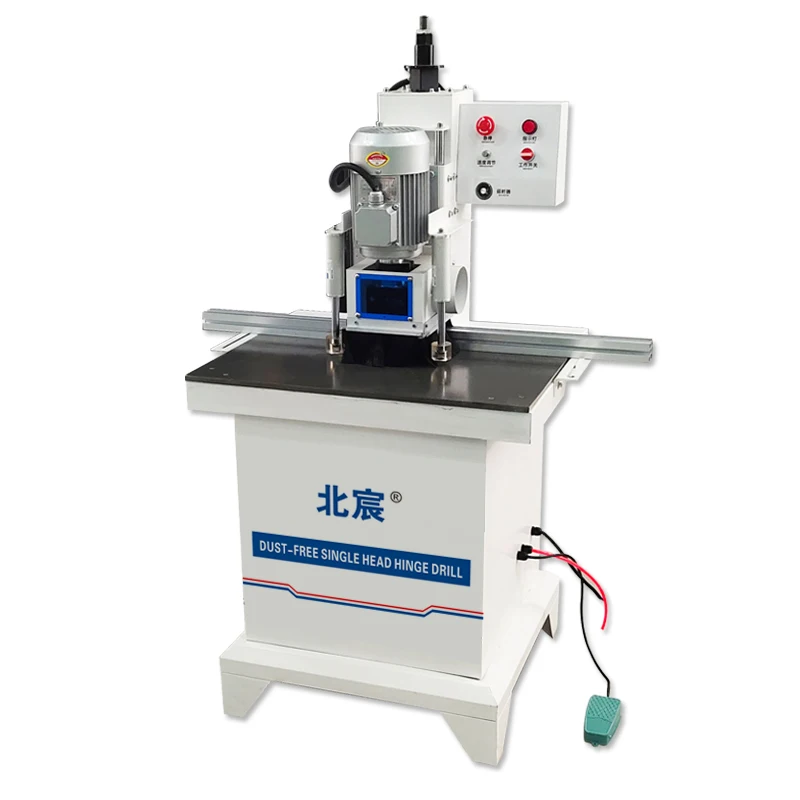
The JL-1 pairs a 35mm large drill with a 3mm small drill in a single row setup. This covers the standard hinge cup bore and the pilot hole for the mounting plate screw in one positioning cycle. Cabinet door production relies on this two-hole pattern repeating across hundreds of panels per shift, and the Single Row Hinge Boring Machine specifications here are built around that exact requirement.
Guide Rail Precision and Repeatability
Drilling position on a hinge boring machine lives or dies by the sliding mechanism. The JL-1 uses precision guide rails rather than simple bushings, which keeps the drill head tracking true as the operator moves it between hole positions. Vertical and horizontal adjustment means you can shift the bore pattern for different hinge brands and door thicknesses without re-fixturing the workpiece. For a workshop running mixed cabinet runs, this flexibility reduces setup time between batches [NEED_CITE: woodworking machinery guide rail tolerance standards].
Reading the Numbers That Matter for Assembly Downstream
The 1.5 kW pure copper motor delivers consistent torque through continuous drilling duty on dense particleboard. Where cheaper aluminum-wound motors lose speed under load and produce torn hole edges in MDF, copper winding holds RPM stable. The 35mm bore depth and clean edge directly affect how the hinge cup seats — a ragged hole means the hinge flange sits proud, and the door will not close flush. External vacuum connection at the drill point pulls chips clear so they do not pack into the bore and affect depth consistency. At 55 kg and a 70×56×145 cm footprint, the JL-1 fits into compact workshops where floor space around the saw and edge bander is already tight.
The Cost of Skipping the Specification Check
When a workshop orders a hinge borer without confirming the drill capacity against their hinge supplier's cup diameter, the machine arrives and the 35mm bit is too small for the hardware they have standardized on. The whole batch of doors has to be reworked by hand or sent back to the saw. Similarly, buying a machine rated only for light duty and running it through eight-hour production shifts wears the guide rails prematurely. The result is bore position drift that only shows up when the assembler tries to hang the door and the hinge screws will not align [NEED_CITE: common hinge boring failures in cabinet assembly].
What This Supplier Brings to a Specification-Driven Purchase
In-house manufacturing means the JL-1 drill head and guide rail assembly are built and tested under one roof, not sourced and assembled from third-party sub-kits. Four-stage quality control covers incoming motor verification, in-process guide rail alignment checks, finished product bore testing, and pre-shipment voltage confirmation. Voltage customization from the standard 380V/415V range to your local supply is handled before the machine leaves the factory. An engineer reviews your panel material and hinge layout before quoting, and a formal specification sheet is issued within 24 hours. Factory visits are welcomed so you can see the JL-1 drill your actual stock before committing.
Documentation & Verification
- Machine specification sheet with drill capacity, motor rating, and footprint confirmed for your workshop
- Electrical schematic and voltage confirmation matching your local three-phase supply
- Factory test record drilling hinge cups on your specified panel thickness range
- Operation and maintenance manual in the agreed language for your operators
- Spare parts list identifying drill bits and guide rail wear components
Installation, Commissioning & Support
- Floor space requirement of 70×56 cm footprint with clearance for panel feeding on both sides
- Dedicated 380V/415V three-phase circuit with isolator switch rated for the 1.5 kW motor load
- Machine arrives fully assembled; bolt to floor and connect external vacuum before first run
- Vertical and horizontal drill position calibration on your actual panel stock during commissioning
- Operator training on foot switch sequence and guide rail locking between drill positions
- Recommended spare drill bit inventory covering both 35mm and 3mm sizes for continuous production
What to Include in Your Inquiry
Share your panel material type and thickness range so we can confirm the drill bit selection and feed approach for your stock. Let us know your local voltage and frequency so the motor and wiring are configured before dispatch. If you run specific hinge brands, send the cup diameter and screw hole pattern so we verify the 35mm and 3mm drill spacing matches your hardware [NEED_CITE: hinge cup diameter standards in cabinet hardware].
Frequently Asked Questions
Q: Can the JL-1 be configured for 220V single-phase or other regional voltage standards?
A: The standard configuration is 380V/415V three-phase. Other voltage and frequency combinations can be arranged during the quotation stage. Confirm your local supply specification early so the motor winding and electrical components are matched before production. This avoids the machine arriving unusable on your shop floor.
Q: What panel thicknesses and materials fall within the JL-1 drilling capability?
A: The JL-1 handles MDF, particleboard, plywood, and solid wood panels used in cabinet and door production. The 1.5 kW motor maintains torque through dense substrates. For unusually thick or abrasive composite boards, share your material data so we can confirm bit selection and feed approach.
Q: What control interface and language options ship with the machine?
A: The JL-1 uses a foot switch for drilling control, keeping the operator's hands free for panel positioning. Chinese and English are standard on any markings. Spanish and other languages are customizable. Confirm your preferred language at the quotation stage so documentation and labels match.
Q: What floor space, power supply, and auxiliary connections does the JL-1 require?
A: The machine footprint is 70×56×145 cm at 55 kg. It needs a dedicated three-phase circuit matching the confirmed voltage, plus an external vacuum connection at the drill head for chip extraction. Allow clearance on both sides for panel handling during operation.
Q: Which components are wear items and what spares should I stock?
A: The 35mm and 3mm drill bits are the primary consumables. Guide rail surfaces require periodic inspection for wear. We provide a spare parts list with the machine identifying all serviceable components and recommended inventory levels for uninterrupted production runs.