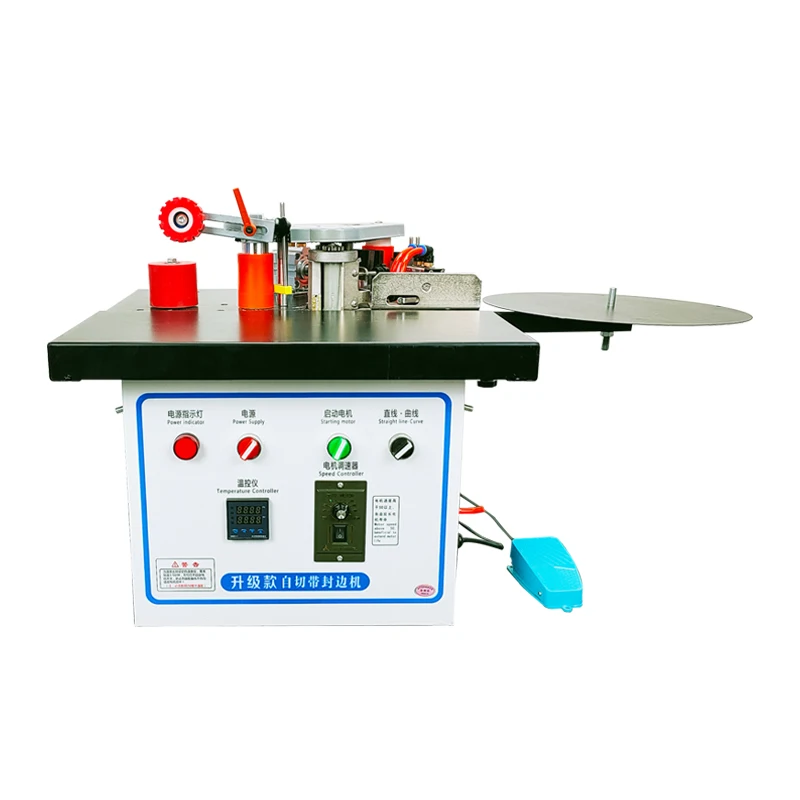
Compact Footprint, Global Voltage — ST-50 Manual Portable Edge Banding Machine specifications confirm a 50×50×47cm benchtop unit with configurable 220V/380V input and four regional plug standards, verified against your local supply before dispatch.
Technical Specifications
| Parameter |
Value |
| Model |
ST-50 |
| Product Type |
Manual Portable Edge Banding Machine |
| Total Power |
1000W |
| Voltage & Frequency |
220V / 380V / customization (frequency to be confirmed) |
| Edge Banding Height |
0–50 mm |
| Edge Banding Thickness |
0.3–3 mm |
| Minimum Sheet Length |
25 cm |
| Minimum Sheet Width |
3 cm |
| Glue Pot Capacity |
1000 ml |
| Air Source Pressure |
0.5–0.8 MPa |
| Edge Trimming Power |
20W |
| Control System |
Manual operation |
| Net Weight |
22 kg |
| Overall Dimensions (L×W×H) |
50×50×47 cm |
| Plug Options |
EU, USA, AU, UK |
| Language Options |
Chinese, English standard; Spanish and others on request |
| Assembly State |
Fully assembled, portable |
| Certification |
CE, ISO 9001 |
Application Suitability
| Application |
Material or Output |
| Small-batch cabinet door edge sealing |
MDF and particleboard with PVC or melamine strip |
| On-site furniture repair and rework |
Plywood and ecological board with veneer or PVC banding |
| Home decoration panel finishing |
Solid wood board and blockboard with wood veneer strip |
| Curved profile edge banding |
Shaped MDF and plywood components for custom joinery |
| Workshop backup edge sealing |
Mixed panel materials during low-volume or prototype runs |
Why the Voltage Question Should Come Before the Price on a Manual Portable Edge Banding Machine
Confirming local voltage and frequency before placing an order prevents a machine from sitting idle on arrival.
Machines quoted without verifying electrical supply conditions show up at workshops only to trip breakers or burn out heating elements within the first hour. A portable edge bander that draws 1000W through a glue pot heater is particularly sensitive to frequency mismatch — a 50Hz motor running on 60Hz supply will overspeed and overheat. [NEED_CITE: voltage and frequency standards by export market]
The ST-50 Manual Portable Edge Banding Machine specifications address this directly: the unit is configurable for 220V or 380V input, ships with one of four plug standards, and the frequency requirement is confirmed during the quotation stage. This step is non-negotiable in the order workflow.

Matching Edge Thickness to Your Panel Substrate
The 0.3–3mm edge banding thickness range on this manual portable edge banding machine covers the three most common banding materials in small workshop production: thin PVC and melamine foil at the lower end, and wood veneer or thicker PVC at the upper end. Each material demands a different glue temperature and feed pressure. PVC typically runs at lower temperatures with moderate pressure, while veneer requires higher heat to penetrate the wood grain. Selecting the wrong combination produces visible glue lines or delamination after a few weeks of use.
Curved and Straight Profiles in One Portable Unit
Workshops that handle both rectangular panels and shaped components — arched cabinet doors, rounded shelf edges, contoured desk fronts — typically need two separate machines. The ST-50 handles both curved and straight edge banding within its 0–50mm height range and 25cm minimum sheet length. The manual feed allows the operator to adjust speed and pressure in real time as the panel curves, which is something automated feed systems struggle with on tight radii. [NEED_CITE: edge banding challenges on curved panel profiles]
How the Core Specs Translate to Workshop Output
The 1000ml glue pot capacity means operators can run extended small batches without stopping to refill — a practical advantage when sealing twenty or thirty cabinet sides in sequence. The 22kg net weight and 50×50×47cm dimensions allow the unit to sit on a standard workbench beside a panel saw, keeping the workflow compact. The 0.5–0.8 MPa air pressure requirement means the unit needs a small compressor, which most joinery workshops already have on hand for nail guns and spray equipment. Edge trimming at 20W handles the flush-cut step after banding application. The manual control system means no PLC calibration is required — the operator sets temperature and feeds the panel by hand, which gives flexibility for one-off repairs but limits throughput compared to automatic models.
The Hidden Cost of Choosing the Wrong Configuration
A workshop that buys a portable edge bander without confirming its primary banding material often discovers the mismatch during the first production run. Veneer strips fed through a machine calibrated for thin PVC will not bond properly, leaving edges that peel under normal humidity changes. Similarly, ordering a unit with the wrong plug standard means waiting for an adapter or rewiring, which delays commissioning. [NEED_CITE: common commissioning delays from specification mismatches] These are not warranty issues — they are selection errors that could have been caught during the quotation stage.
Why Source This Model Through Our Configuration Process
In-house manufacturing with a patented cutting mechanism ensures edge trimming accuracy on the ST-50 without relying on third-party components. The four-stage quality control process — incoming material inspection, in-process checks, finished product testing, and pre-shipment verification — applies to every unit regardless of order size. Voltage, plug type, and language labeling are confirmed as standard options during the formal quotation, not treated as special requests. Engineer-led configuration recommendations arrive within 24 hours of inquiry, including a formal specification sheet matched to your panel material and production volume. Factory visits are available for buyers who want to see the assembly and testing process firsthand.
Documentation & Verification
- CE declaration of conformity covering the ST-50 portable unit
- Machine specification sheet with confirmed voltage and plug type
- Electrical schematic showing wiring for your selected voltage option
- Factory test record using your specified panel thickness and banding material
- Operation and maintenance manual in your operator's language
Installation, Commissioning & Support
- Benchtop placement requires a stable surface supporting the 22kg unit and 50×50cm footprint
- Dedicated 220V or 380V circuit matching the confirmed frequency before first power-on
- Unit arrives fully assembled — no field assembly required, only plug connection
- Initial glue pot temperature calibration matched to your banding material type
- Compressed air connection at 0.5–0.8 MPa from existing workshop compressor
- Spare glue pot seals and trimming blades included for early-stage maintenance
What to Include in Your Inquiry
To match the ST-50 Manual Portable Edge Banding Machine specifications to your workshop, we need your primary panel material and edge banding type, the local voltage and frequency at your facility, and whether your production involves curved profiles or straight panels only. If you plan to run sample tests before committing, send a few panel offcuts and your preferred banding stock so we can verify edge quality on your actual materials.
Frequently Asked Questions
Q: What panel thickness and edge banding materials does the ST-50 handle, and where does it reach its limit?
A: The unit covers edge banding thickness from 0.3mm to 3mm, handling PVC, melamine, and wood veneer strips on MDF, particleboard, plywood, and solid wood. Panels up to 50mm in height are supported. It reaches its limit with thick solid wood edging above 3mm or panels exceeding 50mm height, where an automatic model with higher feed pressure would be required.
Q: How do I confirm the correct voltage, frequency, and plug type for my country before ordering?
A: Provide your local supply voltage and frequency during the inquiry stage. A formal voltage confirmation document is generated before production begins, specifying the exact configuration — 220V or 380V, 50Hz or 60Hz, and your regional plug standard from EU, USA, AU, or UK options.
Q: What is the difference in edge quality between this manual portable unit and a full automatic edge bander?
A: Manual operation allows the operator to adjust feed speed and pressure in real time, which works well for curved profiles and one-off repairs. Automatic edge banders provide consistent feed rates and multiple trimming stations, producing tighter glue lines on high-volume straight runs. The ST-50 suits low-volume and rework tasks where flexibility matters more than throughput.
Q: When should a workshop choose the ST-50 versus stepping up to an entry-level automatic model?
A: The ST-50 fits workshops doing furniture repair, on-site decoration work, or small custom batches where panel sizes vary and curved edges are common. If your daily volume involves hundreds of identical rectangular panels, an entry-level automatic edge bander with powered feed and multi-stage trimming will deliver more consistent output with less operator fatigue.