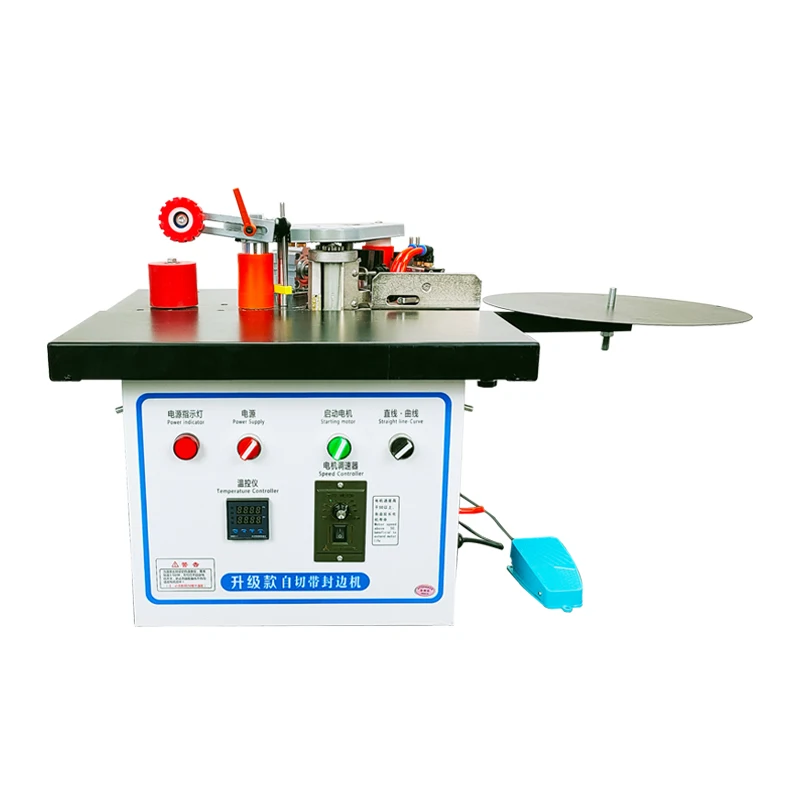
Voltage-Verified Configuration — Every ST-50 Semi-Automatic Edge Bander leaves the factory with confirmed electrical schematics matched to the buyer's local grid, preventing motor burnout and commissioning failures on arrival.
Technical Specifications
| Parameter |
Value |
| Model |
ST-50 |
| Product Type |
Semi-Automatic Edge Bander |
| Total Power |
1000W |
| Voltage Options |
220V / 380V / Customization |
| Plug Options |
EU, USA, AU, UK |
| Edge Banding Height |
0–50 mm |
| Edge Banding Thickness |
0.3–3 mm |
| Minimum Sheet Length |
25 cm |
| Minimum Sheet Width |
3 cm |
| Edge Power |
20W |
| Air Source Pressure |
0.5–0.8 MPa |
| Glue Pot Capacity |
1000 ml |
| Standard Features |
Curved and straight edge banding |
| Control System |
Operation panel in Chinese, English, Spanish, or customized language |
| Product Size |
50 × 50 × 47 cm |
| Product Weight |
22 kg |
| Certification |
CE |
Application Suitability
| Application |
Material or Output |
| Custom cabinet edge sealing |
MDF and particleboard panels with PVC or melamine edging |
| Small-batch furniture repair |
Solid wood board and ecological board with veneer banding |
| Home decoration production |
Plywood panels requiring both curved and straight edge profiles |
| Joinery workshop startup |
Board materials transitioning from manual hand-sealing to machine-assisted banding |
Why Voltage Confirmation Must Precede Every Edge Bander Order
A machine wired for the wrong grid is not a delayed shipment — it is a destroyed motor and a stalled workshop.
I still remember the call from a South American customer who had waited over three weeks for a Semi-Automatic Edge Bander to arrive. The unit was wired for 440V, but the workshop ran on a 220V supply. The moment the operator switched it on, the main motor burned out. The customer lost nearly a month of production before a replacement motor could be sourced and shipped. That incident changed how I approach every single order: before discussing price or lead time, I ask for a photo of the workshop's electrical meter panel. Semi-Automatic Edge Bander specifications mean nothing if the machine cannot be powered on safely when it arrives. Electrical mismatch remains one of the most common and most preventable causes of equipment failure in cross-border machinery trade [NEED_CITE: voltage and frequency standards by export market].
Matching the ST-50 to Workshop Scale and Panel Range
The ST-50 sits at the entry point of mechanized edge sealing, designed for workshops that are moving beyond hand-applied edging but do not yet require a continuous-feed automatic line. Its 0–50 mm edge banding height and 0.3–3 mm thickness range cover the PVC, melamine, and veneer tapes most commonly used in custom cabinet and furniture work. The semi-automatic feed means the operator guides the panel while the machine applies glue, presses the tape, and trims the excess — a practical balance for small batches where panel dimensions vary from piece to piece.
Curved and Straight Profiles Without Reconfiguration
Many small workshops handle both flat cabinet sides and curved decorative panels, yet lack the floor space for two separate machines. The ST-50 handles curved and straight edge banding as a standard feature, not an optional add-on. This eliminates the need to reconfigure or swap tooling between jobs, reducing setup time when switching from a run of rectangular shelving panels to a set of rounded table aprons. For a technical buyer comparing compact models, this dual-capability is a specification worth verifying against the machine's feed mechanism and guide rail geometry before placing an order.
How Key Specifications Translate to Daily Production
The 1000W total power rating places the ST-50 within the range of a standard single-phase workshop circuit, meaning most small facilities can run it without upgrading their electrical infrastructure — provided the voltage and frequency are confirmed in advance. The glue pot holds 1000 ml, which is sufficient for intermittent production runs typical of repair shops and custom furniture makers; larger-volume operations would need to pause for refills more often than a full-production line could tolerate. The minimum sheet dimensions of 25 cm length and 3 cm width define the smallest offcut the machine can reliably grip and feed, a constraint worth checking against any narrow trim pieces in your typical order mix. Air source pressure between 0.5 and 0.8 MPa is required for the pneumatic trimming and pressing functions, so the workshop must have a compressor capable of sustaining that range consistently [NEED_CITE: compressed air requirements for pneumatic edge banding equipment]. The 22 kg weight and compact 50 × 50 × 47 cm footprint allow placement on a sturdy workbench, freeing floor space in workshops where square meters are limited.

The Hidden Cost of Skipping Specification Verification
When a buyer focuses only on the headline price of a compact edge bander and skips the specification confirmation step, the consequences surface after delivery. A control panel printed only in a language the operator cannot read stalls commissioning while the workshop sources a translator or waits for a replacement overlay. A machine quoted without verifying local frequency — 50 Hz versus 60 Hz — may run, but at an altered feed speed that affects glue application consistency and trim accuracy. Panels that fail edge adhesion during assembly trace back not to the operator but to an electrical or pneumatic mismatch that was never caught on paper. These are not rare edge cases; they are recurring patterns in cross-border equipment purchasing [NEED_CITE: common causes of commissioning delays in imported woodworking machinery].
Why Sourcing the ST-50 Through This Channel
Voltage customization from 220V to 380V with region-specific plug configurations (EU, USA, AU, UK) is confirmed in writing before production, not assumed from a catalog default. The multilingual control panel is specified in the purchase agreement — English, Spanish, or a custom language — so the operator interface matches the workshop's working language on day one. The ST-50 sits within a broader product family that ranges from this entry-level semi-automatic model through full-function pre-milling edge banders, meaning a workshop can scale its edge sealing capability over time without switching suppliers. A four-stage quality control process covers incoming material inspection, in-process checks, finished product testing, and pre-shipment verification with photographic records. Engineer-led configuration review ensures the quoted machine matches the buyer's actual panel materials, workshop voltage, and production volume rather than defaulting to a generic catalog build.
Documentation & Verification
- CE declaration of conformity covering the ST-50 Semi-Automatic Edge Bander
- Machine specification sheet confirming voltage, frequency, plug type, and edge banding range
- Electrical schematic showing internal wiring matched to the confirmed voltage configuration
- Factory test record with photographs from pre-shipment edge banding trials on your specified panel material
- Operation and maintenance manual produced in the agreed control panel language
- Spare parts list with part numbers for glue pot, trimming blades, and feed rollers
Installation, Commissioning & Support
- Requires a dedicated circuit matching the confirmed voltage (220V or 380V) with appropriate breaker rating for 1000W total draw
- Compressed air supply must sustain 0.5–0.8 MPa at the machine inlet for reliable pneumatic trimming
- Compact 50 × 50 × 47 cm footprint fits on a standard workbench; ensure a level, vibration-dampened surface
- First-run commissioning includes glue temperature calibration for the specific PVC, melamine, or veneer tape in use
- Operator training covers curved and straight edge banding feed technique and glue pot refill intervals
- Spare trimming blades and glue pot seals included in the initial shipment for early maintenance cycles
Preparing Your Inquiry
To receive an accurate configuration proposal for the ST-50, provide your workshop's confirmed voltage and frequency — a photo of the electrical panel is the most reliable method. Specify the panel materials you work with most often (MDF, particleboard, plywood, solid wood) and the edge banding types and thicknesses you use. If your operators require a control panel in a specific language beyond English or Spanish, state this in your initial inquiry so it is locked into the build order before production begins.
Frequently Asked Questions
Q: How do I confirm the correct voltage and frequency for my workshop before ordering the ST-50?
A: Send a clear photograph of your workshop's electrical meter panel and main breaker label. This allows the engineering team to verify supply voltage, phase configuration, and frequency before the machine is wired. The ST-50 supports 220V and 380V configurations with EU, USA, AU, or UK plug options, and the confirmed specification is documented in the electrical schematic provided before shipment.
Q: What panel materials and edge banding types work within the 0.3–3 mm thickness and 0–50 mm height range?
A: The ST-50 handles MDF, particleboard, solid wood board, ecological board, and plywood. Compatible edge banding materials include PVC, melamine, and veneer tapes within the 0.3–3 mm thickness range. Panels must meet the minimum dimensions of 25 cm length and 3 cm width for the feed mechanism to grip and guide the workpiece reliably through the banding cycle.
Q: How do I verify edge banding accuracy when the specification sheet alone is not enough?
A: Request the factory test record, which documents pre-shipment edge banding trials run on your specified panel material and edge tape type. The record includes photographs of the finished edge, glue adhesion results, and trim quality. This verification step ensures the ST-50 performs to expectation on your actual materials, not just under generic test conditions.
Q: Can the control panel be configured in my local language, and how is this confirmed before shipment?
A: Yes. The ST-50 operation panel is available in Chinese, English, Spanish, or a customized language. Specify your required language in the purchase agreement, and the confirmed language configuration is documented in the machine specification sheet and verified during the pre-shipment quality control inspection before the machine is packed.
Q: What documentation ships with the ST-50?
A: Each machine is accompanied by a CE declaration of conformity, a detailed specification sheet, an electrical schematic matched to your confirmed voltage, a factory test record with pre-shipment verification photographs, an operation and maintenance manual in your agreed language, and a spare parts list with numbered components for reorder reference.