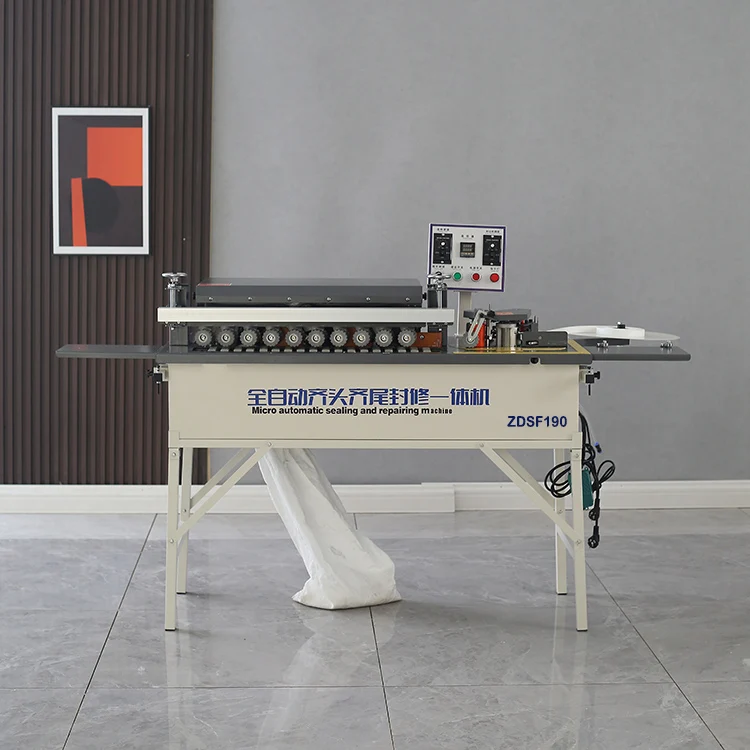
Verifiable specifications at every station — the ZDSF190 exposes trimming wattage, feed speed and air pressure so you can cross-check them against your workshop requirements before ordering.
Technical Specifications
| Parameter |
Value |
| Model |
ZDSF190 |
| Product Type |
Automatic Curved and Straight Edge Banding Machine |
| Voltage & Frequency |
220V / 50Hz (configurable from 110V to 440V) |
| Rated Power |
4 kW |
| Trimming Power |
800 W × 2 |
| Polishing Power |
180 W × 2 |
| Heating Power |
800 W |
| Suction Power |
1200 W |
| Transmission Power |
120 W |
| Belt Power |
25 W |
| Conveyor Belt Speed |
0–14 m/min |
| Sheet Thickness Range |
10–50 mm |
| Strip Thickness Range |
0.5–2.5 mm |
| Glue Capacity |
1000 ml |
| Rated Air Pressure |
0.4–0.6 MPa |
| Overall Dimensions (L×W×H) |
1900 × 560 × 1300 mm |
| Net Weight |
120 kg |
| Key Features |
Dual-purpose 180° rotation for curved/straight edges, double-sided gluing, 4-edge arc-shaped alloy trimming cutter, pneumatically controlled strip cutting, multi-function button control panel |
Application Suitability
| Application |
Material or Output |
| Cabinet side panels with PVC edge banding |
MDF, particleboard, plywood |
| Curved feature panels for custom furniture |
Solid wood panels with veneer banding |
| Mixed-batch workshops processing varying thicknesses |
Boards from 10 mm to 50 mm with 0.5–2.5 mm strips |
| Joinery shops transitioning from manual edge banding |
Small-to-medium production runs of straight and curved components |
Why "Comparable Feed Speed" Means Nothing Without Trimming Power Context
Spec sheets quote feed speed without pairing it to the motor that actually finishes the edge — and that gap is where assembly failures begin.
I have walked into workshops running ZDSF190-class edge banding machines where the feed ran fine but the trimming station could not keep up on 2.5 mm PVC, leaving a ridge that only showed up when the cabinet was squared during assembly. The edge banding machine specifications ZDSF190 addresses this by listing trimming power at 800 W per station alongside the 0–14 m/min feed range, so you can judge whether both ends of the process are balanced for your material mix [NEED_CITE: relationship between trimming motor wattage and PVC edge finish quality].

How to Choose a Curved and Straight Bander Without Guessing
A dual-purpose machine is only as useful as its switching mechanism. The ZDSF190 rotates 180° between curved and straight configurations, and the edge banding machine specifications ZDSF190 sheet lists both modes under one feed speed envelope. This means you do not recalibrate from scratch when moving between a straight cabinet carcase and a curved reception desk panel — you reposition the workpiece and adjust the pressure beam.
What Double-Sided Gluing Actually Changes on Thin Strips
When you run 0.5 mm veneer banding, glue applied only to the panel edge tends to starve at the leading and trailing ends. The ZDSF190 applies adhesive to both the panel edge and the strip back through its 1000 ml glue pot, which matters most on shorter runs where the pot does not stay at a stable temperature between passes. The heating element at 800 W brings the adhesive to working viscosity without overshooting, which is where most small-shop glue-line failures originate [NEED_CITE: adhesive viscosity and edge bonding failure modes on thin veneer strips].
Reading the Specs That Actually Determine Edge Quality
The 4-edge arc-shaped alloy trimming cutter is specified because it produces a consistent radius on both straight and curved profiles without a tool change between shapes. On the ZDSF190, feed speed reaches 14 m/min, but the practical upper limit depends on your strip thickness — running 2.5 mm PVC at maximum speed demands both trimming motors at full 800 W output, and the 0.4–0.6 MPa air supply must remain stable to hold the pneumatic strip cutter timing. Sheet thickness range spans 10–50 mm, which the adjustable aluminum alloy pressure beam accommodates without swapping out feed wheels. The double-row rubber pressure wheels on steel rod slide rails keep the panel tracking true across that range, and the large-diameter surrounding vacuum captures trimmings at the source rather than letting them recirculate into the glue roller.
What Happens When Voltage Is an Afterthought
I once visited a cabinet shop where a newly delivered edge bander sat idle for weeks because the control transformer was wired for 380V three-phase, but the shop only had 220V single-phase available. The ZDSF190 is listed at 220V / 50Hz, and the manufacturer confirms voltage configuration from 110V to 440V is available — but that configuration must happen before the machine leaves the factory floor, not after it arrives at your dock. A mismatched frequency is even harder to catch; a 60Hz supply on a 50Hz-rated motor does not trip a breaker immediately but shortens bearing life through sustained over-speed operation [NEED_CITE: voltage and frequency standards by export market].
Why Procurement Should Start With Documentation, Not a Quote
The ZDSF190 ships from a facility that runs four-stage quality control and holds ISO 9001 certification. What separates a reliable order from a problematic one is whether you received the electrical schematic with your exact voltage confirmed in writing before production started. The manufacturer provides the specification sheet, factory test record and operation manual in your agreed language — but only if you request them explicitly during the configuration stage rather than assuming they arrive automatically with the crate.
Documentation & Verification
- CE declaration of conformity matched to the ZDSF190 dual-purpose configuration
- Factory test record run on your specified sheet thickness and strip material before dispatch
- Electrical schematic confirming your voltage and frequency, signed off before production
- Operation and maintenance manual written in the language your operators actually read
- Spare parts list with trimming cutter and pressure wheel part numbers for local sourcing
Installation, Commissioning & Support
- Allow floor space for the 1900 × 560 mm footprint plus operator clearance on both sides for the 180° rotation
- Confirm a dedicated 220V circuit rated above 4 kW to prevent voltage drop during heating cycles
- Machine ships at 120 kg net weight; verify forklift access for placement on your shop floor
- First commissioning includes setting the 0.4–0.6 MPa air supply and verifying pneumatic strip cutter timing
- Multi-function button panel configured to your agreed language before operator training begins
- Trimming cutter replacement cycle depends on your PVC and veneer strip volume; confirm spare stock at order
Before You Request a Quote, Prepare These Details
Send your typical sheet material, thickness range, and strip type so the configuration matches your daily mix rather than a generic setup. Confirm your local voltage and frequency, your preferred control panel language, and whether you need a sample processing test on your own panel stock before committing to the order.
Frequently Asked Questions
Q: How do I confirm the ZDSF190 feed speed and trimming power match my daily panel throughput?
A: Start with your average daily edge meters and the strip materials you run most often. The 0–14 m/min feed range paired with 800 W trimming motors handles PVC and veneer up to 2.5 mm, but sustained throughput at maximum speed depends on your air supply stability and glue pot recovery time between panels.
Q: What voltage options are available and how is frequency compatibility verified before shipment?
A: The ZDSF190 is configurable from 110V to 440V. Frequency matching is confirmed through the electrical schematic and voltage confirmation document, which you should review and sign before the machine enters production. Running a 50Hz motor on 60Hz supply causes hidden bearing wear.
Q: How do I select between curved and straight mode for different panel geometries?
A: The machine rotates 180° to switch configurations. Straight mode suits cabinet sides and shelving, while curved mode handles reception desks and rounded furniture components. The same 4-edge trimming cutter serves both profiles without a tool change.
Q: What sheet and strip thickness ranges does the ZDSF190 accept, and how is setup handled?
A: Sheet thickness spans 10–50 mm, adjusted via the aluminum alloy pressure beam. Strip thickness covers 0.5–2.5 mm. Setup between different materials involves adjusting the glue roller volume and verifying the pneumatic cutter timing against the new strip thickness.
Q: What documentation is included with the ZDSF190, and in which language?
A: You receive the machine specification sheet, electrical schematic with voltage confirmation, factory test record, operation and maintenance manual, and spare parts list. Specify your preferred language during the quotation stage so all documents arrive matching your operator team.