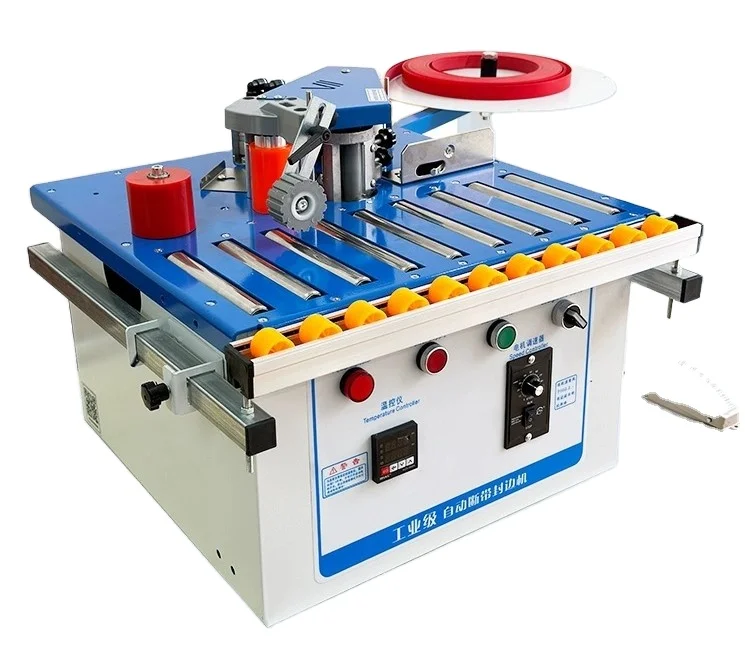
Compact Footprint — the ZDSF50 packs straight, curved, and shaped edge banding into a 54 × 54 × 56 cm, 220 V single-phase frame sized for benchtops and jobsites.
Technical Specifications
| Parameter |
Value |
| Model |
ZDSF50 |
| Product Type |
Mini Portable Edge Banding Machine |
| Rated Voltage |
220V |
| Rated Power |
1.2 kW |
| Function |
Double side gluing for Straight & Curved & Shaped Edge |
| Rated Air Pressure |
0.4–0.6 MPa |
| Strip Thickness Range |
0.5–1.5 mm |
| Sheet Thickness Range |
10–60 mm |
| Glue Pot Capacity |
1000 ml |
| Glue Pot Heating Elements |
4 heating tubes |
| Heating Time |
5–10 min |
| Feed Speed |
0–6 m/min |
| Overall Dimensions (L×W×H) |
54 × 54 × 56 cm |
| Net Weight |
26 kg |
| Belt Breaking Device |
Pneumatically controlled with foot switch and travel switch |
| Pressure Rollers |
Adjustable rubber rollers |
| Edge Strip Transport |
Adjustable bayonet to edge strip height |
| Glue Application |
Double-sided glue-coated rollers |
Application Suitability
| Application |
Material or Output |
| Custom cabinet door edge finishing |
MDF and plywood with PVC or veneer strips on straight profiles |
| Curved panel edge banding for furniture |
Particleboard and MDF with thin PVC strips on shaped contours |
| Onsite carpentry and fit-out jobs |
Solid wood panels and plywood with veneer or PVC banding |
| Small workshop prototype runs |
Mixed substrates including MDF, plywood, and particleboard |
| Repair and rework of pre-assembled panels |
Straight and curved edges requiring portable glue application |
What the Glue Pot Temperature Leaves Unsaid When You Switch Strip Materials
A 1000 ml glue pot with four heating tubes reaches working temperature quickly on thin PVC, but thicker veneer strips demand sustained thermal recovery that small pots struggle to maintain across a long run.
In my years debugging edge banding results across the Pearl River Delta workshops, the most common failure pattern was not the machine itself — it was the assumption that a test run on 0.5 mm PVC represented what would happen with 1.5 mm solid wood veneer. The glue cools faster than the pot reheats, bonding strength drops, and entire batches of door panels delaminate during assembly. The ZDSF50 mini edge banding machine specifications address this with a four-tube heating arrangement, but matching the strip material to the pot's thermal recovery rate remains the buyer's responsibility [NEED_CITE: thermal recovery requirements for veneer vs PVC edge banding].

Matching Feed Speed to Your Actual Panel Mix
The ZDSF50 mini edge banding machine specifications list a feed speed range of 0–6 m/min, which covers the typical pace for small-batch custom furniture work. Slower feed rates allow the double-sided glue-coated rollers to lay down a more consistent adhesive film, particularly important when working with curved or shaped edges where the strip must conform under pressure. Running at the upper end of that range is viable for straight-line PVC work on particleboard, but shaped contours in MDF demand a slower, controlled feed to let the adjustable rubber pressure rollers maintain contact.
Pneumatic Belt Breaking and Workflow Separation
Straight-line and curved-edge banding require fundamentally different breaking strategies. The ZDSF50 addresses this with a pneumatically controlled belt-breaking device that uses a foot switch for curved profiles and an automatic travel switch for straight runs. This separation matters because manual breaking on curved edges often leaves uneven overhang that downstream trimming stations cannot clean up. Having the operator's foot control the break point on shaped work keeps both hands free to guide the panel through the adjustable bayonet strip transport [NEED_CITE: edge banding break methods for curved profiles].
Reading the Specs That Actually Determine Edge Quality
The 10–60 mm sheet thickness range and 0.5–1.5 mm strip thickness range define the working envelope, but the interaction between these two ranges is where edge quality lives or dies. A 60 mm solid wood panel carrying 1.5 mm veneer requires the adjustable pressure rollers to exert consistent force across a thick, heavy substrate — something that tests the limits of a 26 kg portable frame if the operator does not support the panel weight independently. The glue pot's 5–10 minute heating time with four tubes is adequate for intermittent runs, but continuous production across dozens of panels will cause the 1000 ml capacity to deplete and require refill pauses that interrupt thermal stability. The 0.4–0.6 MPa air pressure requirement for the pneumatic belt-breaking device means you need a compressor on site, which is not always obvious when evaluating a machine that looks self-contained.
The Hidden Cost of Underspecifying Your Edge Strip Range
Buying a portable edge bander based on a successful test with thin PVC, then discovering the glue pot cannot sustain temperature for thicker veneer strips, is one of the most expensive mistakes in small workshop procurement. The panels pass initial inspection, but within days the edges begin lifting under humidity changes or mechanical stress. Rework costs in a custom furniture environment often exceed the original panel material cost because the assembled carcass must be partially disassembled to re-band [NEED_CITE: edge delamination failure patterns in custom cabinet assembly].
Why Procurement Through This Channel Reduces Specification Risk
In-house manufacturing with patented cutting mechanisms means the ZDSF50 is built under controlled tolerance verification rather than assembled from generic subassemblies. Voltage and language customization is offered as a standard configuration step, so a 220V machine ships confirmed for the destination market's frequency rather than assumed compatible. A four-stage QC process with pre-shipment verification catches glue pot heating element failures and pressure roller alignment issues before the crate closes. Engineer-led configuration recommendations within 24 hours of inquiry mean the strip material and panel thickness you specify are matched against the machine's actual thermal and mechanical capacity, not just its catalog range.
Documentation & Verification
- Machine specification sheet confirming ZDSF50 voltage, power, and air pressure ratings
- Electrical schematic with voltage and frequency confirmation for destination market
- Factory test record on your specific panel thickness and strip material combination
- Operation and maintenance manual in the agreed operator language
- CE declaration of conformity and ISO 9001 certificate scope verification
- Spare parts list covering heating tubes, pressure rollers, and glue-coated rollers
Installation, Commissioning & Support
- Requires a stable benchtop or workbench surface rated for at least 30 kg to accommodate the 26 kg unit with panel overhang
- Dedicated 220V circuit with appropriate breaker sizing for the 1.2 kW rated power draw
- Arrives fully assembled; only pneumatic hose connection to a 0.4–0.6 MPa compressor required
- First-run calibration of adjustable pressure rollers and bayonet strip transport height against your actual sheet thickness
- Operator training on foot switch technique for curved edges versus automatic travel switch for straight runs
- Replacement heating tubes and glue-coated rollers stocked as standard consumable spare parts
Before You Request a Quote
Share the specific edge strip material and thickness you plan to run most often, along with the panel substrate and thickness range that represents your typical daily mix. Confirm your workshop's voltage and frequency supply so the electrical configuration can be locked in before production. If you are evaluating this unit as part of a larger line, specify which trimming and finishing stations you already have so compatibility can be verified.
Frequently Asked Questions
Q: How do I verify edge banding quality on my substrate before committing to an order?
A: Request a factory test record where the ZDSF50 runs your exact panel material and edge strip combination. The test should cover both straight and curved profiles, with photographs of the glue line and edge finish. This confirms whether the 1000 ml glue pot maintains adequate thermal recovery for your specific strip thickness.
Q: Is the 220V rating confirmed for my local supply, and can voltage be adjusted?
A: The ZDSF50 ships configured for the destination market's voltage and frequency, confirmed through an electrical schematic before production. Voltage customization across the 110V to 440V range is available as a standard configuration option, so the machine arrives ready for your local supply without requiring external transformers.
Q: How does the feed speed and glue pot capacity match small-batch production volumes?
A: The 0–6 m/min feed speed suits intermittent custom furniture runs rather than continuous high-volume output. The 1000 ml glue pot with four heating tubes handles small batches with pause-and-resume cycles comfortably, but sustained production across many panels will require scheduled refill breaks to maintain consistent glue temperature and film thickness.
Q: What operator documentation and control panel languages are available?
A: The operation and maintenance manual is provided in the language you specify during the order confirmation stage. Control interfaces on the ZDSF50 are straightforward given its manual-feed design, but multilingual labeling and documentation ensure the operator can reference heating time, air pressure, and strip adjustment procedures without ambiguity.
Q: Which downstream stations complete the edge processing workflow after the ZDSF50?
A: The ZDSF50 applies and bonds the edge strip but does not include trimming or buffing stations. Pair it with a manual or semi-automatic end trimmer and a flush trim router to complete the edge. For shaped and curved profiles, a hand-held trimming tool guided along the contour typically follows the banding pass.