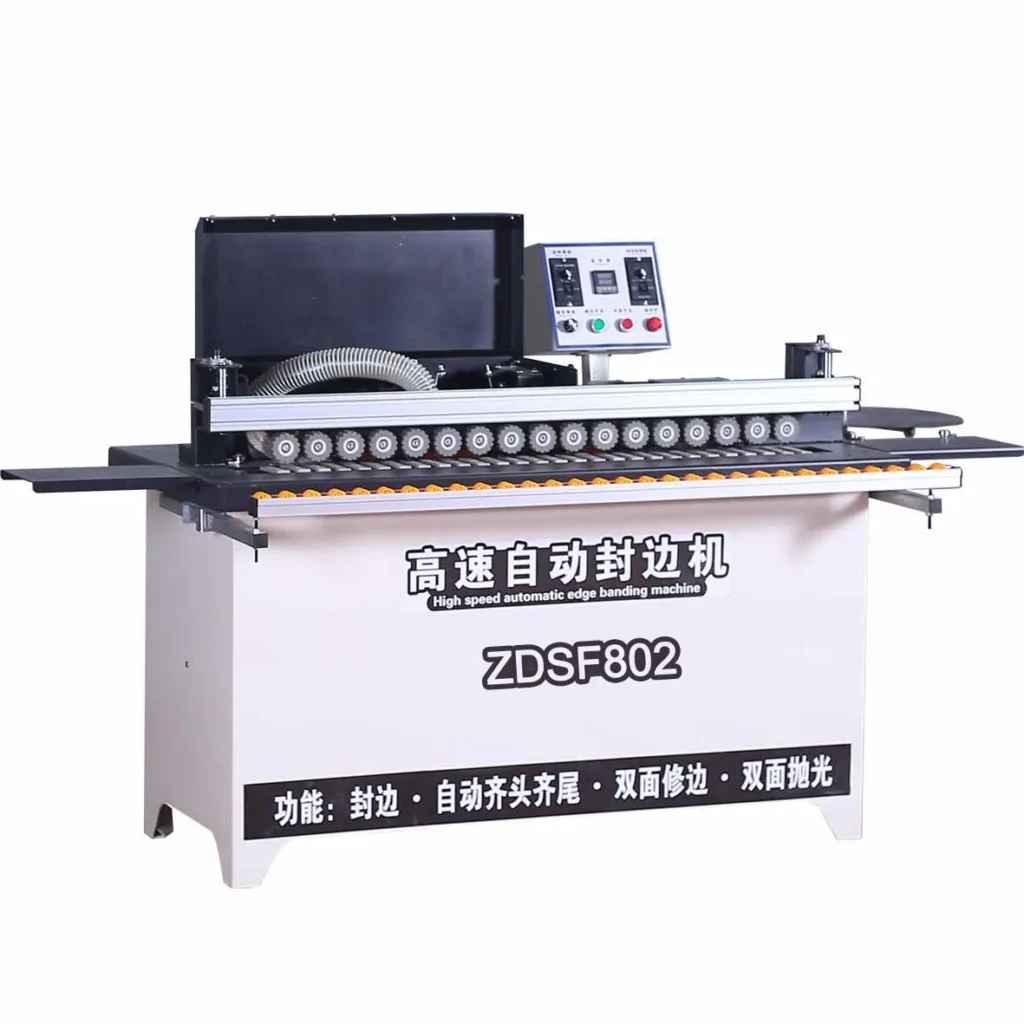
Power Distribution Mapped to Process — Dual 800W trimming motors paired with 180W polishing units on the ZDSF802 ensure each station receives dedicated output, eliminating the compromise common in shared-drive edge banders of this footprint.
Technical Specifications
| Parameter |
Value |
| Model |
ZDSF802 |
| Product Type |
Automatic Edge Banding Machine |
| Edge Type |
Straight line |
| Rated Power |
4 kW |
| Trimming Power |
800W × 2 (double high-speed motors) |
| Polishing Power |
180W × 2 |
| Suction Power |
1200W |
| Heating Power |
1000W (heat-up time 5–10 min) |
| Rated Voltage |
220V (frequency and phase to be confirmed) |
| Feed Speed |
0–10 m/min |
| Conveyor Belt Speed |
0–10 m/min |
| Strip Thickness Range |
0.5–2.5 mm |
| Sheet Thickness Range |
10–50 mm |
| Glue Pot Capacity |
4000 ml |
| Rated Air Pressure |
0.4–0.6 MPa |
| Overall Dimensions (L×W×H) |
130 × 65 × 75 cm |
| Machine Weight |
150 kg |
| Pressure Beam |
Integrated, double-row pressure rollers |
| Conveyor Belt Material |
Silicone |
| Belt Breaking Method |
Pneumatically controlled |
| Board Support |
Extendable fluent strips for large panels |
| Control Panel |
Digital display for glue pot temperature, independent switches |
| Dust Collection |
Integrated dust collector |
| Key Features |
Automatic plate feeding, end cutting, upper and lower polishing, head and tail trimming |
Application Suitability
| Application |
Material or Output |
| Custom cabinet door edge banding |
MDF and particleboard with PVC edge banding, 0.5–2.5 mm strip on 10–50 mm panels |
| Wardrobe and shelving panel finishing |
Plywood panels with melamine or veneer edge strips in straight-line runs |
| Small-batch furniture production |
Solid wood panels requiring head and tail trimming with upper and lower polishing |
| Joinery workshop automation transition |
Replacing manual edge application on MDF and particleboard substrates |
| Contract furniture component edging |
Flat panel components for institutional fit-outs using standard PVC strips |
Why Voltage Must Be Confirmed Before You Compare Automatic Edge Banding Machine Specifications
A machine rated at 220V on paper may arrive at a workshop running 415V three-phase — and sit idle until a local electrician sources a compatible transformer.
I once shipped an edge bander to a furniture plant in the Middle East. The purchase order confirmed 380V/50Hz, but the workshop was wired for 415V/60Hz. The motor would not start on arrival, and it took three weeks of sourcing and fitting a variable-frequency drive locally before production resumed [NEED_CITE: voltage and frequency standards by export market]. With the ZDSF802 drawing 4 kW across trimming, polishing, suction, and heating circuits, a voltage mismatch does not just stall one motor — it can prevent the entire control panel from powering up. Every contract I handle now includes a signed voltage and frequency confirmation sheet before the machine leaves the factory floor.

Mapping Power Allocation to Each Machining Station
When evaluating automatic edge banding machine specifications, the total rated power tells only part of the story. The ZDSF802 allocates 800W to each of the two trimming motors and 180W to each polishing motor, with a separate 1000W dedicated to glue pot heating. This independent power routing means that the trimming station can maintain high-speed spindle rotation through dense PVC or thick veneer without voltage sag affecting the polishing output downstream. For a workshop running mixed materials through a single shift, this separation reduces the risk of one station compromising the finish quality of another.
Feed Speed, Air Pressure, and Their Combined Effect on Edge Quality
The 0–10 m/min feed speed range operates within a pneumatic envelope of 0.4–0.6 MPa. At the lower end of the feed range, the double-row pressure rollers maintain consistent strip-to-panel contact on thin MDF sheets as narrow as 10 mm. As feed speed increases toward the upper limit, the pneumatic belt-breaking mechanism and pressure beam must respond proportionally to keep the edge strip seated flush [NEED_CITE: pneumatic pressure requirements for consistent edge adhesion]. If your workshop air supply fluctuates outside this band — common in facilities sharing a single compressor across multiple machines — the trimming and end-cutting stations will produce uneven results regardless of how precisely the feed motor is calibrated.
Interpreting the Numbers That Actually Affect Downstream Assembly
The sheet thickness range of 10–50 mm and strip thickness range of 0.5–2.5 mm define the working envelope of this automatic edge banding machine. Panels outside this envelope — for instance, 8 mm thin stock or 60 mm thick worktops — will either slip under the pressure beam or jam at the feeding station. The 4000 ml glue pot capacity, heated by a dedicated 1000W element with a 5–10 minute warm-up window, supports continuous runs without mid-cycle refills on standard cabinet-depth panels. The extendable fluent strips on the board support side accommodate wider panels, preventing sag that would otherwise shift the edge strip alignment during trimming. Together, these parameters determine whether the finished panel will meet assembly tolerances when it reaches the boring or doweling station next in line.
The Hidden Cost of Ignoring Specification Details at Order Stage
Buyers who skip the electrical schematic review often discover incompatibility only when the machine is bolted to the floor and wired in. A 150 kg unit with a 130 × 65 cm footprint is compact enough for small workshops, but if the available air supply cannot sustain 0.4–0.6 MPa continuously, the pneumatically controlled belt-breaking and end-cutting stations will cycle inconsistently [NEED_CITE: common causes of edge banding machine downtime in small workshops]. Operators then compensate by reducing feed speed, which narrows the productivity gap between this automatic machine and the manual process it was purchased to replace. The machine is not faulty — the specification simply was not matched to the site conditions before shipment.
What Makes This Purchase Decision Defensible on Paper
In-house manufacturing with patented cutting mechanisms means the trimming tolerances stated on the specification sheet originate from the same facility assembling your machine. The four-stage quality control process covers incoming material inspection, in-process checks, finished product verification, and pre-shipment testing — each stage documented before the crate is sealed. Voltage customization from 110V to 440V is available as a configuration option rather than an afterthought, with the electrical schematic reflecting the confirmed supply before production begins. Engineer-led configuration recommendations arrive as a formal quotation, specifying which stations and power allocations suit your panel mix. Factory visits are welcomed so buyers can witness test runs on their own material samples before committing to an order.
Documentation & Verification
- Machine specification sheet listing every station power rating and dimensional parameter for the ZDSF802
- Electrical schematic and voltage confirmation document signed off before production release
- Factory test record showing trimming and polishing results on your specified panel thickness range
- Operation and maintenance manual produced in the language your operators will use on the floor
- CE declaration of conformity and ISO 9001 certificate covering the manufacturing facility
- Spare parts list with part numbers for trimming motors, polishing pads, and conveyor belt segments
Installation, Commissioning & Support
- Requires a dedicated electrical circuit matching the confirmed voltage and frequency for the 4 kW total rated power draw
- Workshop floor must support the 150 kg machine weight across the 130 × 65 cm footprint without vibration transmission
- Compressed air line delivering a stable 0.4–0.6 MPa must be connected before the pneumatically controlled stations are energized
- Glue pot first heat-up requires 5–10 minutes at 1000W before the first panel enters the feed zone
- Digital control panel settings for glue temperature and feed speed should be calibrated during commissioning with actual production material
- Extendable fluent strips must be positioned and locked before processing panels wider than the base conveyor width
Preparing Your Inquiry for an Accurate Configuration
To match the ZDSF802 to your production line, share the panel materials and thicknesses you run most frequently, along with the edge banding strip type and thickness. Confirm your workshop voltage, phase, and frequency so the electrical configuration is locked before manufacturing begins. Let us know the control panel language your operators require and whether you need the machine integrated with upstream cutting or downstream boring equipment already on your floor.
Frequently Asked Questions
Q: How do I confirm whether 220V single-phase or three-phase is required for this automatic edge banding machine?
A: The ZDSF802 is rated at 220V, but the phase and frequency must be matched to your local supply. We provide a voltage confirmation document for your signature before production, and customization from 110V to 440V is available. An electrical schematic is included so your electrician can verify compatibility before the machine ships.
Q: How does the 0–10 m/min feed speed translate into daily panel output?
A: Actual throughput depends on panel length, strip thickness, and operator loading rhythm. Shorter cabinet panels at moderate feed speeds with 0.5–2.5 mm strips allow more pieces per shift than full-length wardrobe sides. We recommend sharing your typical panel dimensions so we can estimate realistic daily volumes together.
Q: Can this machine handle both PVC and veneer edge banding on MDF and plywood?
A: Yes. The ZDSF802 processes PVC and veneer strips in the 0.5–2.5 mm range on MDF, particleboard, plywood, and solid wood panels between 10–50 mm thick. The independent trimming and polishing motors allow adjustment for the different cutting and finishing behavior of each material combination.
Q: What are the installation requirements for the 130 × 65 × 75 cm footprint?
A: The machine weighs 150 kg and requires a level floor, a dedicated power circuit at the confirmed voltage, and a compressed air supply maintaining 0.4–0.6 MPa. The extendable fluent strips need clearance on the infeed side for large panel support, and the integrated dust collector requires connection to your extraction system or a standalone unit.
Q: How does this machine coordinate with upstream saws and downstream boring stations?
A: The 0–10 m/min feed speed should be balanced against the cycle time of your panel saw and the indexing speed of your boring machine. If upstream cutting produces panels faster than the edge bander can process them, a buffer rack between stations prevents bottlenecks. Share your line layout so we can advise on throughput matching.