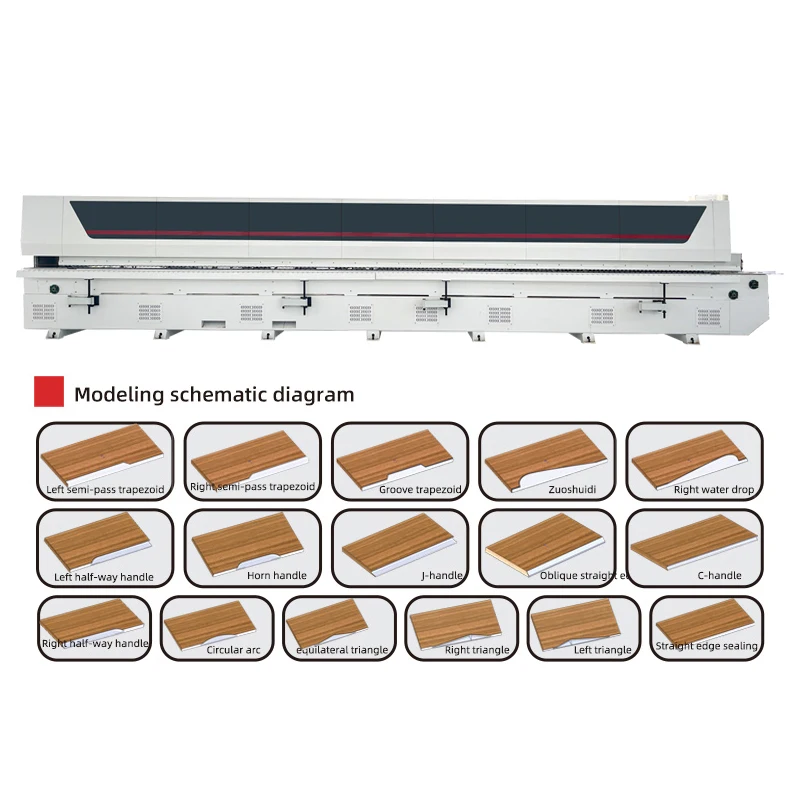
Verified Tolerance on Every Pass — the DW985 Soft Forming Edge Banding Machine runs a patented cutting mechanism held to ±0.02mm, documented in the factory test record you receive before shipment.
Technical Specifications
| Parameter |
Value |
| Model |
DW985 |
| Product Type |
Soft Forming Edge Banding Machine |
| Function Count |
16 Functions |
| Feed Speed |
8–12 m/min (basis not stated in source — confirm board width, thickness and edge material) |
| Semi-J Rough Milling Motor |
5 kW |
| Inclined Straight Edge Pre-milling Motor |
5 kW |
| Semi-J Finish Milling Motor |
6 kW × 2 |
| Milling Servo Drive |
0.75 kW × 3 |
| Slab Chamfering & Edge Banding Breaking Motor |
0.55 kW × 2 |
| Edge Banding & Slotting Motor |
0.3 kW |
| End-to-End Motor |
0.37 kW × 2 |
| Coarse & Fine Finishing Motor |
0.75 kW × 2 |
| Plate Polishing Motor |
0.37 kW × 2 |
| Plate Conveying Motor |
5.5 kW |
| Pressure Beam Lifting Motor |
0.37 kW |
| Voltage |
380V (confirm frequency and phase for your site) |
| Control System |
Touch screen with operation key switches for shape selection |
| Profiling System |
Wheeled profiling design with remote upgrade capability |
| Edge Banding Material |
Veneer (confirm PVC / ABS / melamine compatibility) |
| Language Options |
Chinese, English (customizable to Spanish and other languages) |
| Plug Options |
EU, USA, AU, UK |
| Key Features |
Fully automatic and semi-automatic (handle-free) operation modes; 16 process stations from pre-milling to polishing |
Application Suitability
| Application |
Material or Output |
| Cupboard door edge finishing |
Veneer soft forming on MDF and plywood substrates |
| Custom furniture panel edge banding |
Particleboard and MDF with veneer or compatible edge material |
| Cabinet component profiling |
Shaped panel edges requiring handle-free chamfer and copying chamfer stations |
| Multi-function edge processing cell |
Panels entering pre-milling and exiting polished in a single pass |
Why the Voltage Question Should Come Before the Edge Banding Machine Specifications
Confirm your site voltage and frequency before requesting a quotation — a mismatch renders the entire line inoperable on arrival.
I once watched a workshop uncrate a machine that was wired for a different grid standard, and the electrician spent two days rewiring motors that were never meant for that frequency. Edge banding machine specifications often list 380V as default, but the frequency and phase configuration determine whether the motors run at their rated speed or overheat within the first shift [NEED_CITE: voltage and frequency standards by export market]. When the control panel also arrives in a language the operator cannot read, commissioning stalls entirely while translated overlays are sourced.

Mapping the 16-Station Sequence to Your Edge Quality Requirement
The DW985 runs panels through a defined sequence: linear pre-milling, rough mill, inclined straight pre-milling, finish milling, and then into soft forming, pressing, edge breaking, end-to-end trimming, scraping, chamfering, washing, and polishing. Each station carries its own motor rating, which means a technical buyer can calculate the total connected load and verify that the edge banding machine specifications align with the workshop's electrical capacity. The wheeled profiling system supports remote upgrades, so contour programs can be updated without replacing the physical profiling hardware.
How Soft Forming Changes the Downstream Assembly Tolerance
Soft forming wraps veneer around a profiled edge under heat and pressure, which means the substrate must be pre-milled to a consistent contour before the forming station. The 5 kW inclined straight edge pre-milling motor and the 6 kW × 2 semi-J finish milling motors on the DW985 provide the material removal capacity to hold that contour within tolerance [NEED_CITE: substrate preparation standards for soft forming edge banding]. If the pre-milled profile varies, the heated veneer will not seat uniformly, and the glue line becomes visible after polishing — a defect that only shows up when the panel is held under production lighting.
Reading Motor Ratings Against Panel Thickness and Feed Speed
The relationship between feed speed and motor load is direct: at 12 m/min on a 25mm particleboard panel, the rough milling and finish milling stations must remove more material per minute than at 8 m/min on an 18mm MDF board. The DW985 lists individual motor ratings — 5 kW for rough milling, 6 kW × 2 for finish milling, and 0.75 kW × 3 for servo drives — so you can cross-reference the edge banding machine specifications against the actual substrates and thicknesses your line will process. The 5.5 kW plate conveying motor and 0.37 kW pressure beam lifting motor together define the maximum panel weight the infeed can handle without slippage. A touch screen control with shape-selection key switches lets operators switch between profiles without navigating nested menus, reducing changeover errors during shift transitions.
What Happens When a Single Machine Is Bought Without the Line in Mind
A workshop that purchases one edge bander without confirming how it connects to upstream panel saws and downstream packing stations often discovers the feed height or throughput cadence does not match. The DW985 runs at 8–12 m/min (basis not stated in source — confirm board width, thickness and edge material), and if the upstream CNC panel saw outputs panels faster than this machine can accept them, a bottleneck forms. Alternatively, if the downstream packing line expects a steady panel every few seconds and this machine delivers them in batches, the packing operators stand idle between cycles [NEED_CITE: production line throughput matching for furniture factories]. Matching edge banding machine specifications to the rest of the cell prevents both scenarios.
Why Technical Buyers Source This Configuration Here
The DW985 carries a patented cutting mechanism with tolerance verified to ±0.02mm, and the factory test record documents that tolerance on your specific panel substrate before the machine leaves the facility. Voltage customization from 380V to other standards is configured during production, not adapted on site, which means motors and transformers are matched to your grid from the start. The four-stage quality control process — incoming material, in-process, finished product, and pre-shipment verification — covers each of the 16 stations individually. An engineer-led configuration review ensures the station sequence and motor ratings match your material profile, and the formal quotation arrives within 24 hours of the initial inquiry with confirmed specifications. Factory visits are available so you can witness the machine running your edge material on your panel stock before committing to the order.
Documentation & Verification
- Machine specification sheet listing all 16 station motor ratings and dimensional envelope for the DW985
- Electrical schematic with confirmed voltage, frequency, and phase for your facility's grid
- Factory test record showing ±0.02mm tolerance on your actual panel substrate and edge material
- Operation and maintenance manual delivered in the operator's agreed language, not a generic translation
- Spare parts list covering wear items for soft forming rollers, polishing wheels, and scraping blades across all stations
- CE declaration of conformity and ISO 9001 certificate for the manufacturing facility
Installation, Commissioning & Support
- Verify floor loading capacity for the 4.2 t gross mass and confirm the 950 × 98 × 184 cm footprint clears overhead obstructions
- Provide a dedicated 380V circuit with confirmed frequency and phase matching the DW985 motor specifications
- Confirm infeed and outfeed conveyor heights align with the DW985 pressure beam and plate conveying system
- Commission the touch screen control in the operator's language and calibrate shape-selection key switches to your profiles
- Set feed speed within the 8–12 m/min range based on your substrate thickness and edge material behavior
- Establish a spare parts inventory for soft forming rollers, polishing wheels, and end-to-end cutting blades
Before You Request a Quotation
When specifying the DW985 for your line, include the panel substrates you process, the edge materials you run, and the thickness range you need covered. Confirm your site voltage, frequency, and the control panel language your operators require. If you are integrating this machine into an existing cell, share the upstream panel saw output rate and the downstream station cycle time so the feed speed can be matched accordingly.
Frequently Asked Questions
Q: How do I verify feed speed and tolerance on my specific panel material before ordering?
A: Request a factory test record that documents the DW985 running your actual panel substrate and edge material at the feed speed you intend to use in production. The test should show dimensional measurements taken at the pre-milling, soft forming, and polishing stations, confirming the ±0.02mm tolerance holds on your material, not just on the manufacturer's standard test board.
Q: What happens if my site voltage does not match the default 380V specification?
A: Voltage and frequency must be confirmed before production begins. The DW985 can be configured during manufacturing for your site's specific supply, with motors and transformers selected accordingly. A machine shipped with mismatched voltage will not start, and field rewiring risks motor damage and voids the electrical warranty, so this confirmation is part of the formal quotation process.
Q: Can the touch screen control panel be delivered entirely in a non-Chinese language?
A: Yes. The control panel supports Chinese and English as standard, with customization available for Spanish and other languages. Specify your operator's language during the inquiry stage so the touch screen interface, shape-selection labels, and error messages are all configured before shipment, and the operation manual is provided in the same language.
Q: Which of the 16 stations apply to veneer versus PVC or ABS edge material?
A: The soft forming, pressing, and heating stations are designed for veneer processing, while pre-milling, end-to-end trimming, scraping, and polishing apply across material types. Confirm with the configuration engineer which stations should remain active and which can be bypassed when running PVC or ABS, as the edge banding material listed in the specifications should be verified against your actual production mix.
Q: What is the spare parts lead time for consumables across all 16 stations after commissioning?
A: Request the full spare parts list with the quotation, which identifies wear items for each station including soft forming rollers, polishing wheels, and scraping blades. Lead times for standard consumables are confirmed at the order stage, and maintaining a local inventory of high-wear items prevents unplanned downtime once the machine is in daily production.