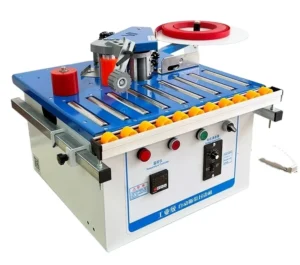
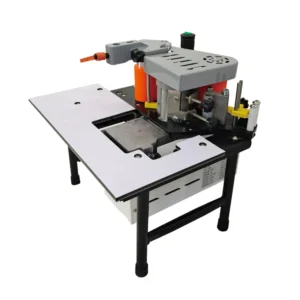
Precision Positioning — the JL-1 hinge boring unit lets technical buyers verify every published parameter against their own panel samples before committing to an order.
Technical Specifications
| Parameter |
Value |
| Model |
JL-1 |
| Product Type |
CNC Wood Boring and Hinge Drilling Machine |
| Total Power |
1.5 kW |
| Voltage & Frequency |
380V / 415V three-phase four-wire, configurable |
| Control System |
PLC (basis not stated in source — confirm PLC brand and model) |
| Large Drill Diameter |
35 mm |
| Small Drill Diameter |
3 mm |
| Operating Mechanism |
Foot switch control |
| Drilling Position Adjustment |
Vertical and horizontal |
| Guide Rail |
Precision guide rails for sliding adjustment |
| Motor Type |
Pure copper motor |
| Vacuum Power |
External vacuum |
| Overall Dimensions (L × W × H) |
70 × 56 × 145 cm |
| Net Weight |
55 kg |
| Assembly State |
Fully assembled at delivery |
| Language Options |
Chinese and English standard; Spanish and other languages customizable |
| Plug Options |
EU, USA, AU, UK |
| Certification |
CE (basis not stated in source — verify certificate availability) |
Application Suitability
| Application |
Material or Output |
| Cabinet door hinge cup boring |
MDF, particleboard, plywood panels |
| Wardrobe and custom panel furniture production |
Laminated and veneered board stock |
| Lock hole drilling for door industry |
Solid wood and composite door blanks |
| Loose leaf and standard hinge fitting |
Melamine-faced and PVC-coated substrates |
Why Voltage Confirmation Must Happen Before the CNC Wood Boring Machine Specifications Review
Every electrical mismatch discovered on arrival traces back to a skipped pre-order voltage check.
I spent weeks on a job in Mexico waiting for a step-down transformer because a hinge drilling unit arrived wired for 380V/50Hz while the workshop ran 220V/60Hz. The motor would not even start. When buyers compare CNC wood boring machine specifications across suppliers, the voltage line often gets less attention than feed speed or drill diameter — yet it determines whether the equipment can power on at all [NEED_CITE: voltage and frequency standards by export market]. A 1.5 kW pure copper motor configured for the wrong three-phase supply will overheat, stall, or fail within the first production shift.
Matching the Boring Head to Your Hinge Format
The JL-1 carries a dual-drill configuration: a 35 mm large drill for standard hinge cups and a 3 mm small drill for pilot holes. This pairing allows an operator to bore both holes in a single setup, reducing repositioning time on cabinet door runs. The precision guide rail system supports vertical and horizontal sliding adjustment, so lateral offset can be dialed in for different hinge brands without swapping tooling.
Foot Switch Operation and Repeatable Cycle Control
A foot switch frees both hands during the boring stroke, which matters when an operator is feeding panels one after another through a batch of identical cabinet doors. The PLC manages the drill cycle sequence, though the specific PLC brand and model should be confirmed against your maintenance team's familiarity. For workshops transitioning from manual hinge fitting, this level of automation shortens the learning curve while maintaining positional consistency across hundreds of repeats [NEED_CITE: CE machinery directive requirements for industrial equipment].
Reading the Numbers That Affect Assembly Downstream
The 70 × 56 × 145 cm footprint means the unit fits into a tight cell beside a panel saw or edge bander without dominating floor space. At 55 kg net weight, it can be repositioned by two workers if the line layout changes. The external vacuum connection requires a separate extraction unit — plan ducting accordingly. Pure copper motor windings run cooler under sustained load than aluminium alternatives, which matters when boring dense particleboard all shift. Voltage configurability across 380V and 415V three-phase four-wire covers most industrial supply standards in Europe, Southeast Asia, and Latin America.

The Hidden Cost of Overlooking Feed and Clamping Compatibility
Buyers who purchase a single hinge borer without confirming panel thickness range often discover that the clamping mechanism leaves crush marks on thin melamine stock or fails to grip 25 mm particleboard firmly enough for clean bore walls. When the drill exits a poorly clamped panel, breakout damage on the reverse face forces rework or scrap. These faults appear only after the machine is installed and running production volumes [NEED_CITE: common assembly failures from bore misalignment].
Why Technical Buyers Source This Range Here
In-house manufacturing with patented cutting mechanisms ensures that claimed tolerances are traceable to the shop floor, not a reseller's brochure. The JL-1 sits within a broader product family of boring and drilling equipment, so a workshop adding multi-spindle capacity later stays with one supplier and one spare-parts channel. Voltage, plug type, and control panel language are configurable as standard — not treated as special requests. A four-stage QC process covers incoming material through pre-shipment verification, and every unit ships with a factory test record on your specified panel thickness.
Documentation & Verification
- Machine specification sheet listing all JL-1 parameters formally documented
- Electrical schematic with voltage confirmation matching your three-phase supply
- Factory test record drilled on your panel thickness range before dispatch
- Operation and maintenance manual in the agreed operator language
- CE declaration of conformity and ISO 9001 certificate for customs clearance
- Spare parts list with drill bit and guide rail wear component references
Installation, Commissioning & Support
- Requires a level concrete floor section within the 70 × 56 cm footprint envelope
- Dedicated three-phase circuit matching confirmed voltage at 380V or 415V
- Arrives fully assembled — position, connect power and external vacuum, then calibrate
- First-run parameter setup covers drill depth, guide rail offset, and cycle timing
- Operator training covers foot switch safety and PLC error code recognition
- Spare drill bits and guide rail lubricant included in the initial parts kit
Preparing Your Inquiry
Share your panel material type, thickness range, and the hinge formats you run most often so the configuration can be matched to your actual work. Confirm your workshop's three-phase voltage and frequency, along with the control panel language your operators need. If you are integrating the JL-1 into an existing line, note the upstream saw and downstream assembly stations so throughput alignment can be reviewed.
Frequently Asked Questions
Q: How do I confirm the correct three-phase voltage for my market?
A: Provide your workshop's supply certificate or a recent utility bill showing voltage and frequency. The JL-1 is configurable across 380V and 415V three-phase four-wire. We cross-reference your supply data against the motor winding specification and issue a voltage confirmation document with the electrical schematic before production begins.
Q: Which hinge formats does the 35 mm and 3 mm drill configuration cover?
A: The 35 mm large drill handles standard European hinge cup bores commonly used in cabinet and wardrobe doors. The 3 mm small drill covers pilot holes for screw mounting. For non-standard hinge diameters or lock bore requirements outside this range, confirm the dimensions with our engineering team to assess tooling compatibility.
Q: Can the control panel language be changed for my operators?
A: Chinese and English are standard. Spanish and other languages are customizable upon request. The agreed language is applied to the PLC interface, the operation manual, and any error code displays. Confirm the required language at the quotation stage so it is programmed before the pre-shipment test.
Q: How do I verify drilling tolerance before the machine ships?
A: Send us samples of your actual panel material in the thickness range you process. We run a boring test on those samples, measure positional accuracy, and include the factory test record with your shipment documentation. This lets you verify tolerance against your assembly requirements before the JL-1 leaves the factory.