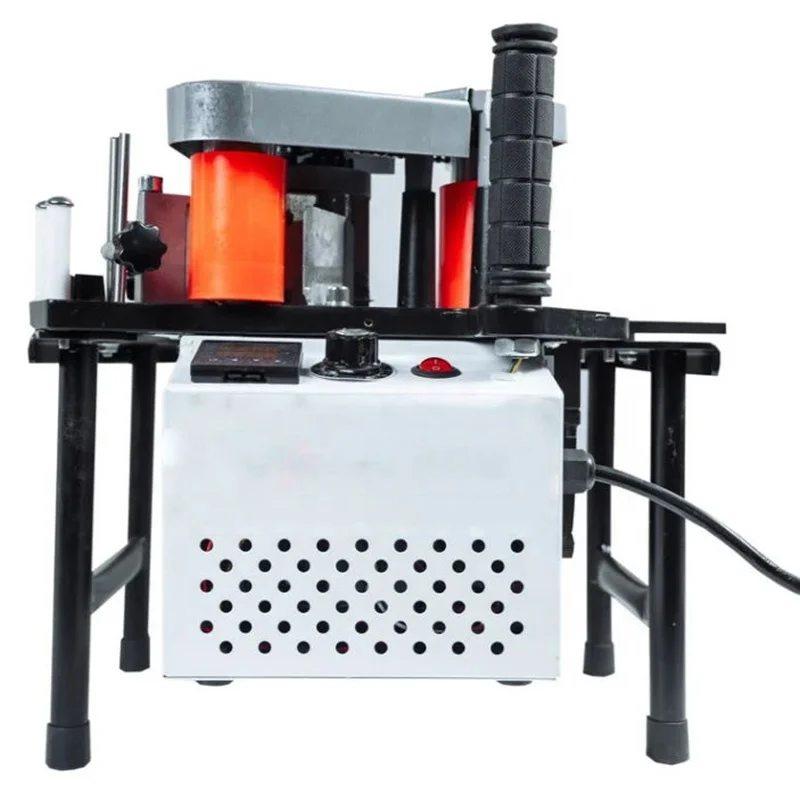
Specification-Led Configuration — A 14 kg portable edge banding machine evaluated against panel thickness, edge material and feed speed to determine whether it fits your workshop or if a full-function automatic unit is warranted.
Technical Specifications
| Parameter |
Value |
| Product Type |
Portable Edge Banding Machine |
| Shape of Edge-banding Plates |
Curved, straight and special-shaped sheet |
| Edge Thickness Range |
0.3–3 mm |
| Edge Sealing Speed |
0–6 m/min (basis not stated in source — confirm panel width, material and edge type) |
| Panel Thickness Range (Sealing Height) |
7–60 mm |
| Gluing Method |
Double-sided gluing |
| Glue Pot Volume |
1000 ml |
| Machine Weight |
14 kg |
| Power Plug Options |
EU / AU / UK / USA / CN |
| Customization |
Logo customization available |
Application Suitability
| Application |
Material or Output |
| Small workshop and on-site joinery edge finishing |
MDF, plywood, particleboard and solid wood panels |
| Curved and special-shaped panel edge banding |
PVC and veneer edge banding materials |
| Supplemental banding for custom furniture and cabinets |
Boards where a full-size automatic edge bander is impractical |
| Prototyping and low-volume production runs |
Mixed panel types with frequent edge profile changes |
Why the Voltage and Frequency Question Should Come Before the Quotation
Confirming the destination voltage and plug type before ordering prevents a portable edge banding machine from arriving unusable on the workshop floor.
I have seen workshops lose weeks of production because a machine was wired for 220V/50Hz and shipped to a region running 110V/60Hz — the motor overheated within the first hour, and the control board failed before anyone could adjust a single parameter. Portable units are especially vulnerable because they move between sites and are often plugged into whatever outlet is nearest, without anyone checking the circuit rating [NEED_CITE: voltage and frequency standards by export market]. The plug shape is only the first layer; the motor winding and frequency tolerance determine whether the glue pot reaches operating temperature and whether the feed motor maintains consistent speed under load.
Mapping Portable Edge Banding Machine Specifications to Workshop Reality
When a technical buyer reviews portable edge banding machine specifications, the panel thickness range and edge thickness envelope define which projects the unit can physically handle. A 7–60 mm panel range covers most furniture-grade board stock, but the real constraint appears when you pair thick particleboard with a 3 mm PVC edge — the double-sided gluing system must apply enough adhesive to both surfaces simultaneously, and the hand-feed speed must remain steady to avoid starved glue joints on the inside radius of a curve.
Feed Speed as a Planning Constraint, Not a Marketing Number
The 0–6 m/min edge sealing speed figure only becomes meaningful when you test it against the panel material and edge banding type you actually run. Rough-surface recycled particleboard absorbs glue faster than smooth MDF, demanding a slower feed to maintain bond strength. Veneer edge banding, being thinner and more heat-sensitive than PVC, may require the lower end of the speed range combined with a carefully managed glue pot temperature to prevent scorching. Without a stated test basis, the speed range should be treated as a mechanical limit rather than a guaranteed production rate [NEED_CITE: edge banding adhesion testing standards for wood-based panels].
Glue Pot Volume and Continuous Run Time
A 1000 ml glue pot determines how long the operator can run before stopping to refill — a practical concern that directly affects throughput on larger jobs. On a curved panel where the operator must guide the workpiece with both hands, a mid-job refill interrupts the rhythm and risks a cold joint where the adhesive temperature drops during the pause. For workshops running batch quantities of shaped panels, the refill interval becomes a scheduling factor, and the pot capacity should be compared against the total linear meters of edge to be banded per shift.

Tolerance Claims and What They Mean on a Portable Unit
Company-level tolerance statements must be verified against the specific portable unit before purchase, because the hand-feed nature of a 14 kg machine introduces variables that a fully automatic line eliminates. Edge overhang, trimming quality and final squareness all depend on operator technique and the condition of the trimming blade. Downstream assembly — particularly cabinet boxes that must meet at 90-degree corners — will reveal any deviation quickly. Request a factory test record that documents the actual edge quality achieved on your specified panel and edge material, rather than relying on a general specification sheet [NEED_CITE: tolerance verification methods for manual edge banding equipment].
The Cost of Skipping the Configuration Step
Ordering a portable unit without matching the glue type to the edge banding material leads to delamination in the field — PVC lifting off melamine-faced chipboard weeks after delivery, discovered only when a customer returns a cabinet door. Similarly, specifying a unit with only one plug type and then using an adapter on site creates a resistance point that can overheat during extended use. These failures are rarely catastrophic; instead, they show up as intermittent quality issues that consume warranty time and erode customer trust.
Why Source This Machine Through Ruiqi Wood Machine
In-house manufacturing with verified tolerance means the portable edge banding machine specifications published here are traceable to the actual unit that ships, not a generic catalog entry. Voltage, plug type and control language are confirmed per order — a 14 kg unit bound for a 60 Hz market receives a motor wound for that frequency, not a 50 Hz motor running hot. The four-stage quality control process includes a pre-shipment test on the buyer's specified panel material and edge thickness, documented in the factory test record. Engineers review the buyer's application before issuing a formal quotation, reducing the chance that a portable unit is sold into a production volume it was never designed to sustain. Factory visits are welcomed for buyers who want to witness the sealing speed test on their own substrate.
Documentation & Verification
- Machine specification sheet confirming panel thickness range 7–60 mm and edge thickness 0.3–3 mm
- Electrical schematic showing motor winding and glue pot heater rated for destination voltage
- Factory test record using buyer-supplied panel material and edge banding type
- Operation and maintenance manual in the agreed language covering glue pot refill and blade replacement
- Spare parts list for glue pot seals, feed rollers and trimming blades
Installation, Commissioning & Support
- Verify workshop circuit rating matches the ordered plug type and motor amperage before unboxing
- Confirm glue pot reaches operating temperature on the correct voltage before first panel run
- Test double-sided gluing on scrap pieces of the actual panel and edge material to dial in feed speed
- Inspect trimming blade alignment on both straight and curved edges during initial setup
- Establish a weekly cleaning schedule for the 1000 ml glue pot to prevent adhesive carbon buildup
Inquiry Checklist Before Quotation
Provide the panel materials you process most frequently — MDF, particleboard, plywood or solid wood — along with the edge banding type (PVC, veneer, ABS, melamine) and typical thickness. Share your destination voltage and frequency so the motor and heater are specified correctly from the start. If your work includes curved or special-shaped panels, note the minimum inside radius so we can confirm the portable unit's capability against your geometry.
Frequently Asked Questions
Q: How do I verify the 0–6 m/min sealing speed against my panel material and edge type?
A: Request a factory test using your exact panel substrate and edge banding material. The test records the feed speed at which the double-sided gluing system achieves full adhesion without starved joints or excess squeeze-out. Rough recycled particleboard typically requires a slower feed than smooth MDF, and the confirmed speed becomes the basis for your production planning rather than the published range.
Q: What voltage and plug configuration will ship, and is the motor rated for my local frequency?
A: The unit is available with EU, AU, UK, USA or CN plugs, and the motor winding is matched to the destination frequency — 50 Hz or 60 Hz — at the time of order. Confirming both voltage and frequency before production ensures the glue pot heater and feed motor operate within their thermal design limits on your workshop circuit.
Q: Can this portable unit hold the same tolerance as a full-function automatic edge bander?
A: A portable 14 kg machine depends partly on operator technique, so tolerance must be verified per unit through a factory test record on your specific panel and edge material. For straight edges on standard panels, the result can approach automatic-machine quality; for high-volume production demanding consistent trimming and squareness across every piece, a full-function pre-milling model is the more appropriate specification.
Q: Which edge banding materials work with the double-sided gluing system?
A: The double-sided gluing method is compatible with PVC and veneer edge banding within the 0.3–3 mm thickness range. ABS and melamine may also be processed, but bond strength varies with surface energy and glue temperature. A sample test on your chosen material confirms adhesion before committing to a production run.
Q: When should a workshop upgrade from this portable model to a full-function edge bander?
A: The threshold appears when daily linear meters of edge exceed what a hand-fed unit can sustain, or when tolerance requirements tighten beyond what operator-guided feeding can maintain. If your panel mix shifts toward high-volume straight edges and downstream assembly demands repeatable squareness on every piece, the specifications of a full-function pre-milling automatic machine become the more suitable match.