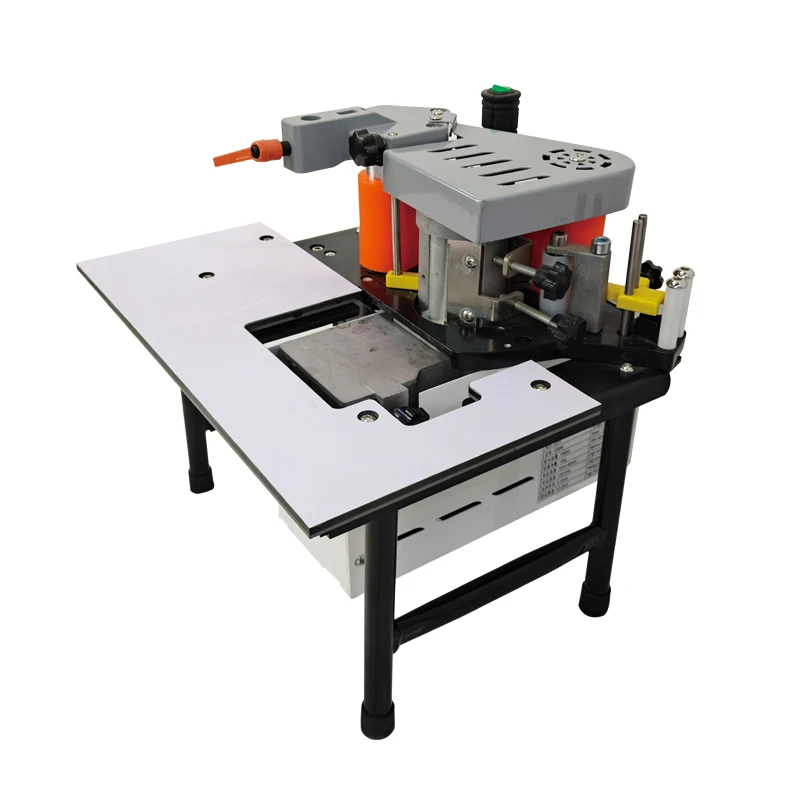
Verified Tolerance Build — every ST-30 leaves the line with a ±0.02mm tolerance claim backed by a factory test record you can inspect before it ships.
Technical Specifications
| Parameter |
Value |
| Model |
ST-30 |
| Product Type |
Portable Edge Banding Machine |
| Total Power |
1000W |
| Voltage |
220V / 380V / customization |
| Edge Type |
Curved and straight edge banding |
| Minimum Length of Sheet |
25 CM |
| Minimum Width of Sheet |
3 CM |
| Edge Banding Height |
0-50 MM |
| Edge Banding Thickness |
0.3-3 MM |
| Edge Power |
20W |
| Air Source Pressure |
0.5-0.8 Mpa |
| Glue Pot Capacity |
1000 ml |
| Product Size |
38 x 35 x 35 CM |
| Product Weight |
12 KG |
| Suitable Edge Banding Tape |
ABS, PVC, Melamine, Veneer |
| Language Options |
Chinese and English standard; other languages customizable |
| Assembly State |
Portable, single-unit |
| Standards |
CE, ISO 9001 |
Application Suitability
| Application |
Material or Output |
| Small workshop edge finishing |
Plywood and MDF panels with PVC or ABS tape on straight and curved profiles |
| On-site interior decoration |
Particleboard shelving and cabinet components with melamine edge banding |
| Furniture factory rework and prototyping |
Solid wood panels and custom short-run pieces with veneer tape |
| Supplementary portable banding unit |
Curved furniture components where stationary machines cannot reach |
Why Voltage Must Be Confirmed Before You Sign the Purchase Order
Machines quoted without verifying local voltage and frequency arrive on site unusable, and the cost of fixing that mistake always falls on you.
I learned this the hard way when a portable edge banding unit I sent to a cabinet shop in Florida was wired for 440V while the workshop only had 220V available at that outlet. The motor burned within minutes of startup, and a replacement transformer took two weeks to air-freight. The installer stood around on the clock the entire time [NEED_CITE: common commissioning failures from voltage mismatch in imported woodworking machinery]. With the ST-30, the Portable Edge Banding Machine specifications call for 220V, 380V, or a custom configuration — but only if someone asks the right questions before the crate is nailed shut. A portable unit that cannot be plugged in is just a heavy paperweight.

Dual Edge Capability in a 12-Kilogram Footprint
Most portable edge banders on the market handle either straight or curved edges, forcing workshops to own two separate units or compromise on one profile. The ST-30 processes both within a single 38 x 35 x 35 CM housing, which matters when floor space is limited or when a job site requires moving the machine between rooms. The 0-50 MM edge banding height range covers standard panel stock from thin shelving material up to thicker worktop substrates without requiring tooling changes mid-job.
Matching Tape Thickness to Your Substrate
The 0.3-3 MM edge banding thickness range lets you run thin melamine tape for cost-sensitive interior carcass work, then switch to heavier PVC or ABS for exposed furniture edges that need impact resistance. Veneer tape falls within this range as well, so a small custom furniture shop can offer a wider material palette without investing in a second Portable Edge Banding Machine specifications sheet. The 1000 ml glue pot holds enough adhesive for sustained short-run production before needing a refill, reducing interruptions during a batch [NEED_CITE: glue pot sizing guidelines for portable edge banding workloads].
Reading the Specs That Actually Affect Your Output
Air source pressure of 0.5-0.8 Mpa is a non-negotiable utility requirement — if your workshop compressor cannot sustain that range, the feed mechanism will stutter and the tape will not seat cleanly against the panel edge. The 20W edge power drives the trimming and finishing functions, which is adequate for the tape thickness range listed but means you should not expect this unit to handle high-volume production runs designed for industrial-grade stationary machines. The minimum sheet dimensions of 25 CM length and 3 CM width define the smallest offcut you can process, which is relevant for prototyping small drawer fronts or custom inlay pieces. Multilingual control panels are available on request, so if your operators read Spanish, Portuguese, or Arabic rather than English or Chinese, that configuration must be locked in during the quotation stage — retrofitting a control panel after assembly is rarely practical.
What Happens When You Skip the Specification Check
Sending a portable edge bander to a market with incompatible electrical standards is the most common and expensive mistake in this equipment class [NEED_CITE: import compliance issues for small woodworking machinery]. Beyond the burned motor, you face customs delays, return shipping costs, and a customer who has already lost confidence before the first panel is edged. Operators who cannot read the control panel language make setup errors that show up as inconsistent glue lines or tape lift after trimming — problems that get blamed on the machine rather than on the ordering process. When tolerance claims cannot be verified against a physical test record, panels fail at the assembly stage and the root cause is traced back to a machine that was never calibrated for the actual substrate being run.
Why Technical Buyers Source This Model Here
The ST-30 is built in a facility with in-house manufacturing and patented cutting mechanisms, meaning the tolerance you see on the spec sheet is something the factory can demonstrate on your material before the order is confirmed. Voltage and language customization are treated as standard configuration steps rather than special requests, so cross-market deployment does not require aftermarket modifications. The four-stage quality control process includes a pre-shipment verification step that catches electrical and mechanical issues before the crate leaves Shandong, which is where most portable unit failures originate. Engineer-led configuration recommendations are provided with a formal quotation within 24 hours, so you are not guessing which options your production environment actually needs.
Documentation & Verification
- CE declaration of conformity covering the ST-30 portable unit classification
- Electrical schematic with your confirmed voltage and frequency printed on the drawing
- Factory test record showing edge banding results on your specified panel thickness
- Operation and maintenance manual supplied in your requested operator language
- Spare parts list with part numbers matched to this specific machine build
Installation, Commissioning & Support
- Requires a dedicated circuit matching confirmed voltage; the 1000W total power draw is modest but must not share a breaker with heavy draw equipment
- Air compressor must deliver stable 0.5-0.8 Mpa; undersized compressors cause feed stutter on curved profiles
- Arrives fully assembled at 12 KG; two people can position it on a standard workbench without hoisting equipment
- First-run calibration includes glue temperature and feed speed adjustment to match your tape material
- Operator training covers tape loading, curved vs. straight edge setup, and trim depth adjustment
- Spare glue pot elements and trimming blades included in initial shipment for early-stage maintenance
What to Include in Your Inquiry
Send us your panel substrate types, the edge tape materials you plan to run, and the voltage and frequency standard at your facility. If your operators require a specific control panel language, state that upfront so it is built into the machine rather than addressed after delivery. Let us know whether this unit will serve as a primary edge bander or a supplementary portable tool alongside a stationary line, so the configuration recommendation matches your actual throughput expectations.
Frequently Asked Questions
Q: How do I confirm the correct voltage and plug type for my country before ordering the ST-30?
A: During the quotation stage, our engineer will request your local voltage, frequency, and plug standard, then confirm these values on the electrical schematic before production begins. The ST-30 supports 220V, 380V, or custom configurations. Do not assume a default setting — always verify in writing before the machine is wired.
Q: What edge banding materials and thicknesses can the ST-30 handle across my panel substrates?
A: The unit processes ABS, PVC, melamine, and veneer tapes in a 0.3-3 MM thickness range with a 0-50 MM edge height capacity. This covers most plywood, MDF, and particleboard applications in small workshop and on-site environments. Confirm your specific tape and substrate combination during inquiry for optimal setup.
Q: How is edge banding tolerance verified, and what documentation ships with the machine?
A: Each ST-30 undergoes a factory test on your specified panel material before dispatch, and the test record is included in the shipment documentation. This record shows measured tolerance results rather than a generic claim, giving you a verifiable baseline for incoming inspection at your facility.
Q: Can the control panel be supplied in a language other than Chinese or English?
A: Yes. Multilingual control panels are available as a configuration option and must be specified before production. Provide the required language during the inquiry stage so the panel is built with the correct interface. Retrofitting after assembly is generally not practical or cost-effective.
Q: What air supply specifications do I need to plan for at my workstation?
A: The ST-30 requires a stable air source between 0.5 and 0.8 Mpa. Your workshop compressor must sustain this pressure continuously during operation, not just at peak output. Undersized compressors cause feed irregularities, particularly on curved edge profiles where consistent pneumatic pressure is critical for tape adhesion.