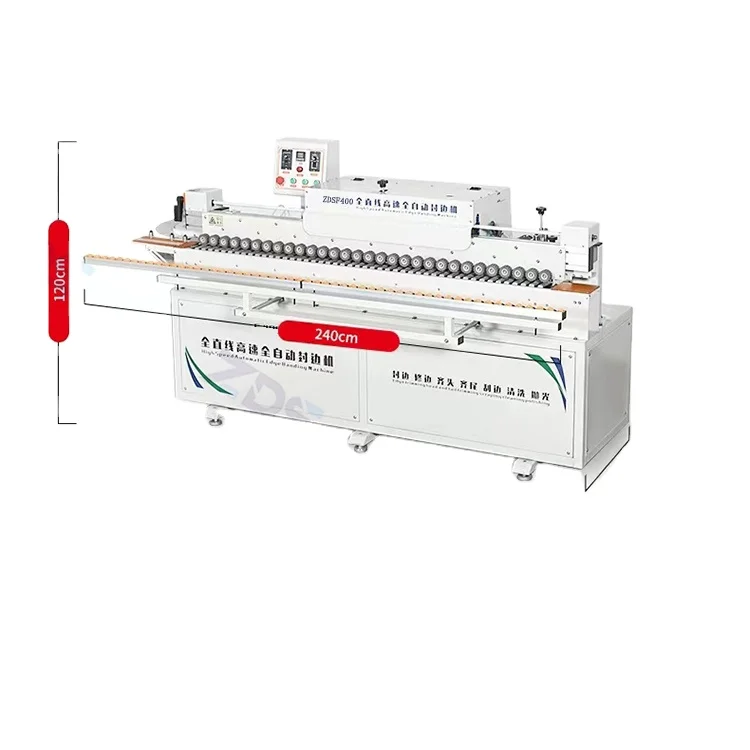
Verified Tolerance Data — the ZDSF400 straight-line edge bander ships with a factory test record documenting actual trimmed samples, not just a brochure claim.
Technical Specifications
| Parameter |
Value |
| Model |
ZDSF400 |
| Product Type |
Automatic Edge Banding Machine |
| Function Sequence |
Gluing, End Cutting, Trimming, Scraping, Polishing, Vacuuming |
| Edge Profile |
Straight Line |
| Rated Voltage |
220V |
| Rated Power |
3 kW |
| Rated Air Pressure |
0.4–0.6 MPa |
| Strip Thickness Range |
1–3 mm |
| Sheet Thickness Range |
10–55 mm |
| Minimum Sheet Width |
≥20 mm |
| Feed Speed |
0–14 m/min |
| Glue Pot Capacity |
1000 ml |
| Heating Power |
800 W (5–10 min heat-up) |
| Trimming Station |
800 W × 2, 24,000 rpm |
| Polishing Station |
180 W × 2, 5,500 rpm |
| Suction Power |
550 W |
| Overall Dimensions |
240 × 70 × 120 cm |
| Machine Weight |
370 kg |
| Warranty |
1 year |
Application Suitability
| Application |
Material or Output |
| Cabinet door edge finishing |
MDF and particleboard with 1–3 mm PVC banding |
| Custom wardrobe panel processing |
Plywood and melamine-faced board with straight edges |
| Small-batch furniture production |
Solid wood panels with veneer edge strips |
| Workshop-scale joinery |
Mixed substrate runs on a single straight-line setup |
Why the Voltage Question Must Come Before the Quote
Specifying voltage after the machine arrives is how entire shipments become unusable.
In my years running after-sales service across Southeast Asia, I once flew to a workshop in Vietnam because a fully automatic edge bander sat idle on the floor — the local grid was three-phase 380V, and the machine had been built for single-phase 220V. Nobody had asked. The ZDSF400 lists 220V in its standard configuration, but many export markets run different frequencies and phase arrangements [NEED_CITE: voltage and frequency standards by export market]. When you evaluate Automatic Edge Banding Machine specifications, the electrical match must be confirmed in writing before production starts, not assumed from a catalog line. A 220V single-phase supply works in some regions but would leave a 380V three-phase workshop unable to power the unit without an external transformer.

Matching Feed Speed to Your Daily Panel Mix
The 0–14 m/min variable feed on the ZDSF400 lets operators dial in speed according to substrate and adhesive behavior. Particleboard with standard PVC banding typically runs smoothly at the upper range, while denser MDF or solid wood panels benefit from a slower pass that gives the glue more open time to bond. When comparing Automatic Edge Banding Machine specifications across suppliers, pay attention to whether the feed range is truly variable or simply a fixed rate listed with a tolerance band.
Trimming RPM and Edge Finish on Mixed Substrates
The dual trimming heads spin at 24,000 rpm driven by 800 W motors each. That speed is necessary to shear PVC and thin veneer cleanly without tearing the substrate edge, especially on particleboard where the core is friable. Lower RPM trimming tends to leave micro-chips along the cut line that become visible after scraping and polishing. For workshops running both PVC and real wood veneer on the same line, confirming the trimming station handles both materials avoids rework downstream [NEED_CITE: edge banding material compatibility with trimming cutter geometry].
What the Glue Pot Capacity Means for Shift Planning
A 1000 ml glue pot with an 800 W heating element reaches working temperature in roughly five to ten minutes. For a single-shift workshop starting fresh each morning, that heat-up window fits into normal preparation time. For continuous two-shift operations, the pot volume determines how often the operator pauses to replenish adhesive. Running the pot dry mid-panel risks cold glue application and immediate delamination, so monitoring consumption rate against batch length is a practical necessity on the shop floor.
The Hidden Cost of Specifying on Price Alone
I have watched workshops buy the cheapest edge bander available and then spend weeks chasing bubbles, uneven trim lines, and glue streaks that no amount of manual scraping could fix. The ZDSF400 sits in a compact 240 × 70 × 120 cm footprint at 370 kg, which makes it approachable for smaller operations — but selecting purely on size and price without verifying that the 10–55 mm sheet thickness range and 1–3 mm strip range cover your actual product mix leads to machines that cannot physically accept half your panels [NEED_CITE: common causes of edge banding rework in small workshops]. A machine that handles your thickest cabinet side panel and your thinnest shelf board in a single setup eliminates the need for manual edge finishing on out-of-range pieces.
Sourcing Depth Behind This Configuration
The ZDSF400 is built in a facility with in-house precision grinding and a four-stage quality control sequence — incoming material inspection, in-process checks, finished product verification, and pre-shipment testing. Voltage and control language are configured per order rather than assumed. The manufacturer holds ISO 9001 and CE certification, and every unit ships with a documented factory test record. For technical buyers comparing Automatic Edge Banding Machine specifications across multiple quotations, this means the numbers on the spec sheet correspond to measurable, pre-verified performance rather than theoretical limits.
Documentation & Verification
- Machine specification sheet listing confirmed ZDSF400 parameters and working envelope
- Electrical schematic showing 220V wiring and dedicated circuit requirements
- Factory test record with trimmed sample panels on your specified substrate
- Operation and maintenance manual in your chosen language
- Spare parts list with trimming cutter and polishing wheel part numbers
- Packing photographs taken before crate closure for shipping verification
Installation, Commissioning & Support
- 240 × 70 cm footprint requires a level concrete floor with clearance for panel infeed and outfeed
- 220V single-phase dedicated circuit rated above 3 kW with appropriate breaker protection
- Machine arrives at 370 kg; plan for two-person or pallet jack positioning
- Compressed air supply at 0.4–0.6 MPa must be clean and moisture-filtered before connection
- Initial commissioning includes feed speed calibration and trimming head alignment on your panels
- Glue pot first-fill procedure and temperature ramp-up supervised during startup call
- Trimming cutter and polishing wheel replacement intervals documented in the manual
What to Include in Your Inquiry
To configure the ZDSF400 correctly, share the substrate types and thicknesses you run most often, the edge banding material (PVC, veneer, or both) with typical strip thickness, and your facility voltage and frequency. If you operate existing upstream saws or downstream boring machines, mention their feed heights so throughput alignment can be verified.
Frequently Asked Questions
Q: How can I verify trimming accuracy before the ZDSF400 ships?
A: Request a factory test record that documents trimmed sample panels processed on your specified substrate and strip thickness. The record should show the edge finish result from the 24,000 rpm trimming heads. Arrange a video call during the test or a physical factory visit to inspect samples in person before the machine is crated for dispatch.
Q: My workshop runs 380V three-phase — can the ZDSF400 be reconfigured?
A: The standard spec sheet lists 220V, but the manufacturer customizes voltage from 110V to 440V per order. State your exact voltage, phase, and frequency at inquiry stage so the motor, heating element, and control wiring are built to match. Confirming this before production prevents a machine that cannot be powered on arrival.
Q: What feed speed should I use for MDF versus particleboard?
A: Particleboard with standard PVC banding generally runs well at higher feed rates within the 0–14 m/min range. Denser MDF benefits from a slower feed to allow the 800 W glue pot adequate open time for adhesion. Run test pieces at two or three speeds and inspect the bond line before locking in your production setting.
Q: What happens if my panels are thinner than 10 mm or thicker than 55 mm?
A: Panels outside the 10–55 mm sheet thickness range cannot pass through the feed conveyor and pressure beam correctly. Thinner sheets may slip, causing misaligned trimming, while thicker panels physically jam. If your product mix includes out-of-range thicknesses, a separate machine or manual edge finishing is required for those pieces.
Q: How often do the trimming cutters and polishing wheels need replacing?
A: Replacement intervals depend on the strip material and daily run volume. PVC is less abrasive than veneer, so cutter life is longer on PVC-only runs. The spare parts list provided with the machine includes specific part numbers for ordering replacements. Monitor edge finish quality during production and change cutters when micro-chipping becomes visible on the trimmed surface.