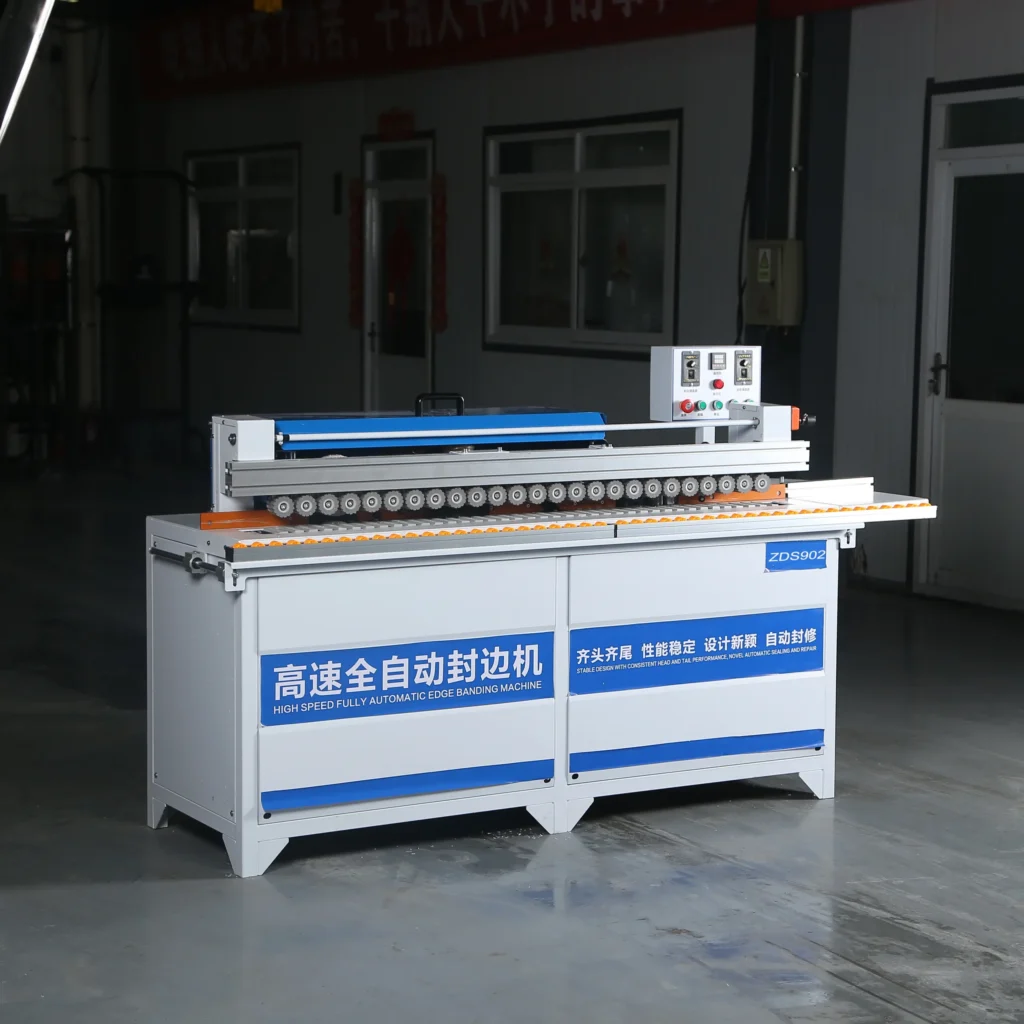
Voltage-Confirmed Engineering — every electrical schematic is verified against your facility's supply before the control panel is wired, eliminating the most common cause of commissioning failure on imported woodworking machinery.
Technical Specifications
| Parameter |
Value |
| Product Type |
Automatic Edge Banding Machine |
| Voltage |
220V (frequency to be confirmed per site supply) |
| Overall Dimensions (L×W×H) |
2070 × 600 × 1220 mm |
| Total Power |
4200W |
| Net Weight |
245 kg |
| Edge Banding Type |
Linear Edge Banding Machine |
| Edge Band Height Range |
0–35 mm |
| Edge Band Thickness Range |
0.5–2.5 mm |
| Glue Pot Capacity |
4000 ml |
| Gluing Method |
Double-sided gluing |
| Pressure Beam |
Integrated pressure beam with double rows of pressure wheels |
| Conveyor Belt |
Silicone material |
| Edge Strip Cutting Device |
Pneumatically controlled |
| Trimming Stations |
Double high-speed trimming motors (up and down) |
| Polishing Stations |
Up and down two polishing motors |
| Pressure Beam Adjustment |
Manual handle for arbitrary board height |
| Control System |
Intelligent temperature control |
| Standards |
CE, ISO 9001 |
Application Suitability
| Application |
Material or Output |
| Custom furniture panel edge banding |
MDF and plywood with PVC edge banding |
| Cabinet door and carcass finishing |
Particleboard with melamine face and PVC banding |
| Shelving and drawer front production |
Melamine-faced chipboard with veneer edge band |
| Joinery workshop scale-up |
Solid wood panels with thin veneer strips |
Why Voltage Must Be Settled Before Automatic Edge Banding Machine Specifications
The single most expensive mistake on a panel processing line is a voltage mismatch discovered after the crate is opened.
I learned this the hard way on a commissioning trip to West Africa. A 415V three-phase supply was connected to a machine configured for 380V, and the inverter board failed within minutes of energizing. The factory stood idle for three weeks while replacement components were air-freighted. That incident reshaped how every Automatic Edge Banding Machine configuration I am involved with is documented — voltage and frequency are confirmed in writing, on the buyer's side, before the control cabinet is assembled [NEED_CITE: voltage and frequency standards by export market]. Skipping this step does not save time; it costs an entire production schedule.

Glue Pot Capacity and Double-Sided Application
A 4000 ml glue pot holds enough adhesive for extended runs without frequent refills, which matters when a furniture workshop is batch-processing hundreds of cabinet panels in a single shift. The double-sided gluing method applies adhesive to both the panel edge and the banding strip simultaneously, improving bond contact area on porous substrates like particleboard where single-sided application often leaves visible glue-line gaps. Intelligent temperature control maintains consistent viscosity across varying ambient conditions, reducing the trial-and-error adjustments operators typically face during cold-start mornings.
Trimming and Polishing Station Configuration
This Automatic Edge Banding Machine carries double high-speed trimming motors working from above and below the panel, followed by two dedicated polishing motors. The two-stage approach means the trimming motors remove excess banding material flush with the panel surface, while the polishing motors smooth any residual micro-ridges left by the trimming cutters. On melamine-faced boards, this sequence directly determines whether the finished edge catches light unevenly — a defect that shows up under showroom lighting long after the panel leaves the factory floor [NEED_CITE: edge banding surface quality standards in furniture manufacturing].
How Core Parameters Shape Daily Output
The 0.5–2.5 mm edge band thickness range covers the PVC and veneer materials most commonly specified for MDF and particleboard furniture. Thinner bands below 0.5 mm require a different feed mechanism, while bands above 2.5 mm typically demand a pre-milling station not present on this configuration. The 0–35 mm band height range accommodates standard 18 mm board stock as well as thicker worktop panels up to roughly 35 mm. The integrated pressure beam with double rows of pressure wheels maintains uniform downward force across the panel width, preventing the slight lift that causes glue-starved edges on warped melamine sheets. The silicone conveyor belt resists adhesive build-up, reducing the cleaning intervals between batch changes. Pneumatically controlled edge strip cutting means the operator does not manually shear the banding at panel length — a detail that matters on longer cabinet sides where manual cuts tend to drift off-square.
The Hidden Cost of an Underspecified Line
When a workshop purchases an entry-level machine into a production volume it was never designed for, the symptoms appear gradually. Trimming motors overheat after consecutive shifts, polishing quality drifts, and the glue pot cannot recover temperature between rapid-feed cycles. I have seen edge banders of this class forced to run ten-hour shifts at full feed speed in humid tropical workshops with no ventilation around the control cabinet — the thermal overload trips repeatedly, and the operator learns to bypass it, which then damages the motor windings [NEED_CITE: thermal overload risks in tropical woodworking environments]. Specifying the correct duty cycle and ambient rating upfront prevents this slow degradation.
Why Procurement Through This Channel Works
In-house manufacturing means the patented cutting mechanisms and precision-ground components are built and inspected under one roof, not assembled from sourced sub-assemblies with unknown tolerances. Voltage customization from 110V to 440V is treated as a standard configuration step, not a special request that adds lead time. The four-stage quality control process covers incoming material, in-process assembly, finished-product testing, and pre-shipment verification — each stage documented so the buyer receives the actual test record, not a generic certificate. An engineer-led configuration recommendation arrives within 24 hours of inquiry, addressing the specific panel thickness, banding material, and daily volume the buyer describes rather than quoting a default package. Factory visits are welcomed at any production stage, giving buyers the chance to witness a sample processing run on their own material before committing to an order.
Documentation & Verification
- CE declaration of conformity covering the full machine assembly and safety circuits
- Machine specification sheet listing every parameter confirmed at order stage
- Electrical schematic with voltage and frequency annotated for your facility supply
- Factory test record on your specified panel thickness and banding material before dispatch
- Operation and maintenance manual delivered in your agreed operator language
- Spare parts list with part numbers matching the as-built configuration
Installation, Commissioning & Support
- Floor area of at least 2.5 × 1.5 m required to accommodate the 2070 × 600 mm footprint plus operator clearance
- Dedicated 220V circuit rated for the 4200W total power draw with appropriate breaker sizing
- Machine ships partially assembled; pressure beam and polishing stations require on-site alignment
- First-run commissioning includes glue temperature calibration on your actual PVC or veneer banding stock
- Pneumatic edge strip cutting device requires connection to workshop compressed air supply at specified pressure
- Silicone conveyor belt inspection and adhesive residue cleaning added to weekly maintenance schedule
What to Include in Your Inquiry
To match the right Automatic Edge Banding Machine configuration to your line, share the panel materials and thicknesses you process most frequently, the edge banding material type and thickness range you specify, and the daily panel volume your workshop targets. Confirm your facility's voltage and frequency so the electrical cabinet is built correctly from the start, and note the language your operators need on the control interface. If you are integrating this machine into an existing line, describe the upstream saw and downstream drilling stations so throughput compatibility can be verified.
Frequently Asked Questions
Q: How do I confirm the correct voltage and frequency for my factory?
A: Provide your facility's electrical supply specification — both voltage and frequency — at inquiry stage. The machine supports configurations from 110V to 440V, and the electrical schematic is adapted to match your confirmed supply before the control cabinet is wired. This prevents the inverter and motor failures that occur when standard-voltage equipment is connected to an incompatible grid.
Q: Which control panel languages are available for this machine?
A: The control interface can be configured in the language your operators read, confirmed during the specification review. This ensures the commissioning process is not delayed by an interface the production team cannot navigate. The agreed language is recorded on the order confirmation and reflected in the operation manual supplied at delivery.
Q: How does the 0.5–2.5 mm banding thickness range affect material selection?
A: This range covers standard PVC and veneer edge banding used on MDF, plywood, and particleboard furniture panels. Bands thinner than 0.5 mm may not feed reliably through the pressure wheel system, while bands above 2.5 mm typically require a pre-milling station for clean trimming. Confirming your banding supplier's exact thickness tolerance helps set the trimming motor positions accurately.
Q: What role do the double trimming and polishing motors play in edge quality?
A: The upper and lower trimming motors cut the banding flush with the panel surface on both sides in a single pass. The two polishing motors then smooth the trimmed edge, removing micro-ridges that would otherwise be visible under angled lighting on melamine-faced panels. This two-stage sequence is what separates a production-grade finish from one that requires manual touch-up before assembly.