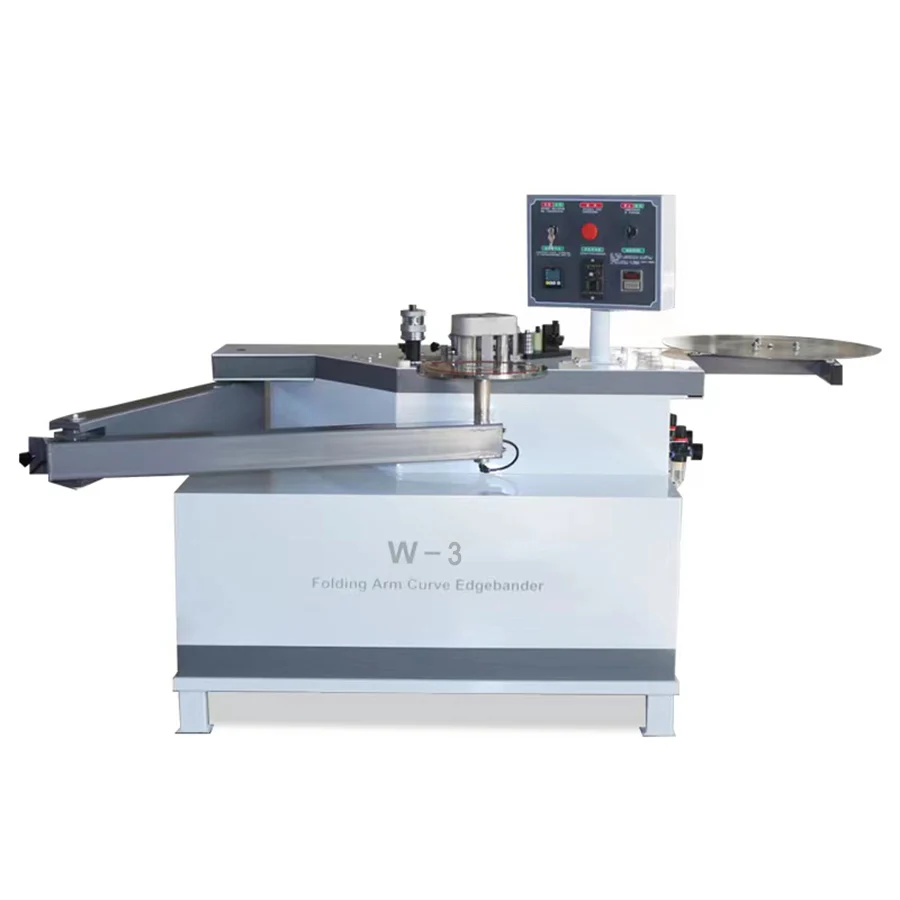
Voltage & Configuration Lock-In — W-series curved edge banding machines ship with electrical schematics and confirmed frequency matched to your local grid before production begins.
Technical Specifications
| Parameter |
Value |
| Model |
W-1 / W-2 / W-3 |
| Product Type |
Curved Edge Banding Machine |
| Voltage & Frequency |
220V 50Hz (configurable 110V–440V per market) |
| Total Power |
1.4 kW (W-1, W-2); 3.4 kW (W-3) |
| Air Supply Requirement |
0.5–0.8 MPa |
| Edge Banding Speed |
0–180 mm/s |
| Edge Band Thickness Range |
0.4–2 mm |
| Edge Band Width Range |
8–50 mm |
| Suction Cup Size |
200×26 mm (W-1); 300×26 mm (W-2, W-3) |
| Overall Dimensions (L×W×H) |
900×620×820 mm (W-1); 1200×800×1220 mm (W-2); 1210×1100×970 mm (W-3) |
| Net Weight |
88 kg (W-1); 152 kg (W-2, W-3) |
| Key Features |
Intelligent temperature control, automatic double-cylinder belt breaking, bottom-up hot air heating, adjustable speed with timer |
Application Suitability
| Application |
Material or Output |
| Custom cabinet and wardrobe panel edge banding |
PVC on MDF and particleboard |
| Shaped office furniture and desk components |
PVC and veneer on plywood substrates |
| Curved door and window frame profiles |
PVC edge banding on solid wood panels |
| Decorative panel and retail fixture finishing |
Thin PVC and veneer on MDF |
Why the Voltage Question Must Precede Every Curved Edge Banding Machine Specifications Review
A machine wired for the wrong frequency burns out its heating element within the first production week.
I have watched workshops receive edge banders that sat idle on the floor for weeks because the local three-phase supply did not match the motor winding. The glue pot never reached temperature, the feed motor stalled under load, and the operator assumed the machine was defective. The real fault was a specification gap that should have been closed before the order was placed. With curved edge banding machine specifications, confirming your facility voltage and frequency is the single step that prevents this category of failure [NEED_CITE: voltage and frequency standards by export market].

Three-Model Power Gradient and Footprint Planning
The W-series spans from 1.4 kW on the W-1 and W-2 up to 3.4 kW on the W-3, which directly affects the electrical circuit you need to prepare. A workshop running the W-1 in a small joinery space can typically share a standard single-phase breaker, while the W-3 demands a dedicated line. Floor space follows the same logic: the W-1 occupies under one square meter, leaving room beside a sliding table saw, whereas the W-3 footprint requires a planned station with operator clearance on at least two sides.
Matching Suction Cup Size to Panel Geometry
The suction cup dimension — 200×26 mm on the W-1 versus 300×26 mm on the W-2 and W-3 — determines the minimum panel radius you can band without the workpiece slipping during the feed. Smaller cups grip tighter on short-radius curves common in custom cabinet doors, while the larger cups stabilize wider panels such as conference table tops. Choosing between them depends less on throughput than on the curvature profile your production mix requires [NEED_CITE: CE machinery directive requirements for industrial equipment].
Reading the Numbers That Actually Govern Edge Quality
The 0.4–2 mm edge band thickness range and 8–50 mm width range are identical across all three models, meaning material compatibility does not change when you step up in power. What does change is the hot air heating configuration: bottom-up hot air delivery pre-softens the PVC before it contacts the glue, improving adhesion on curves where contact pressure is uneven. The 0–180 mm/s feed speed with timer control lets you slow the pass on tight radii to prevent the band from lifting at the apex. Air supply at 0.5–0.8 MPa drives the double-cylinder belt breaking mechanism; if your compressor cannot sustain that range under continuous draw, the belt breaker will misfire and leave ragged ends that require manual trimming.
The Hidden Cost of Underspecifying Auxiliary Requirements
Workshops that size their compressor for peak rather than continuous duty discover the problem only after the first long production run. Pressure drops below 0.5 MPa mid-cycle, the suction cup loses grip, and the panel shifts on the feed table — producing a skewed edge band that must be stripped and reapplied. I have seen this failure pattern repeat across curved edge banding machine specifications reviews when the buyer treated air supply as an afterthought. The same applies to voltage sag: a shared circuit that dips under the W-3's 3.4 kW draw causes the intelligent temperature controller to cycle the glue pot, resulting in cold spots and visible glue lines on finished panels [NEED_CITE: industrial compressor sizing for pneumatic woodworking equipment].
What Separates a Specification Sheet from a Verified Configuration
Every W-series order is backed by a manufacturer that holds proprietary cutting mechanism patents and runs four-stage quality control from incoming material through pre-shipment verification. Voltage and frequency are confirmed in writing before production, so the machine that arrives matches your facility grid — not a generic default. The product family covers entry-level through full-function within one series, meaning a workshop can add capacity later without switching supplier or retraining operators on a different control interface. Custom control panel language is specified at order stage, so the operator reading the temperature and speed settings on day one understands every parameter without translation guesswork.
Documentation & Verification
- Machine specification sheet confirming your selected W-model and rated power
- Electrical schematic with voltage and frequency matched to your local grid standard
- Factory test record on your specified PVC thickness and panel substrate before dispatch
- Operation and maintenance manual in your agreed language covering all three W-models
- Spare parts list with suction cup and belt breaker consumables itemized by model
Installation, Commissioning & Support
- W-1 at 88 kg can be positioned by two operators; W-2 and W-3 at 152 kg require pallet jack clearance
- Dedicated circuit required for W-3 at 3.4 kW; confirm breaker rating matches confirmed voltage
- Air line must sustain 0.5–0.8 MPa continuous; install regulator within two meters of machine inlet
- First-run commissioning includes glue pot temperature calibration against your specific PVC band stock
- Spare suction cups and trimming blades shipped with initial order to prevent unplanned downtime
What We Need from Your Side to Build the Quotation
Send us your typical panel substrate and thickness, the PVC or veneer edge band dimensions you run most often, and the curvature radii in your product mix. Confirm your facility voltage, phase, and frequency so we lock the correct motor winding and heater rating before production. If you operate alongside existing straight-line edge banders or panel saws, share their feed heights so we verify compatibility at the transfer point.
Frequently Asked Questions
Q: How do I choose between the W-1, W-2, and W-3 for my workshop?
A: Start with your largest panel dimension and the tightest curve radius in your production schedule. The W-1 suits small joinery shops handling short-radius components under 88 kg footprint constraints. The W-2 and W-3 accommodate larger panels through the wider 300×26 mm suction cup. The W-3 at 3.4 kW is the choice when continuous operation on thicker substrates demands more thermal headroom from the glue pot.
Q: What voltage and frequency should I specify for my local electrical standard?
A: The W-series is configurable from 110V to 440V. Provide your exact supply voltage, phase configuration, and frequency in hertz at the inquiry stage. We confirm these values in writing and reflect them on the electrical schematic before production begins, ensuring the motor winding, heater element, and control transformer all match your grid.
Q: Which edge banding materials are compatible with the 0.4–2 mm thickness range?
A: Standard PVC edge banding from 0.4 mm through 2 mm falls within range, as do most veneer and ABS strips within the same thickness envelope. The 8–50 mm width range covers narrow trim profiles up to wide bands for thick worktops. Confirm your specific material with a sample test before committing to a full production run.
Q: How much compressor capacity do I need to sustain 0.5–0.8 MPa?
A: Size your compressor for continuous duty at the upper end of the 0.5–0.8 MPa range, not peak output. A compressor rated only for intermittent duty will pressure-drop during extended curved banding passes, causing the suction cup to release and the double-cylinder belt breaker to misfire. Include an inline regulator and moisture trap within two meters of the machine air inlet.
Q: Can the control panel be configured in my operator's language?
A: Yes. Multilingual control panels are available and specified at order confirmation. The intelligent temperature display, speed adjustment interface, and timer settings are all translated so your operator can read every parameter without ambiguity. This eliminates commissioning delays caused by misinterpreted settings on the curved edge banding machine specifications sheet.