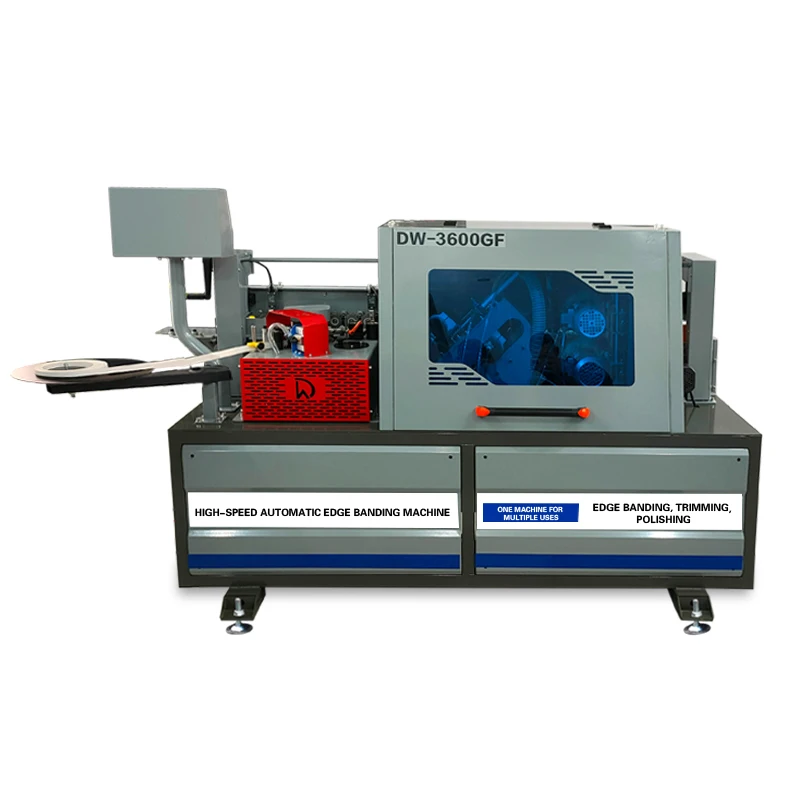
Verified Tolerance Through Patented Mechanisms — the DW-3600GF holds ±0.02 mm edge alignment verified at four inspection stages before dispatch.
Technical Specifications
| Parameter |
Value |
| Model |
DW-3600GF |
| Product Type |
Automatic Edge Banding Machine |
| Voltage & Frequency |
380V Three-Phase Four-Wire |
| Total Power |
4.9 kW |
| Feed Speed |
0–14 m/min |
| Edge Band Thickness Range |
0.3–3 mm |
| Edge Band Height Range |
0–50 mm |
| Minimum Panel Length |
200 mm |
| Trimming Motor |
800 W × 2, 24,000 r/min |
| Polishing Motor |
400 W × 2 |
| Edge Banding Motor |
160 W |
| Transmission Motor |
180 W |
| Edge Banding Type |
Straight Edge Banding |
| Overall Dimensions (L×W×H) |
2200 × 650 × 1250 mm |
| Net Weight |
320 kg |
| Air Supply Requirement |
0.4–0.6 MPa |
| Standard Process Stations |
Gluing, Trimming, Front & Rear Trimming, Scraping, Polishing, Vacuuming |
| Control Language |
Chinese and English standard; other languages customizable |
| Plug Options |
EU, USA, AU, UK |
Application Suitability
| Application |
Material or Output |
| Cabinet door and carcass edge finishing |
MDF and particleboard with PVC edge banding |
| Shelving and wardrobe panel banding |
Plywood panels up to 50 mm edge height |
| Panel furniture component edging |
Straight-edge workpieces minimum 200 mm length |
| Joinery workshop short-run production |
PVC banding 0.3–3 mm thickness |
Why Motor Speed and Feed Rate Decide Your Edge Quality
Clean trimming at 24,000 r/min only matters if the feed speed stays matched to your panel density.
I once watched a furniture factory run high-density MDF through a machine whose trimming spindles were undersized for the feed rate they were pushing. The cutters chattered across the PVC, leaving micro-fractures along the edge that only showed up after the panels reached assembly. The Automatic Edge Banding Machine specifications on paper looked adequate, but nobody had matched the trimming motor power against the actual material being processed. That mismatch cost them two weeks of rework before anyone traced it back to the edge bander [NEED_CITE: MDF density variation and its effect on trimming tool load].

Matching Feed Speed to Your Panel Mix
The DW-3600GF offers adjustable feed speed from 0 to 14 m/min, driven by a dedicated 180 W transmission motor separate from the 160 W edge banding motor. This separation matters on the shop floor: when you switch from lightweight particleboard to denser MDF, you can dial back the feed without losing torque on the band feed itself. Production managers balancing cutting-to-assembly throughput need this range to keep the edge bander from becoming a bottleneck or, worse, pushing panels through faster than the glue can set.
What Six Sequential Stations Actually Cover
The machine runs panels through gluing, trimming, front and rear trimming, scraping, polishing, and vacuuming in a single pass. Each station addresses a specific edge finish requirement: the dual 800 W trimming motors at 24,000 r/min handle the bulk PVC removal, while the scraping station takes off the residual bead left by the trimmer. Polishing with dual 400 W motors then brings the edge to final smoothness before vacuuming collects the debris. For a workshop moving from manual edge finishing to automated production, this sequence replaces multiple standalone operations [NEED_CITE: typical edge banding process stages in panel furniture manufacturing].
Reading the Specs That Affect Downstream Assembly
The edge band thickness range of 0.3–3 mm covers most PVC stock used in cabinet and wardrobe production. If your supplier sends 1 mm PVC and your operator sets the trimming cutters for 3 mm stock, you get over-trimming and exposed substrate — a defect that only becomes visible at the assembly bench. The minimum panel length of 200 mm means small drawer components and narrow shelf brackets can pass through, but anything shorter needs manual handling. The 0.4–0.6 MPa air supply requirement is typical for the pneumatic pressure rollers that maintain contact force during gluing; if your compressor runs below that band, the rollers lose grip and glue transfer becomes uneven. At 4.9 kW total power, the DW-3600GF draws less than many full-function pre-milling models, so existing workshop circuits often accommodate it without a dedicated high-amperage line.
The Cost of Skipping Specification Verification
When a buyer orders an edge bander without confirming that the feed speed range fits their daily panel volume, the machine either idles between batches or gets pushed beyond its designed throughput. Operators compensate by increasing feed speed, which starves the glue station of contact time. Over weeks, this pattern produces intermittent bonding failures that are blamed on glue quality rather than feed-to-glue mismatch. Similarly, if the control panel arrives in a language the floor team cannot read, commissioning stalls until someone translates the menus — and by then the installer has already left the building [NEED_CITE: commissioning delays caused by language barriers on imported machinery].
Why Source This Machine From Our Workshop
In-house manufacturing with patented cutting mechanisms means the trimming spindles on the DW-3600GF are built and tested on the same floor where final assembly happens, not outsourced and bolted on. Full range coverage from entry-level to full-function within one product family lets your workshop add capacity later without re-learning a different supplier's control logic. Voltage, plug type, and control language customization is treated as standard configuration, not a special request. Four-stage quality control with pre-shipment verification means each machine runs on your specified panel material before it leaves the factory. An engineer reviews your factory scale and processing requirement, then delivers a formal configuration proposal with quotation within 24 hours.
Documentation & Verification
- Machine specification sheet confirming DW-3600GF motor power, trimming speed, and air pressure values
- Electrical schematic with voltage and frequency matched to your three-phase supply
- Factory test record showing edge banding results on your panel material and PVC stock
- Operation and maintenance manual provided in your agreed language before shipment
- CE declaration of conformity and ISO 9001 certificate included with dispatch paperwork
- Spare parts list itemizing trimming cutters, polishing wheels, and pneumatic seals
Installation, Commissioning & Support
- 2200 × 650 mm footprint fits standard workshop bays; verify floor levelness within tolerance before placement
- 380V three-phase four-wire supply with dedicated circuit breaker rated for 4.9 kW continuous draw
- Machine ships fully assembled; verify doorway clearance against 1250 mm height and 2200 mm length
- First-run calibration includes feed speed verification and trimming cutter alignment on your actual panel stock
- Operator training covers control panel navigation in your specified language and glue temperature adjustment
- Pneumatic connections require 0.4–0.6 MPa clean dry air; install inline filter upstream of the machine
What We Need to Configure Your Machine Correctly
To prepare a specification-matched proposal, share the panel materials you process most often along with their typical thickness and density range. Confirm your workshop's three-phase voltage and frequency so the electrical system is built to match. Let us know the control panel language your operators require and which plug standard your site uses. If you are integrating the DW-3600GF into an existing line, tell us the upstream cutting output rate so feed speed can be balanced accordingly.
Frequently Asked Questions
Q: How do I confirm the feed speed matches my panel throughput target?
A: Share your daily panel count and average panel dimensions. We calculate the required feed rate within the 0–14 m/min range and confirm whether the DW-3600GF can sustain that pace across your material mix without compromising glue contact time or trimming finish quality.
Q: What voltage and plug configuration will the machine ship with?
A: The standard build is 380V three-phase four-wire, but voltage is configurable from 110V to 440V. Plug options include EU, USA, AU, and UK standards. We confirm your site voltage and frequency before production begins so the electrical system arrives ready to connect.
Q: Can the control panel display my operator's language?
A: Chinese and English are standard. Other languages are customizable at order. Specify your preferred language during the quotation stage so the control interface is configured and tested before dispatch, avoiding commissioning delays on the shop floor.
Q: What are the minimum panel dimensions this machine accepts?
A: The minimum panel length is 200 mm. Edge band thickness ranges from 0.3 to 3 mm, and edge band height covers up to 50 mm. Panels shorter than 200 mm or edge stock outside that thickness range require a different configuration or manual handling.
Q: Which process stations are included and what do they do?
A: Six stations run in sequence: gluing applies adhesive, trimming removes excess band, front and rear trimming clean the ends, scraping removes residual glue bead, polishing smooths the edge, and vacuuming extracts debris. This covers a complete straight-edge finish in one pass.