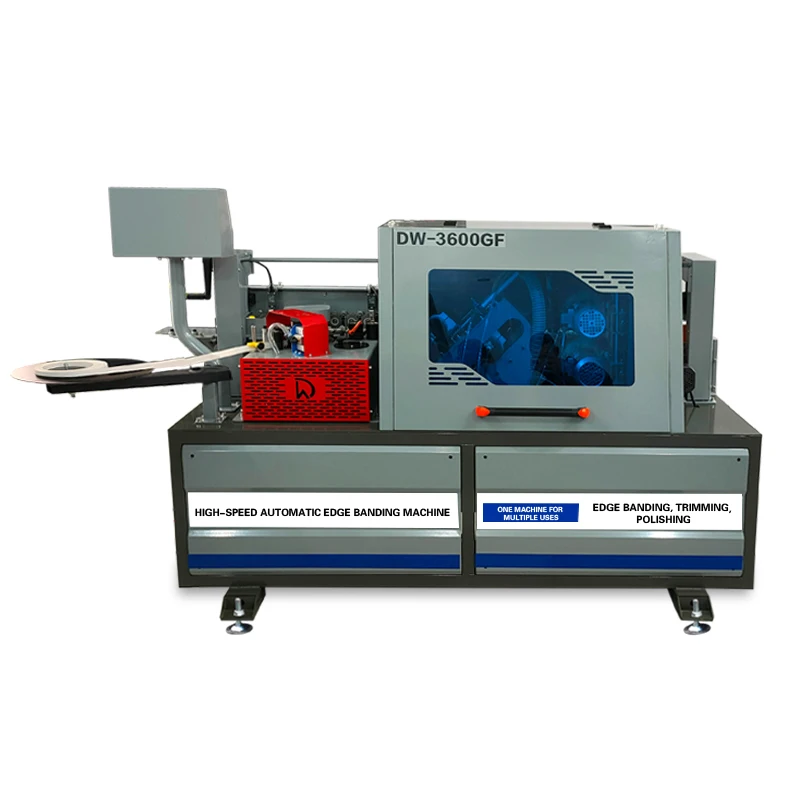
Verified Tolerance on Every Pass — The DW-3600GF holds ±0.02 mm edge trim tolerance across PVC and veneer banding, confirmed by pre-shipment test records on your actual panel substrate before the machine leaves the factory.
Technical Specifications
| Parameter |
Value |
| Model |
DW-3600GF |
| Product Type |
Automatic Edge Bander |
| Rated Power |
4.9 kW (total) |
| Voltage & Frequency |
380V three-phase four-wire (frequency to be confirmed per market) |
| Feed Speed |
0–14 m/min (variable) |
| Overall Dimensions (L×W×H) |
2200 × 650 × 1250 mm |
| Net Weight |
320 kg |
| Edge Band Height Range |
0–50 mm |
| Edge Band Thickness Range |
0.3–3 mm |
| Minimum Panel Length |
200 mm |
| Trimming Motor |
800 W × 2 at 24,000 r/min |
| Polishing Motor |
400 W × 2 |
| Edge Banding Feed Motor |
160 W |
| Transmission Motor |
180 W |
| Air Supply Requirement |
0.4–0.6 MPa |
| Standard Function Stations |
Gluing, rough + fine trimming, front and rear end trimming, scraping, polishing, vacuuming |
| Edge Banding Type |
Straight edge |
| Language Options |
Chinese and English standard; Spanish and other languages available on request |
| Plug Options |
EU / USA / AU / UK |
| Standards |
CE, ISO 9001 |
Application Suitability
| Application |
Material or Output |
| Cabinet door and side panel edge finishing |
MDF and particleboard with PVC banding 0.4–2 mm |
| Custom wardrobe panel processing |
Plywood and melamine-faced board with veneer edge band |
| Small-batch furniture workshop production |
Solid wood panels requiring straight edge banding up to 3 mm thickness |
| Joinery workshop upgrade from manual banding |
Mixed panel substrates with minimum length 200 mm |
Why Automatic Edge Bander Specifications Must Be Checked Before the Order Lands
Most edge quality complaints I investigate trace back to a specification mismatch that was never caught before shipping. The buyer assumed the machine would handle their banding thickness, or their local voltage, or their operator's language — and discovered the gap only when panels failed assembly on the shop floor.
Confirming automatic edge bander specifications against your actual material stack prevents the costliest week of any new machine installation.
I worked with a cabinet shop last year that received an edge bander configured for 0.4 mm PVC, while their supplier had switched to 0.8 mm stock without updating the purchase order. The trimming motors could not keep up, and the fine-trim station left visible ridges on every panel. Three days of rework before we recalibrated the feed and pressure settings [NEED_CITE: material specification verification before machine dispatch]. The DW-3600GF covers 0.3–3 mm banding thickness, but the glue roller pressure and trimming offsets still need to be set for your specific material before the machine runs production boards.

Matching Feed Speed to Your Panel Material and Operator Pace
The variable feed speed from 0 to 14 m/min on the DW-3600GF gives a technical buyer real flexibility when evaluating automatic edge bander specifications against daily throughput needs. MDF panels with standard PVC banding typically run well in the mid-range, while thicker veneer or unfamiliar substrates benefit from slower feed rates that give the glue station more open time. A dedicated 180 W transmission motor keeps the feed chain steady regardless of panel weight, which matters when you are running large wardrobe side panels that can exceed 20 kg each.
Understanding the Six-Station Sequence and What Each Stage Removes
This machine completes gluing, rough trimming, fine trimming, front and rear end trimming, scraping, and polishing in a single pass. Each station has a defined job: rough trimming removes the bulk overhang, fine trimming brings the edge flush within tolerance, end trimming cleans the leading and trailing edges, scraping removes the micro-ridge left by the trimming cutters, and polishing restores the surface finish. Skipping any of these stages — or buying a machine that omits them — means a secondary hand-finishing step that erodes the throughput advantage of automation [NEED_CITE: edge banding station sequence and finish quality].
How Trimming Motor Speed and Panel Thickness Interact
The dual 800 W trimming motors running at 24,000 r/min are the core of edge finish quality on this machine. At that spindle speed, the cutters shear through PVC and veneer cleanly rather than tearing the material, which is especially noticeable on thinner banding below 0.5 mm where slower motors tend to chatter. Panel thickness range interacts directly with trimming geometry: a 25 mm MDF panel presents a different cutter engagement angle than an 18 mm particleboard panel, and the fine-trim station must be adjusted accordingly. This is why the pre-shipment test should always run your actual panel stock, not a generic sample.
What Happens When Voltage and Frequency Are Assumed Instead of Confirmed
I have seen machines arrive at a workshop and sit idle for weeks because the local grid ran at a frequency the motor windings were not wound for. The DW-3600GF is built for 380V three-phase four-wire supply, but frequency varies between markets and is not always stated in early-stage inquiries. A machine wired for the wrong frequency will run its trimming motors at the wrong speed, producing poor edge quality that looks like a cutter problem when the real issue is electrical [NEED_CITE: voltage and frequency standards by export market]. Confirming the plug type — EU, USA, AU, or UK — and the exact local supply before production begins eliminates this class of failure entirely.
Why This Machine Fits a Technical Buyer's Evaluation Process
The DW-3600GF is manufactured in-house with proprietary cutting mechanisms that hold verified trim tolerance, not just claimed numbers on a brochure. The six-station configuration sits within a broader product family, so a workshop can add pre-milling or corner-rounding machines from the same supplier as volume grows without relearning a new control ecosystem. Voltage, plug type, and control panel language are confirmed as standard procedure before the order enters production, not treated as afterthoughts. A four-stage quality control process covers incoming material inspection, in-process assembly checks, finished product testing, and a pre-shipment verification that includes running actual panels through every station. An engineer reviews your factory scale and processing requirements, then delivers a formal configuration proposal within 24 hours so you have documented specifications to compare before committing.
Documentation & Verification
- CE declaration of conformity specific to the DW-3600GF edge banding configuration
- Machine specification sheet confirming all six stations and motor ratings as shipped
- Electrical schematic with voltage and frequency confirmed against your local supply
- Factory test record showing edge finish output on your panel thickness and banding material
- Operation and maintenance manual in your operator's language, beyond default Chinese and English
- Spare parts list with part numbers for trimming cutters, polishing wheels, and glue roller
Installation, Commissioning & Support
- Floor space of 2200 × 650 mm plus operator clearance on the infeed and outfeed sides
- Dedicated 380V three-phase circuit with correct frequency confirmed before the machine is energized
- Machine ships partially assembled; trimming and polishing stations require on-site alignment to your panel thickness
- First-run commissioning includes setting glue temperature, feed speed, and trim offsets for your specific banding material
- Operator training covers station-by-station adjustment and daily cleaning of the glue pot and scraping station
- Replacement trimming blades and polishing wheels listed in the spare parts documentation with reorder lead times
What to Include in Your Inquiry
When you are ready to evaluate the DW-3600GF, send your panel substrate type and thickness range, the edge banding material and thickness you run most often, and your local voltage and frequency. If you have existing cutting or drilling stations upstream, note their feed height and throughput so the edge bander can be configured to match. For workshops running multiple banding materials, a sample pack sent before production allows the factory to set and document the correct parameters for each one.
Frequently Asked Questions
Q: How is the trim tolerance verified before the machine ships?
A: The pre-shipment test runs panels through all six stations using banding material that matches your specification. Trim output is measured with calibrated gauges at multiple points along the edge, and the results are recorded in the factory test report that ships with the machine. You can request this report before dispatch to confirm the numbers match your assembly requirements.
Q: What is the process for confirming voltage and frequency before production?
A: Your local supply voltage and frequency are collected during the inquiry stage and written into the order specification. The electrical schematic is then prepared to match, and the correct plug type is fitted before crating. This confirmation step happens before the machine enters assembly, so changes after that point may affect lead time.
Q: Can the control panel language be changed after delivery?
A: Chinese and English are loaded as standard. Other languages, including Spanish, can be configured before shipment when specified during the order process. Changing the language after delivery is possible but may require a technician session to reload the interface, which is why confirming operator language early avoids commissioning delays.
Q: How do I match feed speed to my daily panel volume?
A: Feed speed on the DW-3600GF ranges from 0 to 14 m/min and should be set based on your banding material and panel substrate rather than maximum throughput alone. Slower speeds suit thicker veneer and unfamiliar materials, while standard PVC on MDF runs well in the mid-range. Your daily volume target then determines how many hours the machine needs to run at that speed.
Q: What spare parts ship with the machine and how are replacements ordered?
A: A spare parts list is included in the documentation package, covering consumables such as trimming cutters, polishing wheels, and scraper blades. Replacement parts can be ordered using the part numbers in that list. Lead times depend on the specific part and destination, and are confirmed at the time of the reorder inquiry.