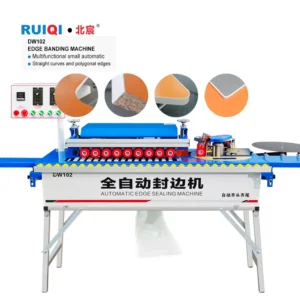
Precision-Ground Assembly — every DW400 component passes multi-stage inspection before final calibration, ensuring tolerance claims hold up when your panels reach assembly.
Technical Specifications
| Parameter |
Value |
| Model |
DW400 |
| Product Type |
Automatic Edge Banding Machine |
| Total Power |
3800W |
| Voltage & Frequency |
220V / 380V / Customizable (frequency to be confirmed) |
| Edge Banding Thickness Range |
0.3–3 mm |
| Edge Banding Height |
0–50 mm |
| Minimum Sheet Length |
25 cm |
| Minimum Sheet Width |
10 cm |
| Trimming Power |
650W × 2 stations |
| Polishing Power |
180W × 2 |
| Edge Power |
20W |
| Transmission Power |
60W |
| Vacuum Power |
1200W |
| Glue Pot Capacity |
1000 ml |
| Air Source Pressure |
0.5–0.8 MPa |
| Overall Dimensions (L×W×H) |
116 × 47 × 69 cm |
| Net Weight |
70 kg |
| Language Options |
Chinese, English; Spanish and others available |
| Plug Options |
EU, USA, AU, UK |
| Standard Functions |
Straight edge banding, trimming, polishing |
| Feed Speed |
(basis to be confirmed) |
| Panel Thickness Range |
(basis to be confirmed) |
| Control System |
(basis to be confirmed) |
| Tolerance |
(basis to be confirmed) |
| Standards |
CE (implied), ISO 9001 (company-level) |
Application Suitability
| Application |
Material or Output |
| Cabinet door and carcass edge finishing |
MDF and particleboard panels with PVC or melamine tape |
| Wardrobe panel edge banding |
Plywood and blockboard with thin wood veneer or ABS edging |
| Polymer door straight-edge processing |
Non-standard polymer substrates requiring adhesive bonding and trimming |
| Small-batch custom furniture production |
Mixed board runs where quick tape changeover matters |
Why the Voltage Question Must Precede the Quotation
Confirming your facility's voltage and frequency before configuration prevents a machine arriving unusable on the shop floor.
I once saw a workshop in Southeast Asia receive a 380V/50Hz edge bander when their supply ran 220V/60Hz. The motor burned within the first hour, and the buyer spent weeks sourcing a replacement transformer that never matched the original torque curve. The DW400 supports voltage customization across 220V and 380V ranges, but that flexibility only helps if the correct specification is locked in at order stage. Frequency mismatches are less visible but equally damaging — a 50Hz motor on a 60Hz supply spins faster, throwing off feed speed calibration and trimming accuracy [NEED_CITE: voltage and frequency standards by export market]. When evaluating edge banding machine specifications, electrical compatibility should be the first item verified, not an afterthought in shipping documents.

Matching the DW400 to Your Panel Mix
The 0.3–3 mm edge banding thickness range means this machine handles everything from thin melamine tape on budget cabinet carcasses to 3 mm ABS on premium wardrobe fronts. Switching between tape types is a physical changeover at the tape guide, and the 1000 ml glue pot provides enough adhesive volume for sustained runs without constant refills. Buyers running mixed board schedules — some MDF, some particleboard — will find the straight-edge workflow covers the majority of panel furniture requirements without needing a separate pre-milling station.
Compact Footprint, Defined Workspace Requirements
At 116 × 47 × 69 cm and 70 kg, the DW400 fits into workshops where floor space is already committed to sliding table saws and boring machines. The minimum sheet dimensions of 25 cm length and 10 cm width set the lower boundary — smaller offcuts cannot be fed reliably through the pressure zone. This matters for operations cutting nested panels where narrow strips are common. The integrated 1200W vacuum system manages trimming debris, but external dust extraction ducting still needs planning based on your workshop layout [NEED_CITE: dust extraction requirements for edge banding operations].
How Trimming Power and Glue Capacity Shape Edge Quality
The dual trimming stations, each rated at 650W, cut top and bottom excess tape in a single pass. This two-motor configuration prevents the chatter marks that appear when a single undersized motor tries to handle both edges simultaneously — a problem that surfaces most visibly on 3 mm PVC tape. The 180W × 2 polishing wheels follow immediately, buffing the trimmed edge to a finish suitable for visible cabinet exteriors. The 1000 ml glue pot operates within a temperature window that suits standard EVA hot-melt adhesives; however, PUR adhesive systems require different pot engineering and are outside this machine's configuration scope. Panel thickness range and feed speed interact directly — thicker boards demand slower feed rates to allow adequate glue penetration and pressure time, so confirming both parameters against your actual stock is essential before committing to an order.
What Happens When Specification Gaps Reach the Shop Floor
Buyers who skip sample testing often discover tolerance problems only when panels reach the assembly bench — edges that look acceptable individually produce visible misalignment once joined into a carcass. Entry-level machines pushed beyond their designed throughput develop premature wear on trimming blades and polishing wheels, creating a cycle of consumable replacement that erodes the margin gained on the initial purchase [NEED_CITE: edge banding consumable wear patterns under sustained production]. A control panel language mismatch means operators guess at parameter settings rather than adjusting them, leading to inconsistent edge quality across shifts. These are not catastrophic failures — they are the slow, expensive friction that accumulates when edge banding machine specifications are accepted at face value rather than verified against your actual panel stock and production rhythm.
Sourcing Decisions Backed by Verifiable Detail
The DW400 is manufactured in a facility that holds ISO 9001 certification at the company level, with a four-stage QC process covering incoming material through pre-shipment verification. Engineers provide configuration recommendations based on your stated panel types and thicknesses, with formal quotations typically issued within 24 hours. Voltage, plug type, and control panel language are treated as standard customization points rather than special requests — the DW400 ships with EU, USA, AU, or UK plugs and supports Spanish alongside Chinese and English. Factory visits are welcomed, and sample processing tests using your own panel stock can be arranged before order confirmation. The product family spans entry-level through full-function pre-milling models, so if your throughput grows beyond the DW400's capacity, you can move within the same supplier ecosystem without re-learning a different manufacturer's service model.
Documentation & Verification
- CE declaration of conformity covering the DW400's electrical and mechanical safety requirements
- Machine specification sheet confirming your selected voltage, frequency, and plug type
- Electrical schematic matching the as-built configuration for your facility's maintenance records
- Factory test record run on your submitted panel samples before dispatch authorization
- Operation and maintenance manual in your specified language with spare parts cross-reference
Installation, Commissioning & Support
- Requires a dedicated circuit matching confirmed voltage — 3800W total power draws substantial current at 220V single-phase
- Air supply must deliver 0.5–0.8 MPa consistently; undersized compressors cause intermittent pressure drops at the glue roller
- Machine ships assembled — position on level floor and verify alignment before first power-on
- First-run calibration of trimming depth and polishing pressure against your actual tape thickness
- Trimming blades and polishing wheels are wear items — confirm regional spare parts availability before installation
- Daily vacuum system check on the 1200W extraction unit prevents debris accumulation around the polishing station
Preparing Your Inquiry
Send us your panel material types, thicknesses, and the edge tape specifications you run most frequently. Include your facility's voltage, phase, and frequency so the electrical configuration can be confirmed at quotation stage. If your production involves non-standard substrates like polymer doors, ship sample pieces for a processing test — we verify edge quality on your actual material before recommending a configuration.
Frequently Asked Questions
Q: What feed speed does the DW400 support, and how does it match my daily panel volume?
A: Feed speed for the DW400 has not been published in the current specification sheet. We recommend requesting confirmed feed rate data alongside your quotation, then comparing it against your daily panel count to verify throughput alignment. If your volume exceeds entry-level capacity, our engineering team can recommend a higher-tier model within the same product family that matches your output requirements.
Q: Can the voltage and plug type be confirmed to my country's standard before production?
A: Yes. The DW400 supports 220V and 380V configurations with plug options for EU, USA, AU, and UK markets. You must specify your exact voltage, frequency, and plug type at order stage so the electrical system is built to match. We provide an electrical schematic confirming the as-built configuration for your records and local compliance documentation.
Q: Is the control panel available in languages other than Chinese and English?
A: The standard configuration includes Chinese and English interfaces. Spanish and additional languages are available as customization options and must be specified when the order is placed. This ensures operators can read parameter settings and fault codes without relying on translated paper manuals during production.
Q: What panel thickness range is verified, and how do I test edge quality on my substrate?
A: The verified panel thickness range is not stated in the current source documentation and should be confirmed with our engineering team. We strongly recommend sending representative panel samples — including the specific board material and edge tape you use — for a factory processing test. This confirms glue adhesion, trimming quality, and polish finish on your actual stock before you commit to an order.


![DW802 Automatic Edge Banding Machine | Technical Guide 记录 ID 14183,数字和为 1+4+1+8+3=17 17 mod 6 = 5,对应句式:[站点修饰词] [品类词] – [规格或产能限定] 角色:技术选型类,池=[Specifications, Technical Guide, Model Selection],长度 3 17 mod 3 = 2,选中:Model Selection 草稿:Model Selection Automatic Edge Banding Machine – DW802 4200W PVC MDF 字符数:66](https://ruiqiwoodmachine.com/wp-content/uploads/2026/05/H9322a2861acd4beb869461711bad6c51H-1-300x300.webp)