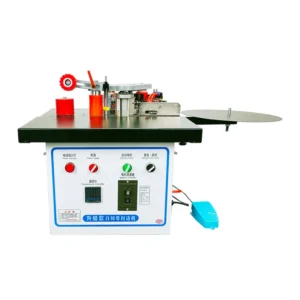
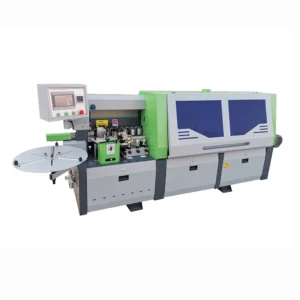
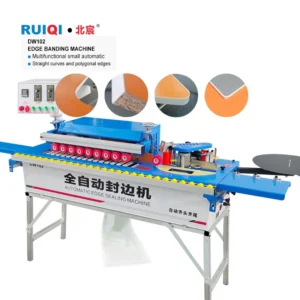
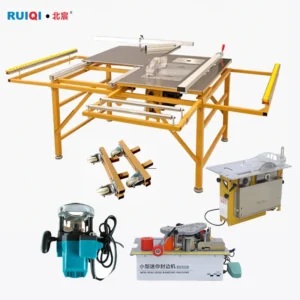
Verified Tolerance Claim — The ST-30 portable edge banding machine carries ±0.02 mm cutting tolerance backed by in-house patented mechanisms and four-stage quality control, not just a catalog number.
Technical Specifications
| Parameter |
Value |
| Model |
ST-30 |
| Product Type |
Portable Edge Banding Machine |
| Total Power |
1000W |
| Edge Power |
20W |
| Voltage Options |
220V / 380V / customization |
| Plug Options |
EU, USA, AU, UK |
| Edge Banding Thickness |
0.3–3 mm |
| Edge Banding Height |
0–50 mm |
| Edge Type |
Straight and curved |
| Minimum Sheet Length |
25 cm |
| Minimum Sheet Width |
3 cm |
| Glue Pot Capacity |
1000 ml |
| Air Source Pressure |
0.5–0.8 MPa |
| Suitable Banding Tape |
ABS, PVC, Melamine, Veneer |
| Product Size |
38 × 35 × 35 cm |
| Product Weight |
12 kg |
| Language Options |
Chinese, English, customizable |
| Standards |
CE, ISO 9001 |
Application Suitability
| Application |
Material or Output |
| Small workshop furniture edge banding |
MDF, plywood, particleboard with PVC or ABS tape |
| Interior decoration on-site curved edge work |
Solid wood panels with veneer or melamine banding |
| Cabinet door and drawer panel finishing |
Particleboard and MDF panels from 25 cm minimum length |
| Joinery workshop first-machine transition |
Mixed substrates with 0.3–3 mm banding thickness |
Why Voltage Must Be Confirmed Before the Portable Edge Banding Machine Specifications Are Finalized
A portable edge banding machine wired for the wrong frequency will trip breakers on day one, regardless of how accurate the spec sheet looks.
Machines quoted without confirming local voltage and frequency arrive unusable — a pattern I have watched repeat across export orders where the buyer assumed 220V/50Hz was universal. The ST-30 quotation process locks voltage, plug type, and control language before production begins, which should be standard practice but frequently is not. When a 380V unit shows up in a 220V-only workshop, the entire commissioning timeline stalls until a transformer is sourced or the motor is rewound [NEED_CITE: voltage and frequency standards by export market].

Panel Size Range and What It Means for Your Workshop Layout
The ST-30 handles sheets as small as 25 cm long and 3 cm wide, which places it squarely in the range needed for cabinet components, drawer sides, and small decorative panels. Full-size automatic edge banders typically require longer minimum feed lengths, making them impractical for short-run or mixed-dimension production. Portable edge banding machine specifications like these matter when your daily output includes dozens of differently sized parts rather than long runs of identical panels.
Curved and Straight Capability in a Single 12 kg Unit
Running both curved and straight profiles on one machine eliminates a second workstation, which is significant when floor space is limited. The 0–50 mm edge banding height range covers standard cabinet panel thicknesses, and the 0.3–3 mm tape thickness range accommodates everything from thin PVC to thicker veneer. This dual capability is what separates a portable edge banding machine from a dedicated straight-line unit that leaves curved profiles to manual work.
Reading the Numbers That Actually Affect Edge Quality
The glue pot capacity of 1000 ml sets the interval between refills during continuous operation — a smaller pot means more frequent pauses that let adhesive temperature fluctuate, which shows up as uneven bonding on melamine and veneer substrates. The air source pressure requirement of 0.5–0.8 MPa is the specification most frequently overlooked during installation; undersized compressors cause inconsistent pressure roller contact, and the resulting glue lines are blamed on the machine rather than the air supply [NEED_CITE: pneumatic pressure requirements for edge banding equipment]. The 1000W total power rating is modest, meaning a standard single-phase circuit can support the unit without dedicated wiring in most workshop environments. Edge power at 20W drives the feed and trimming mechanism, adequate for the target material range but a reason to keep expectations aligned with a portable-class unit rather than a production-line machine.
The Hidden Cost of Skipping Specification Verification
When a workshop orders a portable edge bander without confirming whether its compressor meets the 0.5–0.8 MPa requirement, the machine runs but produces visible glue lines on every panel. I have seen entire batches of particleboard cabinet doors sent back for rework because the trimming step could not compensate for poor initial adhesion. The cost is never just the wasted tape — it is the labor hours spent diagnosing a problem that a specification check would have prevented [NEED_CITE: common causes of edge banding adhesion failure on particleboard].
Why Technical Buyers Source This Model Here
The ST-30 is built on an in-house manufacturing line with patented cutting mechanisms and multi-stage precision grinding, which means tolerance claims are traceable to actual process controls rather than reseller specifications. Voltage and plug configuration are confirmed at the quotation stage with a written electrical schematic, eliminating the guesswork that plagues cross-border machinery orders. The four-stage quality control process — incoming material, in-process, finished product, and pre-shipment verification — includes a factory test run on your specified panel material before the crate is sealed. Engineer-led configuration recommendations arrive within 24 hours of inquiry, covering not just the machine but air compressor matching and upstream panel saw compatibility. Every unit ships with documentation in the buyer's agreed language, from operation manual to spare parts list.
Documentation & Verification
- CE declaration of conformity matching the ST-30 portable edge bander configuration
- Machine specification sheet with confirmed voltage, frequency, and plug type
- Electrical schematic and voltage confirmation document provided pre-shipment
- Factory test record demonstrating edge banding on your specified panel material and thickness
- Operation and maintenance manual in the buyer's agreed language with illustrated spare parts list
- Packing photographs and customs documentation support for export clearance
Installation, Commissioning & Support
- Requires a stable flat surface rated for 12 kg with clear access on all sides for curved panel feeding
- Dedicated circuit matching confirmed 220V or 380V supply with correct plug type per order specification
- Arrives fully assembled; connect air supply hose to the 0.5–0.8 MPa source and power on
- First-run glue temperature and feed speed calibration on your actual panel material and edge tape
- Operator training covers glue pot refill intervals, tape loading for straight and curved profiles, and daily cleaning
- Spare parts list included with recommended wear items for initial inventory stocking
What to Prepare Before Requesting a Quotation
Share your primary panel materials — MDF, plywood, particleboard, or solid wood — along with the edge banding tape type and thickness you intend to use daily. Confirm your workshop's available voltage, frequency, and plug standard so the electrical configuration is locked before production. If you are running both straight and curved profiles, note the typical panel dimensions and daily volume so the configuration recommendation matches actual throughput rather than a catalog maximum.
Frequently Asked Questions
Q: How do I confirm voltage, frequency, and plug type match my workshop before ordering?
A: Provide your local electrical supply details — voltage, phase, frequency, and plug standard — during the initial inquiry. The quotation will include a written voltage confirmation document and electrical schematic reflecting your exact configuration. This prevents the common failure mode where a machine arrives wired for a different regional standard and cannot be commissioned without costly rewiring or an external transformer.
Q: What panel dimensions and edge banding thicknesses does the ST-30 handle, and when should I consider a full-size automatic model?
A: The ST-30 processes panels from 25 cm long and 3 cm wide with edge banding tape between 0.3 and 3 mm thick. If your daily volume consistently involves long straight runs on panels exceeding one meter, a full-size automatic edge bander with multiple trimming stations will deliver higher throughput. The ST-30 fits workshops where panel sizes vary frequently and curved profiles are part of regular production.
Q: How does curved versus straight edge banding performance compare across different tape materials?
A: ABS and PVC tape conform readily to both curved and straight edges within the 0.3–3 mm thickness range. Veneer tape requires more careful temperature management on tight curves to prevent cracking, particularly at thicknesses above 1 mm. The glue pot capacity and air pressure consistency directly affect how well any material adheres on curved profiles, so matching your compressor to the 0.5–0.8 MPa requirement is critical.
Q: What air compressor specification is required to run this portable edge banding machine reliably?
A: The ST-30 requires an air source delivering 0.5–0.8 MPa sustained pressure. Flow rate matters equally — a compressor that reaches target pressure but cannot maintain it during continuous cycling will cause inconsistent roller pressure and visible glue lines. Verify your compressor's rated CFM output against the machine's consumption rate before installation to avoid adhesion failures during production runs.
Q: How is the control panel language confirmed, and what documentation arrives with the machine?
A: Language preference is confirmed during the quotation stage, with options including English, Spanish, or other languages by request. The shipment includes an operation and maintenance manual in the agreed language, an illustrated spare parts list, the electrical schematic, and a factory test record showing edge banding results on material matching your specification.