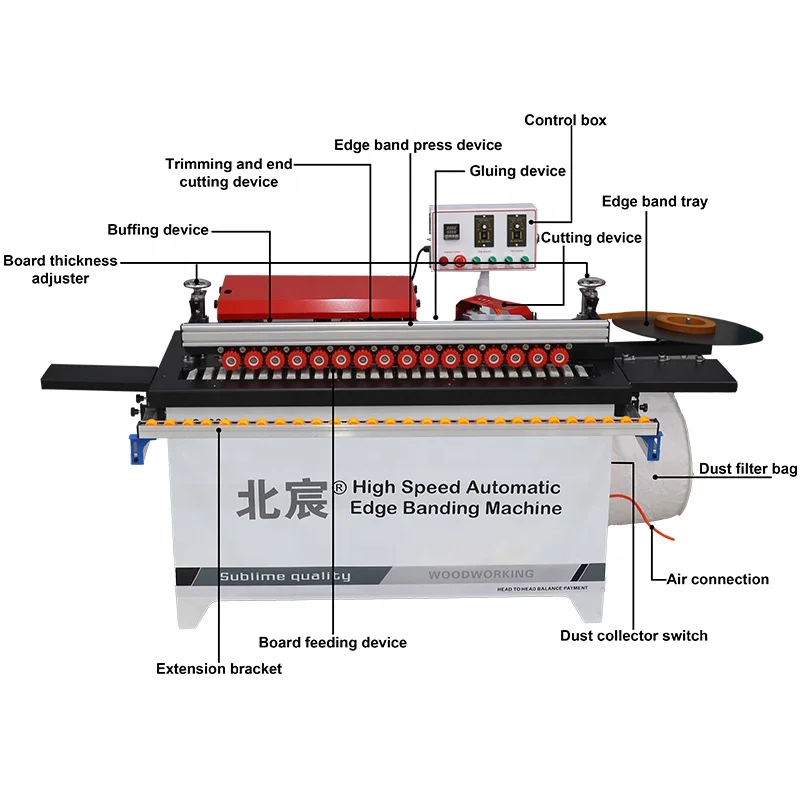
Precision-ground edge banding with verified electrical fit — the DW802 automatic edge bander is configured to your workshop's exact voltage and frequency before dispatch, preventing the most common commissioning failure in exported machinery.
Technical Specifications
| Parameter |
Value |
| Model |
DW802 |
| Product Type |
Automatic Edge Bander |
| Total Power |
4200 W |
| Voltage Options |
220V / 380V / customization available |
| Edge Banding Thickness Range |
0.3–3 mm |
| Edge Banding Height Range |
0–50 mm |
| Minimum Sheet Length |
250 mm |
| Minimum Sheet Width |
100 mm |
| Glue Pot Capacity |
4000 ml |
| Air Source Pressure |
0.4–0.8 MPa |
| Edge Feed Motor Power |
140 W |
| Conveyor Motor Power |
140 W |
| Trimming Motor Power |
800 W × 2 |
| Polishing Motor Power |
180 W × 2 |
| Vacuum Motor Power |
1200 W |
| Machine Dimensions (L×W×H) |
1300 × 600 × 950 mm |
| Net Weight |
135 kg |
| Feed Speed |
(basis to be confirmed) |
| Control Panel Language |
(options to be confirmed) |
| Certification Status |
(CE / ISO status to be confirmed for this model) |
Application Suitability
| Application |
Material or Output |
| Small-batch custom furniture production |
MDF and particleboard with PVC or ABS edge banding |
| Home-decoration cabinet workshops |
Plywood and ecological board with thin veneer or melamine edges |
| Straight-edge panel sealing for joinery startups |
Solid wood panels with 0.3–3 mm banding material |
| Upgrade path from manual to machine edge banding |
Standard panel substrates requiring trimming and polishing finish |
Why the Voltage Question Must Come Before the Price
Confirming local voltage and frequency at the specification stage eliminates the most frequent cause of delayed commissioning in cross-border equipment orders.
When a buyer focuses on Automatic Edge Bander specifications without locking down the electrical standard first, the machine can arrive on-site and refuse to start. I once spent three weeks coordinating an electrical cabinet rebuild because a 380V unit was shipped to a workshop running 220V three-phase. The cost of the rewiring was small; the cost of idle installers and delayed production was not [NEED_CITE: voltage and frequency standards by export market].
Matching the DW802 to Your Panel Substrate
The 0.3–3 mm edge banding thickness range covers the full span from thin wood veneer to heavy PVC profiles, which means a single DW802 Automatic Edge Bander can handle material changes without tooling swaps. Workshops processing both MDF and plywood benefit from this flexibility, as the trimming motors at 800 W each are sized to cut cleanly through the thicker end of the range without stalling on dense substrates.
Reading the Power Distribution Across Stations
The total 4200 W draw is distributed across seven individual motors rather than a single large drive, which affects how you plan your workshop's circuit allocation. The vacuum motor alone accounts for 1200 W, and the dual trimming motors add another 1600 W — both circuits that experience peak draw simultaneously during the trim pass. Understanding this Automatic Edge Bander specifications breakdown helps your electrician allocate breaker capacity correctly [NEED_CITE: electrical load distribution in multi-motor woodworking machinery].

How Glue Pot and Air Pressure Shape Daily Output
The 4000 ml glue pot capacity supports sustained batch runs without frequent refill pauses, which matters when you are sealing cabinet components in sets of forty or more panels. The 0.4–0.8 MPa air source requirement is moderate by workshop standards, but it must be stable — pressure dips below 0.4 MPa will cause the pneumatic cylinders controlling the head-and-tail cutting mechanism to lag, leaving visible overhang on the finished edge. This is the kind of interaction between Automatic Edge Bander specifications and shop-floor infrastructure that only surfaces during live production, not during a factory demonstration.
The Hidden Cost of Skipping Configuration Verification
Ordering an edge bander without confirming feed speed against your existing panel saw and boring machine cycle times creates a bottleneck that no amount of operator effort can fix. If the upstream saw cuts faster than the bander can seal, panels pile up on the floor, edges chip during handling, and the quality problem gets blamed on the wrong machine. Similarly, specifying a control panel language the operator cannot read turns a straightforward setup procedure into a guesswork exercise, and errors in glue temperature or feed rate compound across every panel in the batch [NEED_CITE: operator error rates in machinery with non-native control panels].
Why Procurement Through This Configuration Channel Works
Each DW802 order begins with a formal voltage and frequency confirmation before the electrical cabinet is wired, so the machine matches your grid on arrival. The four-stage QC process includes a pre-shipment test run on panel material you specify, generating a factory test record you can review before the crate is sealed. Patented cutting mechanisms in the trimming stations hold tolerance that you can verify on your own samples. Engineer-led configuration means the quotation reflects your actual substrate mix and production volume, not a generic brochure package [NEED_CITE: ISO 9001 quality management requirements for machinery manufacturers].
Documentation & Verification
- CE declaration of conformity matched to the DW802 configuration you ordered
- Electrical schematic confirming your specified voltage and frequency before crating
- Factory test record run on your chosen panel thickness and edge material
- Operation and maintenance manual delivered in your agreed language
- Spare parts list with part numbers for trimming blades, polishing wheels, and feed rollers
- Packing photographs documenting the machine condition at dispatch
Installation, Commissioning & Support
- Allocate a dedicated 4.2 kW circuit with breaker rating matching your confirmed voltage option
- Reserve a 1300 × 600 mm footprint with rear clearance for dust extraction ducting
- Verify 0.4–0.8 MPa air supply at the connection point before pneumatic commissioning
- Run initial calibration sheets through all stations to set trimming depth on your substrate
- Confirm glue pot temperature settings against your specific hot-melt adhesive type
- Schedule polishing wheel and trimming blade inspection after the first production week
Preparing Your Specification Inquiry
To move from browsing to a confirmed configuration, share your primary panel substrates and the edge banding materials you run most often. Include your workshop's voltage, phase, and frequency so the electrical package is quoted correctly from the start. If you operate upstream saws or downstream boring machines, note their cycle times so feed speed can be matched for line balance.
Frequently Asked Questions
Q: How does the 0.3–3 mm banding thickness range map to different edge materials?
A: Thin veneer and melamine strips typically fall in the 0.3–1 mm range, where lighter trimming passes preserve the surface. PVC and ABS profiles used on cabinet edges sit in the 1–2 mm zone, which the dual 800 W trimming motors handle comfortably. The upper 2–3 mm range covers heavy-duty profiles for worktops, requiring full trimming and polishing station engagement.
Q: What electrical details must I confirm before placing an order?
A: Beyond voltage (220V or 380V), you need to confirm your local frequency in Hz and whether your supply is single-phase or three-phase. A 380V/50Hz machine shipped to a 60Hz market will run its motors at higher RPM than designed, affecting trim quality. Providing these details at inquiry stage ensures the correct motor and transformer specification.
Q: Can the control panel be supplied in a language my operators read?
A: The control interface language should be specified at order confirmation. Running a machine with instructions in an unfamiliar language leads to incorrect parameter settings for glue temperature and feed rate, which directly affect edge adhesion quality. Confirm the available language options before finalizing your configuration.
Q: How do I assess whether my workshop air supply meets the requirement?
A: The 0.4–0.8 MPa range means you need a compressor delivering consistent pressure within that band at the machine inlet, not just at the compressor outlet. Pressure drops across long pipe runs and shared lines can push the delivery below 0.4 MPa. Measure at the connection point with the compressor under load from all other shop equipment.
Q: What upstream information do I need to evaluate line balance with this edge bander?
A: You need the cycle time of your panel saw and any boring machines that feed into or receive panels from the edge banding station. Since the DW802 feed speed is to be confirmed with the manufacturer, request that figure early so you can calculate whether panels will queue at the infeed or whether the bander will idle waiting for the upstream saw.