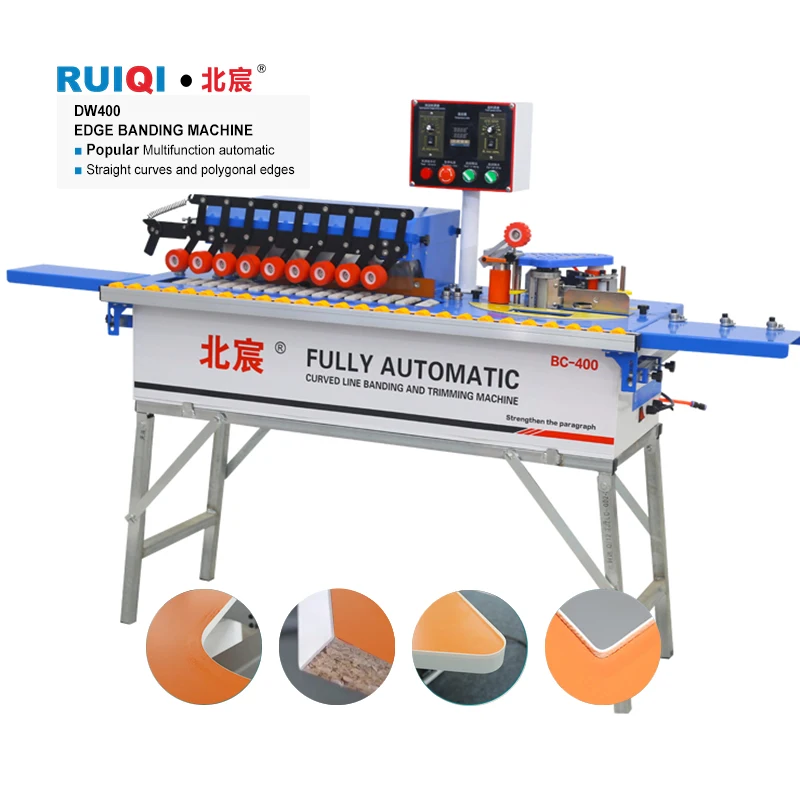
Precision-ground station allocation — Each trimming and polishing motor on the DW400 is individually rated, letting you calculate actual load before wiring the panel line.
Technical Specifications
| Parameter |
Value |
| Model |
DW400 |
| Product Type |
Edge Banding Machine |
| Total Power |
3800W |
| Voltage Options |
220V / 380V / customization available |
| Trimming Power |
650W × 2 motors |
| Polishing Power |
180W × 2 motors |
| Transmission Power |
60W |
| Edge Power |
20W |
| Vacuum Power |
1200W |
| Edge Banding Thickness Range |
0.3–3 mm |
| Edge Banding Height Range |
0–50 mm |
| Minimum Sheet Length |
25 cm |
| Minimum Sheet Width |
10 cm |
| Glue Pot Capacity |
1000 ml |
| Air Source Pressure |
0.5–0.8 MPa |
| Overall Dimensions (L×W×H) |
116 × 47 × 69 cm |
| Net Weight |
70 kg |
| Assembly State |
Standalone unit |
| Control Panel Language |
Chinese, English (Spanish and other languages available on request) |
| Plug Options |
EU, USA, AU, UK |
| Standard Functions |
Straight edge banding, trimming, polishing |
Application Suitability
| Application |
Material or Output |
| Cabinet door edge finishing |
MDF and plywood with PVC or veneer banding |
| Office furniture panel edging |
Particleboard and blockboard, straight edges |
| Small-batch joinery components |
Solid wood panels down to 25 cm length |
| Polymer door frame trimming |
Polymer substrates within 0.3–3 mm band thickness |
| Workshop-scale production runs |
Medium density fiberboard panels requiring trim and polish |
Why the Voltage Question Should Come Before the Edge Banding Machine Specifications
Confirming your local grid standard prevents a machine that arrives but never runs.
I once saw a furniture workshop take delivery of a bander wired for 380V three-phase when their facility only had single-phase 220V available. The machine sat on the floor for weeks while an electrician reconfigured the shop supply. When buyers focus on edge banding machine specifications without first locking down voltage and frequency, the best trimming station in the world still will not help [NEED_CITE: voltage and frequency standards by export market]. The DW400 ships configurable between 220V and 380V with region-specific plug options — EU, USA, AU, and UK — so the electrical match happens at the order stage, not after the crate is opened.

Mapping Motor Allocation to Your Panel Profile
Evaluating edge banding machine specifications means looking past total wattage. The DW400 assigns 650W to each of two trimming motors, which handles the resistance difference between dense MDF and lighter particleboard without stalling mid-pass. The dual 180W polishing motors follow immediately, removing residual burrs before the panel reaches your assembly bench. When your production mix includes both board types across the same shift, this station-by-station allocation matters more than the headline 3800W total.
Edge Thickness and Substrate Compatibility
The 0.3–3 mm banding thickness range covers thin PVC foil used on cabinet interiors up to thicker veneer strips applied on visible furniture faces. Matching band thickness to substrate density prevents the glue squeeze-out that shows up as visible lines on light-colored laminates. A 1000 ml glue pot keeps the adhesive at stable temperature through a run of small panels, avoiding the cold-start inconsistency that appears when the pot cycles between refills too frequently [NEED_CITE: hot melt adhesive behavior at varying pot volumes].
How Board Dimensions Define the Working Envelope
The 25 cm minimum sheet length and 10 cm minimum width set the lower boundary for what this machine can handle. For joinery shops producing drawer sides and narrow shelving brackets, these dimensions determine whether a component can be machine-banded or must still go to a hand trimmer. The 0–50 mm edge banding height accommodates standard 18 mm and 25 mm board stock with margin above, so taller blockboard panels still pass through without requiring manual height adjustment between batches.
The Cost of Skipping Air Supply Planning
A machine that requires 0.5–0.8 MPa air pressure needs a compressor sized for continuous duty, not a small workshop unit already feeding two other tools. When pneumatic pressure drops below threshold mid-cycle, the pressure roller fails to seat the band fully, leaving a gap that only appears after trimming. The DW400's vacuum station draws 1200W independently, meaning your air system and dust extraction must each be rated on their own circuit rather than sharing a single line [NEED_CITE: pneumatic system sizing for woodworking machinery].
Sourcing From a Factory That Tests Before Crating
The DW400 is built in a facility with proprietary cutting mechanism patents and a four-stage QC protocol covering incoming material through pre-shipment verification. Each unit undergoes a factory test on the buyer's specified substrate before packing, so tolerance claims are documented rather than assumed. Multi-voltage customization is treated as a standard configuration step, and control panels ship in the language your operators actually read. Engineer-led configuration recommendations arrive with a formal quotation, matching machine capability to your stated panel mix and daily volume.
Documentation & Verification
- Machine specification sheet listing each station motor rating and overall power draw
- Electrical schematic confirming voltage, frequency, and plug type against your local grid
- Factory test record showing edge quality on your submitted panel sample before dispatch
- Operation and maintenance manual provided in your agreed language at shipment
- CE declaration of conformity included with customs documentation package
Installation, Commissioning & Support
- Allocate a dedicated circuit matching the confirmed 220V or 380V supply and 3800W total draw
- Position the 116 × 47 × 69 cm unit with clearance on the infeed side for panels up to your maximum sheet length
- Connect air supply at 0.5–0.8 MPa from a compressor rated for continuous duty alongside the 1200W vacuum line
- Verify glue pot temperature settings against your banding material before the first production run
- Confirm control panel language matches operator requirement during initial power-on sequence
- Review spare parts list for trimming cutters and polishing pads based on your weekly panel volume
What to Include With Your Inquiry
Send your typical panel material, board thickness range, and the edge banding material you plan to run so the station configuration can be matched before quoting. Include your facility voltage and frequency, preferred plug type, and the language your operators need on the control interface. If you run upstream panel saws or downstream boring machines, noting their cycle timing helps determine whether this unit fits your existing line rhythm or whether a higher-throughput model is more appropriate.
Frequently Asked Questions
Q: How can I verify edge quality on my specific board material before placing an order?
A: Submit a sample of your panel stock along with the edge banding material you intend to use. The factory runs a test on the DW400 under production conditions and shares a test record documenting trim finish, glue line visibility, and polish result. This lets you evaluate output quality on your actual substrate rather than relying on generic demonstration samples that may not represent your daily material mix.
Q: What lead time applies if I need a non-standard voltage or plug configuration?
A: Voltage customization between 220V and 380V is treated as a standard build option, and plug types for EU, USA, AU, and UK markets are routinely configured at the factory. Non-standard frequency requirements or control panel language requests beyond English and Chinese may extend the typical multi-week production schedule. Confirming these details at the inquiry stage prevents delays once the order enters the build queue.
Q: Does the 25 cm minimum sheet length limit small-component production?
A: Panels shorter than 25 cm cannot be fed through the DW400 reliably because the transport system requires sufficient contact length to maintain registration through each station. For workshops regularly banding drawer components or narrow brackets below this threshold, a manual edge trimmer or a compact benchtop unit may be needed alongside this machine. Confirming your smallest regular component dimension at the inquiry stage ensures the right equipment mix.
Q: How does the DW400 throughput align with upstream and downstream stations?
A: Throughput depends on panel length, feed speed setting, and the number of passes required for your edge profile. When specifying a line, share your panel saw cycle time and boring station feed rate so the DW400 can be evaluated as part of the overall material flow. This prevents a situation where one station consistently waits on another, which reduces effective output across the entire workshop.