Verified Tolerance — Every DW802 rolling off our line goes through a four-stage inspection, and we test it on your actual panel samples before it ships.
Technical Specifications
| Parameter |
Value |
| Model |
DW802 |
| Product Type |
Automatic Edge Banding Machine |
| Total Power |
4200W |
| Voltage |
220V / 380V / customizable (frequency to be confirmed) |
| Edge Banding Height |
0–50 mm |
| Edge Banding Thickness |
0.3–3 mm |
| Minimum Sheet Length |
25 cm |
| Minimum Sheet Width |
10 cm |
| Glue Pot Capacity |
4000 ml |
| Trimming Motor Power |
800W × 2 |
| Polishing Motor Power |
180W × 2 |
| Edge Banding Motor Power |
140W |
| Transmission Motor Power |
140W |
| Vacuum Power |
1200W |
| Air Source Pressure |
0.4–0.8 MPa |
| Product Size |
130 × 60 × 95 cm |
| Product Weight |
135 kg |
| Feed Speed |
(basis to be confirmed) |
| Panel Thickness Range |
(basis to be confirmed) |
| Control System |
(basis to be confirmed) |
| Language Options |
Chinese and English standard; Spanish and other languages available on customization |
| Plug Options |
EU, USA, AU, UK |
| Assembly State |
Fully assembled, wooden box packed |
| Certification |
CE |
Application Suitability
| Application |
Material or Output |
| Custom cabinet door edge sealing |
MDF, particleboard, ecological board |
| Small-batch furniture panel finishing |
Plywood, solid wood board |
| Workshop transition from manual to automated banding |
PVC and veneer edge banding on panel substrates |
| Home decoration joinery components |
Boards down to 25 × 10 cm minimum dimensions |
Why Voltage and Frequency Must Come Before the Quotation
A machine wired for the wrong grid is a crate of dead iron the day it arrives.
I have watched workshops take delivery of edge banders only to find the motor hums but will not start, or the glue pot never reaches temperature. The local supply runs at a frequency the machine was never configured for. The trimming motors stall under load. The compressor cannot keep up because the vacuum circuit was spec'd for a different voltage altogether. Sorting that out after arrival means rewiring, replacing contactors, and losing weeks of production [NEED_CITE: voltage and frequency standards by export market]. Confirming the DW802 automatic edge banding machine specifications against your local grid before production begins is the single most important step in the entire procurement process.

Mapping Each Station to the Cut It Performs
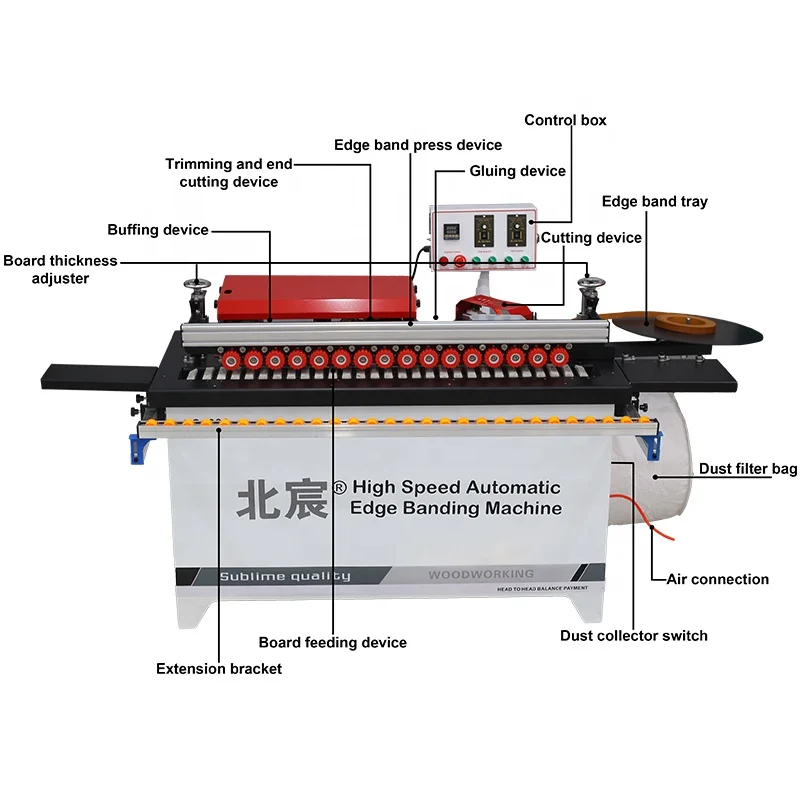
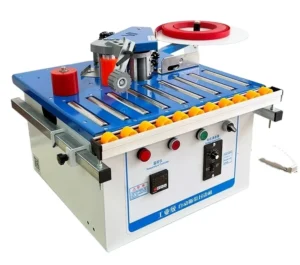
The DW802 runs a sequential station layout where each motor handles one distinct operation. The edge banding motor at 140W feeds the strip from the coil and presses it against the heated glue surface. The two trimming motors at 800W each then remove the overhang — one for the leading edge, one for the trailing edge. The polishing wheels at 180W each finish the trimmed edge smooth. Understanding this automatic edge banding machine specifications breakdown tells you exactly which motor to inspect when a particular cut quality degrades, rather than shutting the entire line down to troubleshoot.
Glue Pot Capacity and Continuous Run Length
The 4000 ml glue pot on the DW802 determines how many linear meters of banding you can run before stopping to reload. In a small workshop running batch sizes of twenty to fifty panels, this capacity typically covers a full morning session. Larger production runs will require scheduled refill breaks. The key point here is matching the automatic edge banding machine specifications to your actual batch rhythm — a pot that is too small for your volume forces frequent stops, while one that is too large lets glue degrade from prolonged heating [NEED_CITE: thermal degradation of hot melt adhesive in open pots].
What the Trimming and Polishing Numbers Mean for Edge Quality
The dual 800W trimming motors give the DW802 enough torque to cut cleanly through banding thicknesses up to 3 mm on dense substrates like particleboard. When you run thin PVC at 0.3 mm on MDF, those same motors must be dialed back to avoid scoring the panel face. The polishing wheels at 180W each handle the micro-burrs left after trimming. If your workshop processes a mix of board types — MDF one day, plywood the next — the ability to adjust trimming depth and polishing pressure across this range is what keeps edge quality consistent without swapping tooling between jobs.
When a Misconfigured Spec Shows Up on the Assembly Floor
A panel that leaves the bander with a 0.5 mm overhang might stack fine in the workshop, but it will not slide into a cabinet carcass during assembly. I have seen entire kitchen runs come back from installation because the edge banding thickness was set for a material the shop no longer uses. The trimming station was never recalibrated. By the time the installer notices, the panels are already drilled and the damage is done. This is why sending actual board samples for a test run matters more than any spec sheet promise [NEED_CITE: panel dimension tolerance requirements for frameless cabinet assembly].
What the Factory Puts Behind Every DW802
In-house manufacturing means the cutting mechanism patents and precision-ground components are built and inspected under one roof, not outsourced to a third-party assembler and relabeled. The four-stage quality control sequence — incoming material, in-process, finished product, pre-shipment verification — catches tolerance drift before the machine is crated. Voltage, plug type, and control language are configured at order stage, not improvised at the dock. An engineer reviews your panel samples and production volume before recommending the station configuration, so the machine you receive matches the work it will actually do.
Documentation & Verification
- CE declaration of conformity covering the DW802 and its electrical components
- Machine specification sheet listing every motor rating and dimensional parameter
- Electrical schematic confirming voltage, frequency, and plug type for your market
- Factory test record on your supplied panel samples before dispatch
- Operation and maintenance manual in the language you specified at order
- Spare parts list with part numbers for trimming blades, polishing wheels, and glue pot seals
Installation, Commissioning & Support
- Requires a dedicated 380V or 220V circuit rated for the 4200W total draw plus compressor load
- Machine footprint of 130 × 60 cm needs clearance on both sides for panel feed and offcut removal
- Air supply line must deliver 0.4–0.8 MPa from a compressor sized for continuous pneumatic actuation
- Arrives fully assembled; connect power, air, and vacuum before first test run
- Glue pot initial heat-up and temperature calibration performed on your actual banding material
- Trimming and polishing station depth set to your panel thickness range during commissioning
What to Include with Your Inquiry
Send the panel materials you run most often — substrate type, thickness, and the edge banding material and width you intend to use. Confirm your local voltage and frequency, and tell us which plug standard your facility requires. If your operators need the control panel in a specific language, note that at inquiry stage so the interface is configured before the machine enters production.
Frequently Asked Questions
Q: How do I verify the feed speed and panel thickness range match my daily volume?
A: Send your typical batch size and the panel dimensions you process most often. We cross-reference those against the DW802 feed speed and thickness range under actual running conditions, using your board samples, so you see real throughput numbers before placing an order rather than relying on catalog claims.
Q: What voltage and frequency details should I confirm before ordering?
A: Provide your facility voltage, phase configuration, and local grid frequency. The DW802 supports 220V and 380V with plug options for EU, USA, AU, and UK markets. Frequency must be confirmed separately because motor speeds and heating element behavior change between 50 Hz and 60 Hz systems.
Q: Can the control panel display in a language other than Chinese or English?
A: Yes. Spanish and other languages are available on customization. Specify your preferred language when you place the order so the control interface is loaded and tested before shipment, avoiding commissioning delays caused by unreadable menus on the shop floor.
Q: How do the minimum sheet dimensions affect small-part production?
A: The DW802 handles sheets as small as 25 cm long and 10 cm wide. Panels below these dimensions cannot be fed through the station sequence reliably. If your product mix includes very narrow drawer fronts or small shelving brackets, confirm those dimensions early so we can advise whether this model covers your full range.
Q: What does each motor in the trimming and polishing sequence actually do?
A: The two 800W trimming motors remove the banding overhang at the leading and trailing edges of each panel. The two 180W polishing wheels then smooth the trimmed surface. If your edge quality requirements change — for instance, moving from PVC to real wood veneer banding — the polishing stage is where adjustment has the greatest visible effect.